LoRaWAN® Gas Sensors: H₂S, NH₃, O₂ & Ethylene
Wireless Electrochemical Gas Monitors for STPs, Sewers, Landfills, Plants, Confined Spaces and Ripening Rooms · 0–100 ppm H₂S and NH₃ · 0–30 % O₂ · 0–100 ppm C₂H₄ · Battery or 9–36 V DC

The MacSync gas family puts an industrial electrochemical cell on a LoRaWAN® node: the LH2S X1 for hydrogen sulphide, the L Odor X2 for ammonia and hydrogen sulphide together, the LOXGS X1 for oxygen and the LC2H4 X1 for ethylene, each with threshold alerts, on a 19 Ah battery or 9–36 V DC, kilometres from your gateway
Wireless Gas Monitoring for STPs, Sewers, Landfills, Process Plants, Confined Spaces & Cold Chains.
Wireless Gas Monitoring for
STPs, Sewers, Landfills, Process Plants, Confined Spaces & Cold Chains.
MacSync Gas Sensors
Explore the highlights
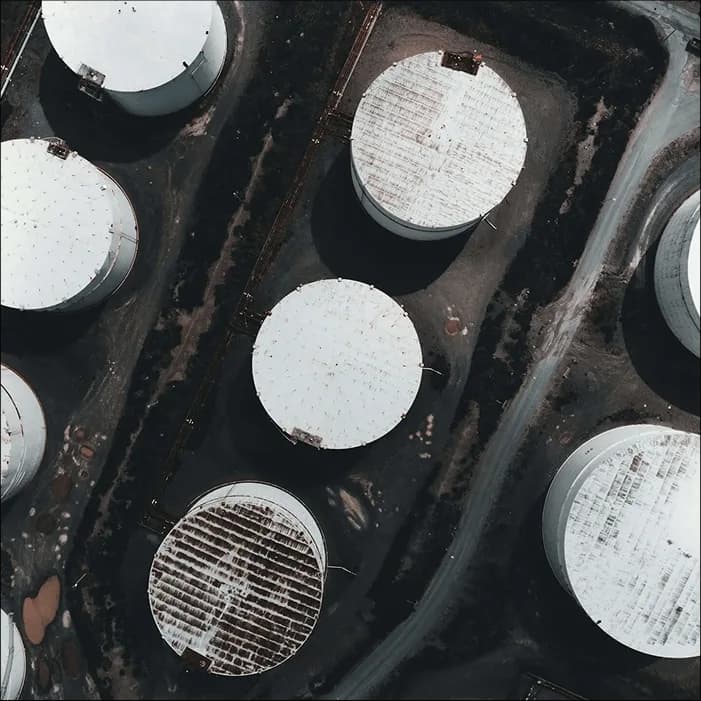
Hydrogen sulphide for sewers and STPs, ammonia with hydrogen sulphide for odour and livestock, oxygen for confined spaces and gas stores, ethylene for ripening rooms and cold stores: the same node, radio, app and decoder, so one gateway carries all of them.
The H₂S cell resolves 0.1 ppm with repeatability under 2 % and zero drift of 0.2 ppm or less; the oxygen cell resolves 0.1 % vol and responds within 15 seconds; the ethylene cell filters SOₓ, NOₓ and H₂S. Sensitivity, repeatability, drift and expected life are on each datasheet.
Set a low and a high limit per gas and the node reports the moment the reading crosses it, within the sampling interval, so a pumping station filling with H₂S or a ripening room drifting off its set point is known in minutes.
A monitoring and alerting sensor that reports in minutes over LoRaWAN®. It is not a certified fixed gas detector or a personal monitor, and no explosion-protection certification is claimed. Where law or a safety case requires one of those, this sensor adds coverage beside it, not instead of it.
At 23 dBm with −137 dBm sensitivity, a node in a sewer chamber, a sludge yard, a landfill cell or a cold store reaches a gateway kilometres away, so a site is instrumented without trenching a signal cable or buying a SIM per point.
The 19 Ah variant is rated about 2, 4 and 7+ years at 5, 15 and 60-minute reports; the DC variant runs from 9–36 V in a plant or a ripening room with power at the point.
Glass-filled nylon enclosure, IP65 as standard with an IP67 option, rated −40 to +80 °C, for sludge yards, wet wells and cold stores; the ethylene cell itself is rated −20 to +50 °C.
Pair over Bluetooth with the Maya app to set the sampling and reporting intervals, the limits per gas and the LoRaWAN class; change them later by downlink.
Designed and manufactured in Pune. WPC compliant on IN865 and RoHS conforming, with an engineer in Pune who answers during the Indian working day.
In plain terms
What Is a LoRaWAN Gas Sensor?
The short answer
An electrochemical gas cell on a battery-powered radio node: it measures the concentration of one gas in the air around it, in ppm or percent, and sends the reading over LoRaWAN® kilometres to a gateway, with threshold alerts and no cable or SIM at the point. Macnman makes four: the LH2S X1 for hydrogen sulphide, the L Odor X2 for ammonia and hydrogen sulphide together, the LOXGS X1 for oxygen and the LC2H4 X1 for ethylene, each on the same node with a 19 Ah battery or 9–36 V DC and setup from the Maya app.
H₂S (LH2S X1)
- 0–100
ppm, 500 ppm maximum
- 0.1
ppm resolution
- ≤0.2
ppm zero drift
NH₃ + H₂S (L Odor X2)
- 0–100
ppm each
- 0.5 / 0.1
ppm resolution, NH₃ / H₂S
- 2
Cells in one node
O₂ (LOXGS X1)
- 0–30
% vol
- 0.1
% vol resolution
- ≤15 s
Response time (T90)
Ethylene (LC2H4 X1)
- 0–100
ppm, 200 ppm maximum
- 0.5
ppm resolution
- 3 yr
Expected cell life in air
Alerts
- 1 min
Shortest sampling interval
- 3
Modes: periodic, event, hybrid
- 24 h
Longest sampling interval
Power and radio
- 19 Ah
Battery variant, 7+ years at hourly reports
- 9–36 V
DC variant
- 23 dBm
Transmit power, −137 dBm sensitivity


MacSync LH2S X1 · L Odor X2 · LOXGS X1 · LC2H4 X1
Four industrial LoRaWAN gas sensors from Macnman, for STPs and sewers, odour and livestock, confined spaces and gas stores, and ripening rooms and cold stores, on LoRaWAN® v1.0.4 with threshold alerts, battery or DC power and the Maya app. For carbon dioxide, the MacSync LCO2 X1; for a qualitative washroom odour level, the MacSync L Odor X1.
Hydrogen sulphide in sewers, STPs, biogas and oil and gas sites.
Ammonia and hydrogen sulphide together, for odour and livestock.
Oxygen depletion or enrichment in confined spaces and gas stores.
Ripening-room dosing and storage-room drift.
Low and high limits per gas that report the moment they are crossed.
A 19 Ah cell or 9–36 V DC; LoRaWAN® v1.0.4 on IN865 and six other bands.
Also searched for as a wireless H2S sensor, an IoT gas detector, an ammonia sensor for poultry or an STP, an oxygen deficiency monitor, an ethylene sensor for a ripening chamber, or a LoRaWAN toxic gas sensor. These are monitoring sensors; certified fixed detectors and personal monitors remain where law or a safety case requires them.
Get a quote
Need a quote for the MacSync Gas Sensors?
Tell us how many you need and where they are going. A product engineer replies within one working day with availability, lead time and the right variant for your site.
- Reply within one working day
- Designed and built in Pune, India
- WPC compliant, RoHS conformant
Downloads
Everything You Need to Get Building
Datasheets, drawings, firmware, and tools — all in one place.
MacSync LH2S X1 H₂S Sensor Datasheet (PDF)
Cell, radio, power and variant specifications
MacSync L Odor X2 NH₃ + H₂S Sensor Datasheet (PDF)
Two-cell quantitative odour sensor
MacSync LOXGS X1 Oxygen Sensor Datasheet (PDF)
0–30 % vol electrochemical oxygen cell
MacSync LC2H4 X1 Ethylene Sensor Datasheet (PDF)
0–100 ppm ethylene cell with SOₓ/NOₓ/H₂S filter
Datasheet web pages
H₂S, NH₃ + H₂S, oxygen and ethylene datasheets on the documentation site
Maya App Setup Guide
LoRaWAN settings shared by all MacSync sensors
Engineered for
What Sets the MacSync Gas Sensors Apart for Site Monitoring
Each datasheet states range, maximum concentration, sensitivity, resolution, repeatability, monthly stability, zero drift and expected life for its cell. Those are the figures a safety officer or a plant engineer compares, and they are on the specification tab, not behind a form.
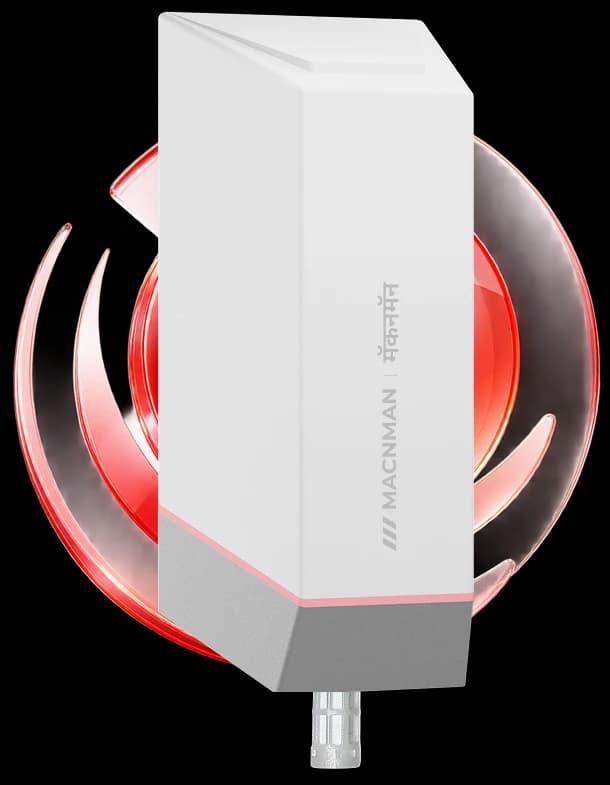
01 / 05
Works with
Why Choose the MacSync LoRaWAN Gas Sensors?
Electrochemical H₂S, NH₃, O₂ and ethylene cells with threshold alerts and a battery rated for years, sending over LoRaWAN® to any network server, with no cable, Wi-Fi or SIM at the point.Electrochemical H₂S, NH₃, O₂ and ethylene cells with threshold alerts and a battery rated for years, sending over LoRaWAN® to any network server, with no cable, Wi-Fi or SIM at the point.
Applications
Where Are LoRaWAN Gas Sensors Used?
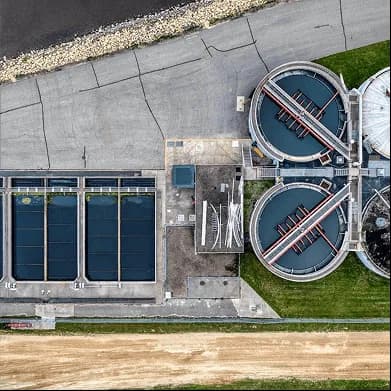
Sewage & Effluent Treatment Plants
Hydrogen sulphide at the inlet works, the screens, the sludge beds and the pumping stations, with an alert the moment a limit is crossed and a log for the environmental officer.
Read case studiesSewer Networks & Pumping Stations (Wet wells, Chambers with no power): H₂S in wet wells and manhole chambers where no cable or power exists, on a battery rated for years, reporting to the utility's SCADA over the same gateways as the pressure and level sensors.
Landfills, Composting & Waste Yards (H₂S and NH₃ at the fence line, Odour complaints): Ammonia and hydrogen sulphide at the cells, the leachate pond and the fence line, so an odour complaint is answered with a record rather than a guess.
Process Plants & Refineries (H₂S at process points, Into SCADA): Hydrogen sulphide and oxygen at points a wired detector never reached: tank farm corners, pits, utility trenches and remote valve stations, reported into the plant SCADA over MQTT.
Confined Spaces & Gas Stores (Oxygen depletion, Nitrogen and argon lines): Oxygen in cylinder stores, around nitrogen and argon lines, in pits and tanks between entries, so depletion is seen before the entry permit, not during it.
Biogas & Oil and Gas Sites (H₂S around digesters, Remote wellheads): Hydrogen sulphide around digesters, gas holders and remote wellheads, on a battery rated for years and a gateway kilometres away.
Ripening Rooms & Cold Stores (Ethylene dosing, Storage-room drift): Ethylene in banana and mango ripening chambers to confirm the dose, and in apple, kiwi and vegetable stores to catch the drift that shortens shelf life, beside temperature and humidity on the same gateway.
Poultry, Dairy & Livestock Sheds (Ammonia at bird height, Ventilation control): Ammonia in poultry and dairy sheds, where it costs weight gain and respiratory health long before a person smells it, with the reading driving the ventilation through a MacSet controller.
Smart City Environmental Monitoring (Odour at the fence line, ICCC feed): H₂S and NH₃ around STPs, dumping grounds and drains, into the city's ICCC over MQTT beside the air-quality and water sensors on the same gateways.
Laboratories & Hospitals (Oxygen enrichment and depletion, Gas manifold rooms): Oxygen in manifold rooms, cryogenic stores and laboratories where enrichment is a fire risk and depletion an asphyxiation risk, logged continuously.
Browse all 10 applications
01 / 10
Where it fits
From Wet Wells to Ripening Rooms, Wherever a Gas Concentration Is the Signal
STPs, Sewers, Landfills & Biogas
Hydrogen sulphide at pumping stations, inlet works, sludge yards, sewer chambers and landfill cells, with an alert the moment a limit is crossed and a continuous record for the environmental return.
Confined Spaces, Plants & Gas Stores
Oxygen depletion and enrichment around nitrogen and argon lines, cylinder stores, pits and tank farms, and H₂S and NH₃ at process points, logged on the plant's own server.

Ripening Rooms, Cold Stores & Farms
Ethylene in banana and mango ripening chambers and apple and kiwi stores, ammonia in poultry and dairy sheds, and odour at the fence line of a plant or a composting yard.
STPs, Sewers, Landfills & Biogas
Hydrogen sulphide at pumping stations, inlet works, sludge yards, sewer chambers and landfill cells, with an alert the moment a limit is crossed and a continuous record for the environmental return.
Confined Spaces, Plants & Gas Stores
Oxygen depletion and enrichment around nitrogen and argon lines, cylinder stores, pits and tank farms, and H₂S and NH₃ at process points, logged on the plant's own server.
Ripening Rooms, Cold Stores & Farms
Ethylene in banana and mango ripening chambers and apple and kiwi stores, ammonia in poultry and dairy sheds, and odour at the fence line of a plant or a composting yard.
Installing it
Installing a Wireless Gas Sensor: Height, Airflow, Node Placement and a Bump Test
The four decisions every installation turns on. The figures are from the datasheets; the practice is standard for any electrochemical gas monitor.
Installing it
The four decisions every installation turns on. The figures are from the datasheets; the practice is standard for any electrochemical gas monitor.
Height: where the gas goes
Hydrogen sulphide is heavier than air and collects low: mount near the floor or the liquid surface in a wet well or a chamber. Ammonia is lighter and rises: mount high in a shed. Ethylene and oxygen are read at breathing or produce height, where the decision is made.
Airflow: in the path, out of the spray
Place the sensor where the air it should sample actually moves past it, away from direct wash-down spray, exhaust fans that dilute the reading, and sunlight on the enclosure.
Node and antenna
The node is IP65 with an IP67 option; mount it on the wall or a post above any flooding level. A deep chamber with a metal lid is served by an indoor gateway nearby or a node near the opening; the Maya app's Ping confirms the link before the lid closes.
Bump test, then trust the record
At commissioning and on a schedule, expose the cell to a known gas concentration or compare it against a calibrated portable instrument and note the result. The datasheets publish factory calibration and cell life, not a field calibration interval; the site's safety procedure sets one.
Free planning tools
Size your deployment before you order the hardware
Free engineering calculators for coverage, range and battery life — built on measurements from our own deployments rather than textbook models, which is why the answers tend to be smaller and a good deal more useful. Nothing here quotes a range we have not actually achieved.
No sign-up, no email, nothing to install. More on the way for Wi-Fi and BLE.
Hardware
IP65 Node with an IP67 Option, Rated −40 to +80 °C
The glass-filled nylon node is IP65 rated as standard, IP67 optional, and operates from −40 °C to +80 °C on a wall or a post in a wet well, a sludge yard, a landfill or a cold store. The ethylene cell is rated −20 to +50 °C; the expected life of the electrochemical cells is about two years for H₂S, NH₃ and oxygen and three years for ethylene, after which the cell is replaced.

Ready to see gas concentration at every point? Ask for a quote on the MacSync gas sensors.
At a glance
MacSync LoRaWAN Gas Sensor Specifications
Every key specification in one view, from the four datasheets.

H₂S 0–100 ppm
LH2S X1 and L Odor X2
0.1 ppm · <2 % repeatability · ≤0.2 ppm zero drift · 500 ppm max
NH₃ 0–100 ppm
L Odor X2
0.5 ppm · <10 % repeatability · 200 ppm max · 2 years at 2 ppm
O₂ 0–30 % vol
LOXGS X1
0.1 % vol · T90 ≤15 s · <2 % repeatability · ~2 years
C₂H₄ 0–100 ppm
LC2H4 X1
0.5 ppm · T90 <30 s · 1 % repeatability · 3 years in air
19 Ah or 9–36 V DC
power
~2 / 4 / 7+ years at 5 / 15 / 60-minute reports
LoRaWAN® v1.0.4
IN865 and six more bands
23 dBm · Class A, Class C via Maya · OTAA · IP65 node
Features
Built into the MacSync Gas Sensors: Cell, Radio, Power and Setup
Periodic, Event or Hybrid Reporting
Report on a fixed interval, on an event, or both, with sampling from 1 minute to 24 hours.
Commission and diagnose from the Maya app in minutes, at the chamber, with no laptop.
Long-Range LoRaWAN®
LoRaWAN® v1.0.4, Class A with Class C via the app, on IN865, EU868, US915, AU915, RU864, KR920 and AS923.
Battery or 9–36 V DC
A 19 Ah cell rated 7+ years at hourly reports, or site power from 9 to 36 V DC.
Electrochemical Cells
H₂S, NH₃, oxygen and ethylene cells with published sensitivity, repeatability, drift and life.
Threshold Alerts per Gas
Low and high limits that report the moment they are crossed, within the sampling interval.
Any LoRaWAN® Network Server
ChirpStack, The Things Network, Orbiwise, Netmore, MQTT platforms, SCADA or a private LNS, with AES-128 end to end.
Macnman Maya App
Intervals, gas limits, LoRaWAN class and live readings from your phone; the same settings by downlink later.
Four Cells, One Platform
The LH2S X1, L Odor X2, LOXGS X1 and LC2H4 X1 share the node, the radio, the battery and DC options, the app and the decoder, so an STP runs H₂S at the inlet works, NH₃ and H₂S at the fence line and oxygen in the pits on one gateway and one dashboard, beside the MacSync CO₂ sensor and the temperature and humidity sensor.
Capabilities
A Reading Every Few Minutes Is a Different Instrument from a Portable Once a Shift
A portable detector tells you the concentration where a person stood for a minute. A node on LoRaWAN tells you how it moves all day: H₂S that climbs every afternoon as the sludge warms, ammonia that rises overnight when the fans stop, oxygen that falls in a pit after a nitrogen purge, ethylene that drifts up in a store after a delivery. The pattern is the diagnosis.

Before you order
Send Us the Point List and We Confirm the Sensors
Four details are enough for an engineer to reply with the sensor for each point, the limits, the reporting interval and the gateway count.
Before you order
Four details are enough for an engineer to reply with the sensor for each point, the limits, the reporting interval and the gateway count.
Gas and expected range at each point
H₂S, NH₃, oxygen or ethylene, and the concentration you expect: the cells read to 100 ppm (oxygen to 30 % vol) and tolerate higher peaks, but a point that sits above the range needs a different instrument.
What the reading must do
A log for compliance, an alert to a phone, a fan or a damper through a MacSet controller, or a feed into SCADA. This sets the reporting mode and the interval.
Power at the point
No power points to the 19 Ah battery variant; a plant, a shed or a ripening room with power points to the 9–36 V DC variant.
Network and platform
An existing LoRaWAN® gateway and network server, or a new MacLink Gen-2; or MacTalk to a MacSet controller that acts on the reading with no gateway.
Ready now: Get a quote · Request a pilot kit · Partner programme
Architecture
LoRaWAN Network Architecture: Gas Sensor, Gateway, Network Server and SCADA or Dashboard

Why it matters
See the Gas Where It Builds, Not When Someone Smells It.
A portable detector is read when a person walks the plant. A node on LoRaWAN is read every few minutes, and the control room sees the build-up, the depletion and the drift as they happen, point by point.
Why it matters
A portable detector is read when a person walks the plant. A node on LoRaWAN is read every few minutes, and the control room sees the build-up, the depletion and the drift as they happen, point by point.
Catch H₂S before the entry
A wet well or a chamber that fills with hydrogen sulphide between visits is known from the screen, and the entry permit is written from the record rather than the hope.
Answer the odour complaint with data
Ammonia and hydrogen sulphide at the fence line, logged around the clock, show what reached the neighbours and when, and which process step caused it.
Know the oxygen before the pit
Oxygen in cylinder stores, pits and inert-gas rooms logged continuously, so depletion after a purge or a leak is seen in minutes.
Confirm the ethylene dose
A ripening room that reached and held its set point, and a store whose ethylene stayed low, both proven by the record rather than by the fruit a week later.
How it works
How Does a LoRaWAN Gas Sensor Work?
Step 1 of 5
Node on the wall at the right height
Mount the node with the supplied clip where the gas collects: low for H₂S, high for ammonia, at breathing or produce height for oxygen and ethylene.
Join the LoRaWAN network with Maya
Pair over Bluetooth, set the intervals and limits, and the sensor joins your network server by OTAA with its pre-loaded keys.
The electrochemical cell reads the air
The target gas diffuses into the cell and produces a current proportional to its concentration; the node reads it on the sampling interval you set, from 1 minute to 24 hours.
Readings travel kilometres to the gateway
Concentration, events and the battery level are sent as LoRaWAN® uplinks, encrypted with AES-128, to the gateway and on to your network server.
Your platform shows it and raises the alarm
The values land in your SCADA, ICCC or dashboard over MQTT or HTTPS. Cross a limit and the sensor reports immediately; a MacSet controller can start a fan or close a damper on the same network.
Reporting modes
Periodic, Threshold and Hybrid Reporting: Chosen by What Acts on the Reading.
An uplink on a fixed interval with the current concentration. Predictable data for a compliance log; every 5 to 15 minutes is the usual setting at an STP or a plant.
Note: At hourly reports the 19 Ah battery is rated about 7+ years; 15-minute reports about 4 years.
The sensor samples on its own schedule and reports the moment the gas crosses the low or high limit: H₂S rising in a wet well, oxygen falling in a store, ethylene drifting in a cold room. Note: Alert latency is the sampling interval, from 1 minute; this is monitoring, not a seconds-fast alarm.
The periodic record plus immediate reports on limit events, so you keep the continuous log and still hear about the excursion at once. Note: Sampling from 1 minute to 24 hours; the reporting interval is set independently.
Cloud & LNS
Works with Every LoRaWAN® Network Server You Already Run
TTN, ChirpStack, MQTT, Orbiwise & Private LNS — No Vendor Lock-In
MacSync gas sensors join any LoRaWAN® network server — The Things Network, ChirpStack, MQTT platforms, Orbiwise, Netmore, or your own private gateway — with AES-128 encryption end to end and no vendor lock-in. Readings reach your plant SCADA, the utility's control room, an ICCC or a dashboard over MQTT or HTTPS.


Build the network: MacLink Gen-2 outdoor LoRaWAN gateway · Setu X1 indoor LoRaWAN gateway · MacSet LX1 controller for fans and dampers · Gateway and coverage calculator · LoRaWAN battery life calculator
Device-to-device
Monitor Smarter with Macnman
Why Choose the Macnman LoRaWAN® Gas Sensors
Electrochemical cells with published figures, alerts the moment a limit is crossed, and a battery rated for years, in one rugged wireless node.

Plug & Play
Truly plug & play — no complex setup.
Real-Time Alerts
Instant threshold alerts the moment conditions drift.
Long-Range
Long-range coverage for hard- to-reach places.
RF performance
Stable in Wet Wells, Yards and Cold Stores
The H₂S and oxygen cells state monthly stability under 2 % and the H₂S cell a zero drift of 0.2 ppm or less; the ammonia cell's wider drift band is stated too, and this page shows it. The node is rated from −40 to +80 °C and holds the LoRaWAN® link from a chamber wall or a shed post at 23 dBm with −137 dBm sensitivity; a deep chamber is served by an indoor gateway nearby or a node near the opening.
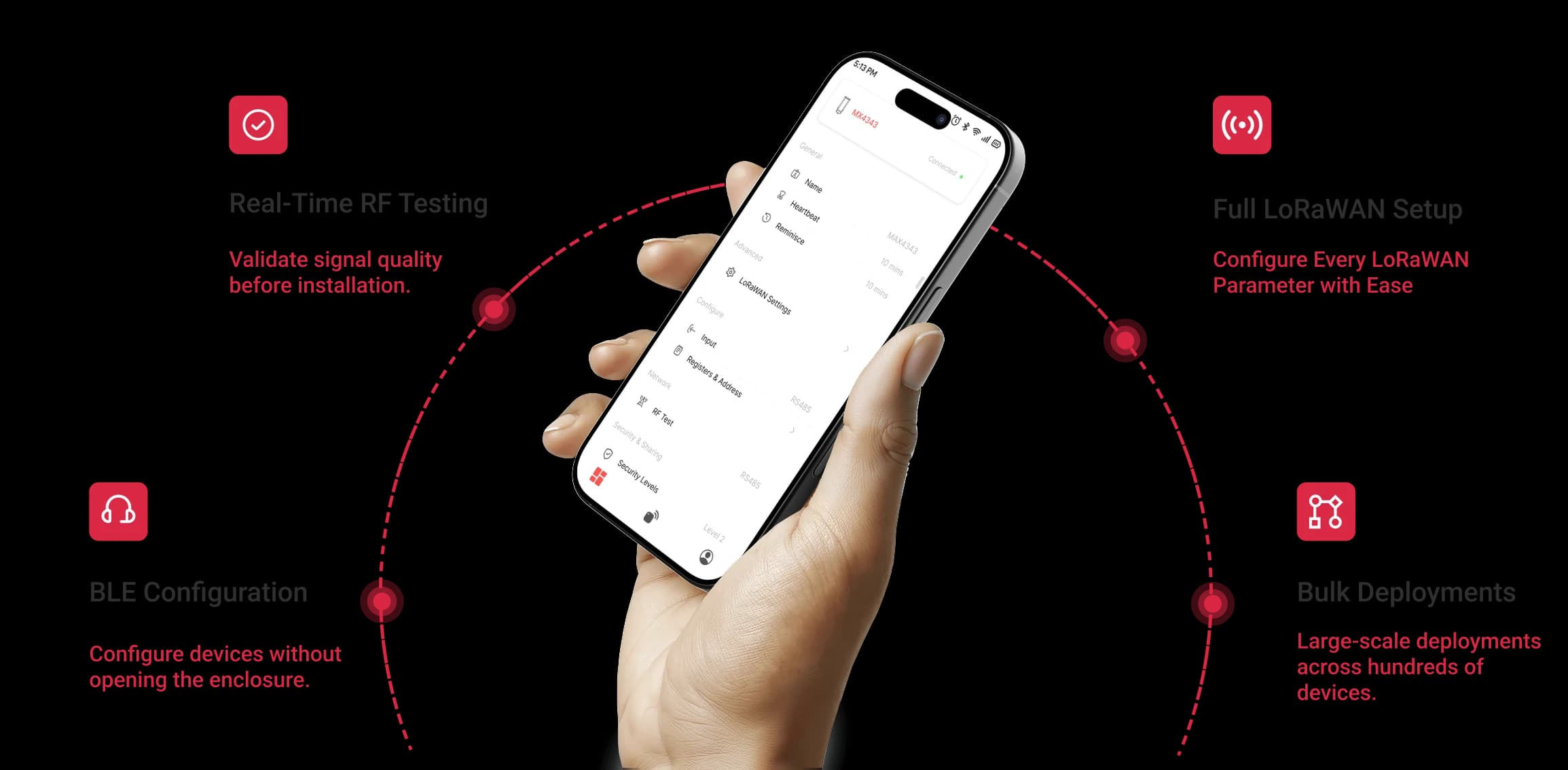
Installation
Gas Sensor Installation in Minutes, No Trench to the Control Room
A MacSync gas sensor goes on with two screws and the supplied mounting clip — low for H₂S, high for ammonia, at produce height for ethylene. With no signal cable, mains power or SIM at the point, a plant, a sewer network or a cold store can be instrumented in a day.
A MacSync gas sensor goes on with two screws and the supplied mounting clip — low for H₂S, high for ammonia, at produce height for ethylene. With no signal cable, mains power or SIM at the point — a plant, a sewer network or a cold store can be instrumented in a day.

Installation
On the wall in minutes, reporting for years.
Mount at the height the gas collects
Fix the node with the supplied clip and screws: low in a wet well or chamber for hydrogen sulphide, high in a shed for ammonia, at breathing height for oxygen, at produce height in a ripening room for ethylene, out of wash-down spray and direct exhaust.

Power it
The battery variant is ready as shipped; the DC variant wires to the site's 9–36 V supply in a plant, a shed or a ripening room.
Pair with Maya over BLE
Set the sampling and reporting intervals, the low and high limits for the gas and the LoRaWAN class, read the live value beside a portable instrument, and run a Ping to confirm the gateway. The device joins by OTAA with its pre-loaded keys.
Bump test on a schedule, then trust the record
Compare the cell against a known gas or a calibrated portable at commissioning and on the schedule the site's safety procedure sets; record the result with the data. The record then stands on its own for the control room and the audit.
Range & reliability
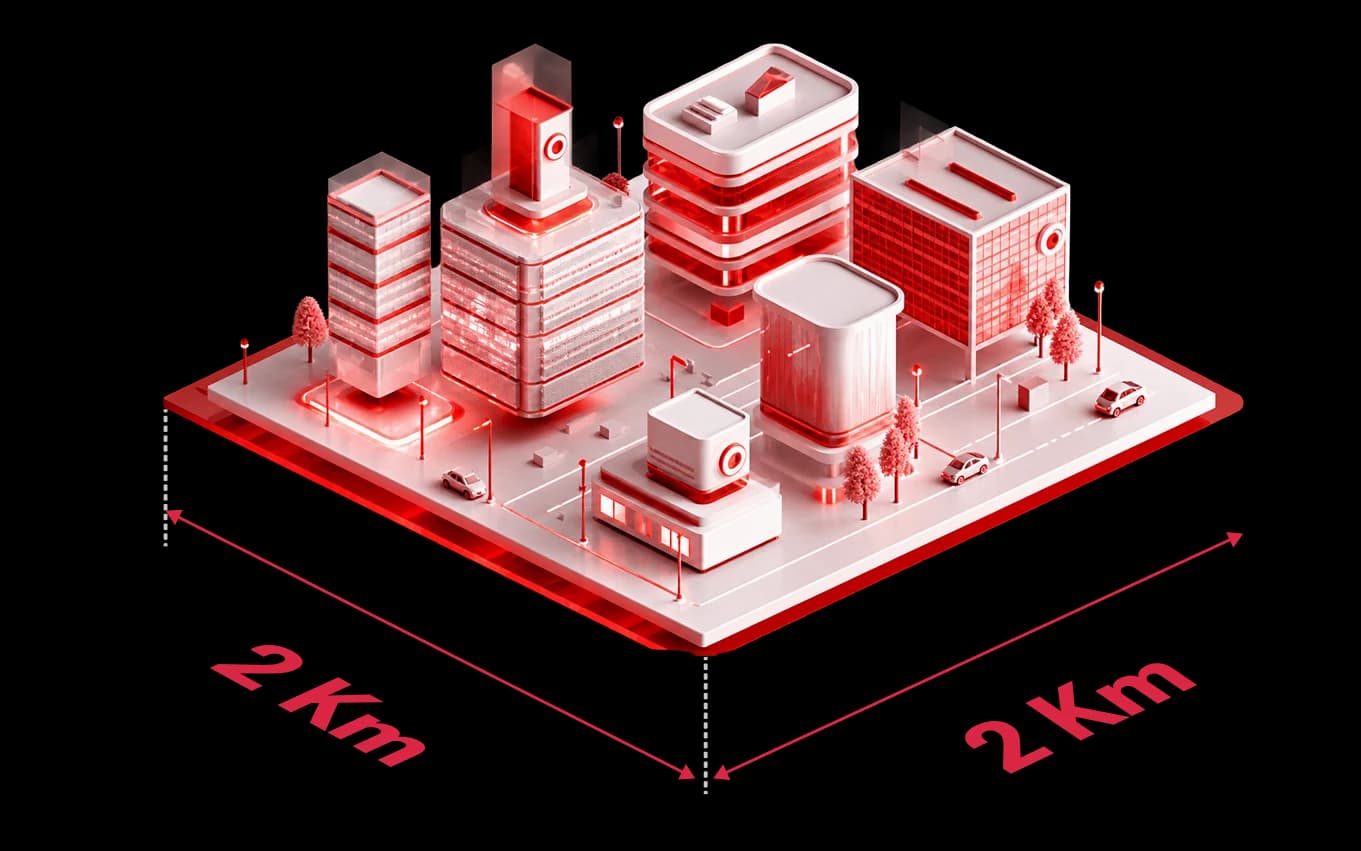
Long-Range LoRaWAN® Coverage Across the Plant, the Network or the Cold Chain
One gateway reaches gas sensors spread over kilometres of yards, chambers, sheds and stores
At 23 dBm with −137 dBm sensitivity, a MacLink Gen-2 gateway on an STP's admin block or a plant building reaches sensors across the works, the sewer chambers nearby and the yards, so one installation carries a ring of them. Range depends on terrain, chambers and antenna height; the coverage calculator gives a first estimate and the Maya app's Ping test confirms each point before the lid closes.
Made in India
LoRaWAN gas sensors made in Pune, India
Sites in India get the IN865 plan as standard, a WPC compliant radio, and an engineer in Pune who answers during the Indian working day. Projects abroad take the same sensors on EU868, US915, AU915, RU864, KR920 or AS923.
Made in India
Sites in India get the IN865 plan as standard, a WPC compliant radio, and an engineer in Pune who answers during the Indian working day. Projects abroad take the same sensors on EU868, US915, AU915, RU864, KR920 or AS923.
IN865 as standard
Shipped on the 865–867 MHz LoRaWAN® plan for India; another regional plan is set when ordering.
WPC compliant radio
The LoRaWAN® radio is WPC compliant for use in India and the hardware conforms to RoHS.
Built in Pune
Designed, assembled and tested at one site in Pune, where the support engineers also sit.
Next steps: LoRaWAN in India: the IN865 band and WPC rules · Request a pilot kit · All LoRaWAN sensors · Industrial IoT manufacturer in India
The four cells
MacSync LH2S X1, L Odor X2, LOXGS X1 and LC2H4 X1 Side by Side
Four electrochemical cells on the same node. The measurement rows are from each datasheet; the rest is shared.
| Model | LH2S X1 · H₂S | L Odor X2 · NH₃ + H₂S | LOXGS X1 · O₂ | LC2H4 X1 · ethylene |
|---|---|---|---|---|
| Gas | Hydrogen sulphide | Ammonia and hydrogen sulphide, two cells | Oxygen | Ethylene (C₂H₄) |
| Range | 0–100 ppm | NH₃ 0–100 ppm · H₂S 0–100 ppm | 0–30 % vol | 0–100 ppm |
| Maximum detectable | 500 ppm | NH₃ 200 ppm · H₂S 500 ppm | Not stated | 200 ppm |
| Resolution | 0.1 ppm | NH₃ 0.5 ppm · H₂S 0.1 ppm | 0.1 % vol | 0.5 ppm |
| Stated accuracy | Not stated; repeatability, stability and drift are stated instead | Not stated; repeatability, stability and drift are stated instead | Not stated; repeatability, stability and drift are stated instead | Not stated; repeatability, stability and drift are stated instead |
| Repeatability | <2 % of output | NH₃ <10 % · H₂S <2 % of output | <2 % of output | 1 % of output |
| Stability and drift | <2 % per month · zero drift ≤0.2 ppm | NH₃ <10 % per month, zero drift −3 to +10 ppm · H₂S <2 %, ≤0.2 ppm | <2 % per month | Not stated |
| Response time (T90) | Not stated | Not stated | ≤15 s | <30 s |
| Sensitivity | 0.8 ± 0.15 µA/ppm | NH₃ 50–100 nA/ppm · H₂S 0.8 ± 0.15 µA/ppm | Linear output | 0.04 ± 0.012 µA/ppm |
| Cross-sensitivity | Not stated | Not stated; ammonia cells of this type commonly respond to H₂S and amines | Not stated | Filter for SOₓ, NOₓ and H₂S; other gases not stated |
| Expected cell life | 2 years in air | NH₃ 2 years at 2 ppm · H₂S 2 years in clean air | About 2 years | 3 years in air |
| Cell operating range | Not stated (node −40 to +80 °C) | Zero drift stated for −20 to +40 °C | Not stated (node −40 to +80 °C) | −20 to +50 °C |
| Calibration | Factory calibrated | Factory calibrated | Factory calibrated | Not stated |
| Local alarm | None: no buzzer or relay; alerts go to the platform, or to a MacSet controller over MacTalk | None: no buzzer or relay; alerts go to the platform, or to a MacSet controller over MacTalk | None: no buzzer or relay; alerts go to the platform, or to a MacSet controller over MacTalk | None: no buzzer or relay; alerts go to the platform, or to a MacSet controller over MacTalk |
| SKUs | 8305 battery · 8306 DC · 8307/8308 MacTalk · 8309 BLE | 8516 battery · 8517 DC · 8518/8519 MacTalk · 8520 BLE | 8521 battery · 8522 DC · 8523/8524 MacTalk · 8525 BLE | 8526 battery · 8527 DC · 8528/8529 MacTalk · 8530 BLE |
Figures are from the four MacSync datasheets; 'not stated' means the datasheet is silent, not that the figure is zero. The ammonia cell's drift band is wide against its resolution, which is why the L Odor X2 is positioned for odour and shed monitoring rather than low-ppm hygiene limits. None of the four sheets states an accuracy figure, a cross-sensitivity table or a field recalibration interval; the ethylene sheet has no calibration row.
What the numbers mean
Exposure and Process Limits the Readings Are Compared Against
The limits a threshold is usually set from, Indian first, with the sources linked below. The sensor reports a concentration; the limit that applies to a site is set by its regulator and its safety case, not by this page.
| Gas | Commonly cited limits | What the sensor can do about it | What it cannot |
|---|---|---|---|
| Hydrogen sulphide (H₂S) | Factories Act 1948, Second Schedule: 10 ppm time-weighted, 15 ppm short-term. OSHA general industry: 20 ppm ceiling, 50 ppm ten-minute peak. NIOSH: 10 ppm ten-minute ceiling; 100 ppm immediately dangerous to life. ACGIH TLV: 1 ppm time-weighted, 5 ppm short-term. Smelt at 0.01–1.5 ppm; the nose fails above about 100 ppm | Log 0.1 ppm steps in a wet well or a sludge yard, alert at the site's limit within the sampling interval, show the afternoon peaks and the record for the environmental return | Replace a certified fixed detector or a personal monitor where an entry permit or the law requires one; alarm in seconds |
| Ammonia (NH₃) | Factories Act 1948, Second Schedule: 25 ppm time-weighted, 35 ppm short-term. OSHA PEL: 50 ppm time-weighted. NIOSH: 25 ppm time-weighted, 35 ppm short-term. Poultry: CPCSEA guidance puts the harm threshold above 20 ppm and the ceiling at 25 ppm; UGA Precision Poultry advises control below 25 ppm | Trend ammonia at bird height or a fence line in 0.5 ppm steps and drive ventilation through a MacSet controller; the stated zero drift of −3 to +10 ppm sits beside those 20–25 ppm thresholds, so the trend and the fan rule matter more than the last digit | Resolve low single-digit ppm hygiene limits reliably, given the cell's stated drift band |
| Oxygen (O₂) | OSHA confined-space rule: oxygen-deficient below 19.5 % vol, enriched above 23.5 %. The MoHUA/CPHEEO 2018 SOP for cleaning sewers and septic tanks: do not enter below 19.5 % or above 21 %; test at the bottom, middle and top; open two or three manholes at least an hour before work; carry a four-gas monitor | Log oxygen in a store, a pit or an inert-gas room in 0.1 % steps between entries, alert at 19.5 % and 23.5 %, show a purge or a leak in minutes | Stand in for the pre-entry test with a calibrated direct-reading instrument that the SOP and OSHA require |
| Ethylene (C₂H₄) | Bihar Directorate of Horticulture ripening guideline: banana 100–150 ppm for 24–48 h at 15–18 °C, mango 100 ppm for 24 h at 20–22 °C, papaya and tomato 100–150 ppm. Ripening rooms commonly run 100–200 ppm. Ethylene-sensitive produce in storage responds at 5–10 ppb (kiwifruit), far below any 0.5 ppm cell | Confirm a ripening dose arrived and the room cleared, in 0.5 ppm steps to 100 ppm with a 200 ppm maximum; show ppm-level drift into an adjacent store | Resolve the sub-ppm levels that matter for ethylene-sensitive storage; that is a different instrument class |
Limits summarised from the sources linked below; regulators revise them, so check the current figure for the site. The DGMS scan of the Factories Act shows an OCR artefact for ammonia; the Delhi Labour Department page is the clean copy. The sensors' figures are from the Macnman datasheets.
Sources: Factories Act 1948, Second Schedule, permissible levels of chemical substances (Delhi Labour Department copy) · The Factories Act 1948, DGMS PDF (Second Schedule, s. 41F) · OSHA, hydrogen sulfide hazards and exposure limits · OSHA chemical data, ammonia (PEL, NIOSH REL) · OSHA 29 CFR 1910.146, permit-required confined spaces (19.5 % and 23.5 % oxygen) · NIOSH Pocket Guide, hydrogen sulfide · NIOSH Pocket Guide, ammonia · MoHUA / CPHEEO, SOP for cleaning of sewers and septic tanks, 2018 (oxygen 19.5–21 %, ventilation, four-gas monitor) · CPCSEA guidelines, poultry and bird facilities (ammonia above 20 ppm harms performance; never above 25 ppm) · University of Georgia Precision Poultry, controlling ammonia emissions in poultry houses · Bihar Directorate of Horticulture, ripening chamber guidelines (banana 100–150 ppm, mango 100 ppm) · MSA Safety, fruit ripening ethylene (rooms at 150–200 ppm) · Gas Nose ethylene sensor guide citing UC Davis (kiwifruit softens at 5–10 ppb) · BARC hydrogen sulphide sensor page (10 / 15 ppm, sewage treatment plants)
Range against reality
Where 0–100 ppm and 0–30 % Fit the Job, and Where They Do Not
The searches around these sensors mix ambient monitoring with gas streams and sub-ppm storage. The table says which is which.
| Situation | Typical concentration | Fit for the MacSync cell | Use instead, or alongside |
|---|---|---|---|
| Air in a sewer wet well, pumping station or STP yard | Parts per million to tens of ppm H₂S, rising on warm afternoons | Yes: LH2S X1 mounted low, 0.1 ppm steps, 500 ppm maximum | A certified detector where a permit requires an alarm |
| Raw biogas inside the digester line | Up to about 3 % H₂S, that is 30,000 ppm | No: far above the cell's range; the LH2S X1 watches the air around digesters, scrubbers and flares | An in-line biogas analyser for the gas stream |
| Poultry or dairy shed air | Thresholds of 20–25 ppm NH₃ | Yes: L Odor X2 at bird height, 0.5 ppm steps, with its drift band shown beside the threshold | A handheld check when the trend looks wrong |
| Landfill or composting fence line | Low ppm NH₃ and H₂S, episodic | Yes: L Odor X2 downwind, for the complaint record | Landfill gas wells and probes for percent-level methane and CO₂, a different instrument |
| Manhole, pit or tank between entries | Oxygen 19.5–21 % is the entry window | Yes: LOXGS X1 logs between entries | The SOP's pre-entry test with a calibrated portable, every time |
| Banana or mango ripening room | 100–200 ppm C₂H₄ during the dose | Yes for dose confirmation and clearance: 0–100 ppm range, 200 ppm maximum; a room held at 150 ppm reads as above range until it clears | The chamber controller's own dosing instrument for the level |
| Apple, kiwi or vegetable store | 5–10 ppb affects sensitive produce | No for storage protection: the 0.5 ppm floor is fifty times too coarse; yes for catching ppm-level drift after a delivery | A ppb-class ethylene analyser |
Concentrations are from the sources linked above and from the Macnman datasheets; they are context for choosing the instrument, not specifications of the site.
Ways to read a gas
LoRaWAN Gas Sensor, Certified Fixed Detector, Portable Detector or Fence-Line Analyser: What Each Gives You
Four ways sites get gas concentrations today. The MacSync sensors are the monitoring layer; the detectors and analysers remain where the safety case or the permit needs them.
| Compare | MacSync LoRaWAN gas sensor | Certified fixed detector | Portable or personal detector | Fence-line analyser |
|---|---|---|---|---|
| What it is | Electrochemical cell on a LoRaWAN node with a 19 Ah battery or DC | Wired detector head with a controller, alarm relays and certification for its purpose | Hand-held or clipped instrument carried by the worker | Reference-grade analyser in a cabinet, often with a sampling system |
| Reading and latency | Every 1 minute to 24 hours, plus limit events within the sampling interval | Continuous, seconds-fast alarm | Continuous where the person is | Continuous or sampled, high precision |
| Coverage | Many points, including chambers and yards with no power or cable | The points a cable and power reach | Wherever the person walks | A few points |
| Certification for safety use | None claimed (our weaker row) | Yes, for its purpose | Yes, for its purpose | As specified by the regulator |
| Recurring cost | Cell replacement every 2 to 3 years; no SIM on your own gateway | Head replacement and controller maintenance | Cells, calibration gas, bump tests | Service contract and consumables |
| Where it fits | Monitoring and alerting at many points; the record for compliance and operations | Where law or the safety case requires an alarm | The pre-entry test and the person's own protection | The regulator's reference figure |
The detector and analyser columns describe the categories, not one product. Macnman makes the LoRaWAN sensors; a site that needs certified alarms runs them where required and LoRaWAN sensors at the many points they never reach.
Confined spaces
Between the Entries: What the Node Adds to the SOP, and What It Never Replaces
The MoHUA/CPHEEO 2018 standard operating procedure for cleaning sewers and septic tanks, and OSHA's permit-required confined-space rule, both rest on a pre-entry test with a direct-reading instrument. The MacSync sensors sit around that procedure, not inside it.
Confined spaces
The MoHUA/CPHEEO 2018 standard operating procedure for cleaning sewers and septic tanks, and OSHA's permit-required confined-space rule, both rest on a pre-entry test with a direct-reading instrument. The MacSync sensors sit around that procedure, not inside it.
The pre-entry test stays
Open two or three manholes at least an hour before work, test oxygen at the bottom, middle and top with a calibrated instrument, do not enter below 19.5 % or above 21 %, carry a four-gas monitor: the SOP's steps, every time, with the worn monitor on the worker.
What the node adds
A continuous record between entries: the wet well that fills with H₂S every afternoon, the pit whose oxygen falls after a nitrogen purge, the store that drifts overnight. The permit is written from a record rather than from the hope that nothing changed since the last visit.
What the node is not
Not the direct-reading instrument the rule requires at entry, not a personal monitor, not a certified fixed detector, and not a seconds-fast alarm: it reports within its sampling interval, from one minute, to the platform, with no buzzer or relay of its own.
Where it sits
Low on the chamber wall above the water line for H₂S, at breathing height for oxygen, with the node near the opening or an indoor gateway nearby; the Maya app's Ping confirms the link before the lid closes.
Which Macnman sensor
Which Macnman Air Sensor Do You Need: H₂S, NH₃ + H₂S, Oxygen, Ethylene, CO₂ or an Odour Level?
Six Macnman LoRaWAN devices meet a gas or air question. Choose by the gas and by what the site must do with the reading.
| Criterion | MacSync gas sensors (this page) | MacSync LCO2 X1 CO₂ | MacSync L Odor X1 washroom | MacSync LX1 converters |
|---|---|---|---|---|
| Measures | H₂S, NH₃ + H₂S, O₂ or ethylene concentration | CO₂ 400–2,000 or 400–5,000 ppm, temperature and humidity | A qualitative odour level from NH₃ and H₂S cells | Any 4–20 mA or Modbus gas transmitter or analyser |
| Output | ppm or % vol with limits | ppm with limits | An odour index for cleaning on demand | The transmitter's value |
| Power | 19 Ah battery or 9–36 V DC | 19 Ah battery or 9–36 V DC | Battery | 19 Ah battery or 9–36 V DC; powers the loop |
| Choose it when | A toxic gas, oxygen or ethylene concentration is the question | Indoor air quality and ventilation are the question | A washroom needs cleaning when it smells, not on a timer | A transmitter or analyser is already on site and only needs the radio |
| Page | This page | Product page | Product page | Product pages |
Figures are from the Macnman datasheets. An STP usually runs several: H₂S at the works, NH₃ + H₂S at the fence line, oxygen in the pits and the existing analyser through a converter.
See also: Compare all MacSync gas sensor versions · MacSync LCO2 X1 LoRaWAN CO₂, temperature and humidity sensor · MacSync L Odor X1 washroom odour level sensor (qualitative) · MacSync LTS X1 temperature and humidity sensor for the same cold store · Already have a 4–20 mA gas transmitter? The MacSync LX1 analog converter reads it · Modbus gas analysers: the MacSync LX1 RS485 converter
Power
Battery, DC or MacTalk: How Each MacSync Gas Sensor Variant Is Powered
Every gas ships in the same five variants; the SKU changes with the gas.
| Variant | Power | Runtime | Choose it when |
|---|---|---|---|
| LoRaWAN battery (8305 H₂S / 8516 NH₃+H₂S / 8521 O₂ / 8526 C₂H₄) | 19 Ah Li-SOCl₂ cell | ~2 years at 5-minute reports · ~4 years at 15-minute reports · ~7+ years at hourly reports (datasheet estimate) | No power at the point: chambers, yards, fence lines, remote sites |
| LoRaWAN DC (8306 / 8517 / 8522 / 8527) | 9–36 V DC from the site | Continuous | Plants, sheds, ripening rooms and stores with power at the point |
| MacTalk battery or DC (8307–8308 / 8518–8519 / 8523–8524 / 8528–8529) | As above | As above | A MacSet controller must act on the reading with no gateway on site |
| BLE battery (8309 / 8520 / 8525 / 8530) | 19 Ah Li-SOCl₂ cell | As the battery variant | Local reading and commissioning with the Maya app |
Datasheet figures; spreading factor, event frequency and temperature change the battery figure. Battery level is sent in every uplink.
Application map
Wet Well, Sludge Yard, Fence Line, Cylinder Store, Ripening Room and Poultry Shed: Which Sensor and How It Is Set
Each row is a point found on most Indian plants, utilities and farms, with the sensor and variant that suit it and how it is usually set to report.
| Point | What is watched | Sensor, variant and placement | Reporting |
|---|---|---|---|
| Sewer wet well or pumping station | H₂S build-up between visits | LH2S X1 battery variant, low on the chamber wall above the water line | Every 5 minutes; high limit at the site's figure |
| STP inlet works and sludge yard | H₂S at the screens and the beds | LH2S X1 battery or DC variant, low, out of wash-down spray | Every 5 minutes; high limit; daily peak report |
| Landfill cell or composting yard | H₂S and NH₃ at the fence line | L Odor X2 battery variant on fence posts downwind | Every 15 minutes; both limits |
| Cylinder store or inert-gas room | Oxygen depletion and enrichment | LOXGS X1 DC variant at breathing height | Every minute; limits at 19.5 % and 23.5 % vol |
| Pit, tank or vessel between entries | Oxygen before the permit | LOXGS X1 battery variant lowered or wall-mounted; portable test still made at entry | Every 5 minutes; low limit |
| Banana or mango ripening room | Ethylene dose reached and held | LC2H4 X1 DC variant at produce height; LTS X1 for temperature and humidity | Every 5 minutes during the cycle; both limits |
| Apple, kiwi or vegetable cold store | Ethylene drift after deliveries | LC2H4 X1 battery variant at produce height | Every 15 minutes; high limit |
| Poultry or dairy shed | Ammonia at bird or animal height | L Odor X2 DC variant; MacSet controller on the fans | Every 15 minutes; high limit drives ventilation |
Intervals are typical starting points, not standards; the safety officer or the agronomist sets them per site. Each variant is in the compare tab with its SKU.
Related: Industrial IoT solutions: process instruments and plant safety · Smart city IoT: STPs, drains and the ICCC · Smart water management: pumping stations and wet wells · Smart agriculture IoT: cold stores and livestock sheds
Deployments: Case study: underground water level monitoring
What you set
What the Maya App and a Downlink Can Set on the MacSync Gas Sensors
Everything an integrator or a safety officer changes, from the phone at installation or later from the network server by downlink.
| Setting | What it does | Set from |
|---|---|---|
| Sampling interval | How often the cell is read, from 1 minute to 24 hours | Maya app over BLE · downlink |
| Reporting interval | How often an uplink is sent, independent of sampling | Maya app · downlink |
| Gas thresholds | The low and high limits per gas that trigger an immediate report | Maya app · downlink |
| Reporting mode | Periodic, event-based or hybrid | Maya app · downlink |
| LoRaWAN class | Class A by default; Class C for sites that need fast downlinks | Maya app |
| Live readings and Ping | Read the live concentration beside a portable instrument and confirm the gateway is reachable before the lid closes | Maya app |
The device joins by OTAA with pre-loaded keys; configuration is AES-128 encrypted like the data. Settings are described in the datasheets and the Maya guide linked above.
Choosing a wireless gas sensor
Integrated LoRaWAN Gas Sensor, Transmitter with a Converter, or Cellular Gas Monitor
Three ways sites buy wireless gas data today. Here are all three, with our weaker rows left in.
| Criterion | MacSync gas sensors | Gas transmitter + MacSync LX1 converter | Cellular gas monitor |
|---|---|---|---|
| What you get | Cell, LoRaWAN node, battery or DC supply and enclosure as one unit | Your transmitter or analyser plus a converter node | Cell, logger, SIM and the vendor's software |
| Cell figures | Published per datasheet: range, resolution, repeatability, drift, life | The transmitter's | Typically stated per monitor |
| Alarm latency | The sampling interval, from 1 minute (our weaker row) | The converter's interval | Varies; often minutes |
| Getting the data out | LoRaWAN® to any network server; MQTT or HTTPS onward | LoRaWAN® to any network server | Cellular to the vendor's cloud; API if offered |
| Recurring cost | Cell replacement every 2 to 3 years; no SIM on your own gateway | Transmitter maintenance; no SIM | A SIM and usually a subscription per monitor |
| Safety certification | None claimed (our weaker row) | The transmitter's, if certified | Varies |
| Points per gateway | A ring of sensors on one gateway | Two channels per converter, many converters per gateway | One SIM per monitor |
| Made in | India (Pune), WPC compliant | Converter: India; transmitter: varies | Varies |
MacSync figures are from the four datasheets. The other two columns describe the common pattern across widely sold products rather than any single model.
Against the shortlist
MacSync LH2S X1 and L Odor X2 vs Milesight GS301 vs Zonewu vs Daviteq vs Atomsenses
The LoRaWAN gas sensors an Indian buyer finds on the same search, on figures published on their own pages, opened 25 October 2026. 'Not on the page' means the maker does not publish it there.
| Criterion | Macnman MacSync LH2S X1 / L Odor X2 | Milesight GS301 | Zonewu LoRaWAN H₂S | Daviteq WSLRW-G4 | Atomsenses AS-108 |
|---|---|---|---|---|---|
| Gases and range | H₂S 0–100 ppm; NH₃ 0–100 ppm on the L Odor X2; oxygen 0–30 % and ethylene 0–100 ppm on sister nodes | NH₃ 0–10 ppm, H₂S 0–5 ppm, temperature, humidity | H₂S 0–10 ppm, temperature, humidity | CO, NO, NO₂, H₂S, NH₃, O₂, O₃, SO₂, Cl₂, HCHO options; ranges not on the page | H₂S 0–100 ppm, temperature, humidity |
| Resolution | 0.1 ppm H₂S · 0.5 ppm NH₃ | 0.001 ppm H₂S · 0.01 ppm NH₃ | 0.01 ppm | Not on the page | 0.01 ppm |
| Stated accuracy | Not stated; repeatability under 2 % (H₂S), under 10 % (NH₃) | ±5 % FS | Not stated | Not on the page | Under ±3 % |
| Cell life and calibration | 2 years; factory calibrated; field interval not stated | Over 3 years; drift under 1 % per month | Under 2 years; recalibrate every 6–12 months (maker's FAQ) | Not on the page | Not on the page |
| Power | 19 Ah: about 2 / 4 / 7+ years at 5 / 15 / 60-minute reports; or 9–36 V DC | Four 4,000 mAh cells, about 3 years at 10-minute reports | 5–28 V DC only, no battery | Two AA cells, 5–10 years claimed | Three ER14505 or four ER18505 cells |
| Enclosure and temperature | IP65, IP67 option; −40 to +80 °C; glass-filled nylon | IP30; −40 to 55 °C, recommended below 35 °C | 120 g; cell −20 to 50 °C; IP not stated | Not on the page | IP30 |
| Local alarm | None; alerts to the platform or a MacSet controller | Buzzer and traffic-light LED | Not stated | Not stated | Not stated |
| Radio and IN865 | LoRaWAN 1.0.4, Class A, Class C from the app; IN865 standard; MacTalk device to device | Class A, OTAA and ABP; IN865 among eight plans; NFC | LoRaWAN 1.0.3, Class C default; IN865 among eight plans | LoRaWAN; IN865 listed on the optical oxygen model | Class C, OTAA and ABP; IN865 among eight plans |
| Positioning | Outdoor and industrial: STPs, sewers, sheds, yards, stores | Indoor washrooms and rooms | Indoor and industrial, DC powered | Built to order | Indoor; 'between personal detectors and fixed systems' |
| Designed and made in | Pune, India; WPC compliant, RoHS | China | China | Vietnam | China |
Sources are the pages linked below, opened 25 October 2026. Competitor figures are quoted as published and may change; the Macnman figures are from the datasheets.
Sources: Milesight GS301 product page · Zonewu LoRaWAN H₂S gas sensor page · Daviteq WSLRW-G4 LoRaWAN gas detecting sensor page · Atomsenses AS-108 product page · MacSync LH2S X1, L Odor X2, LOXGS X1 and LC2H4 X1 datasheets
More: MacSync gas sensors vs Milesight GS301 vs Zonewu vs Daviteq vs Atomsenses, in full · All comparisons
FAQ
MacSync LoRaWAN Gas Sensors: Frequently Asked Questions
An electrochemical gas cell on a battery-powered radio node. It measures the concentration of one gas in the air around it, in ppm or percent, and sends the reading over LoRaWAN® kilometres to a gateway, with threshold alerts and no cable or SIM at the point. Macnman makes four: the LH2S X1 for hydrogen sulphide, the L Odor X2 for ammonia and hydrogen sulphide together, the LOXGS X1 for oxygen and the LC2H4 X1 for ethylene.
Start from the gas and the place. Sewers, STPs, biogas and oil and gas sites are hydrogen sulphide: the LH2S X1. Odour at a fence line, a composting yard or a livestock shed is ammonia and hydrogen sulphide together: the L Odor X2. Confined spaces, cylinder stores and inert-gas lines are oxygen: the LOXGS X1. Ripening rooms and produce stores are ethylene: the LC2H4 X1. Indoor air in offices and classrooms is carbon dioxide: the MacSync LCO2 X1 on its own page.
From the datasheets: the LH2S X1 reads H₂S from 0 to 100 ppm (500 ppm maximum) at 0.1 ppm resolution with repeatability under 2 % and zero drift of 0.2 ppm or less. The L Odor X2 adds an ammonia cell reading 0–100 ppm (200 maximum) at 0.5 ppm with repeatability under 10 %. The LOXGS X1 reads oxygen 0–30 % vol at 0.1 % with a response time of 15 seconds or better. The LC2H4 X1 reads ethylene 0–100 ppm (200 maximum) at 0.5 ppm with 1 % repeatability and a response under 30 seconds.
No. The MacSync gas sensors are monitoring and alerting devices that report on a sampling interval over LoRaWAN®. No explosion-protection, fixed-detector or personal-monitor certification is claimed, and the alert latency is the sampling interval, from one minute, not seconds. Where law, an entry permit or a safety case requires a certified detector or a portable test, keep it; these sensors add coverage at the many points those never reach and the continuous record.
No. The MacSync gas sensors carry WPC compliance for the radio and RoHS conformity, and nothing else is claimed. They are not approved for classified hazardous zones where explosion-protected equipment is required; use them in unclassified areas, and keep approved equipment where the area classification demands it.
No. The node has one internal status LED and no buzzer, relay or local display; the alert goes to your platform over LoRaWAN® within the sampling interval, and a MacSet controller on the same network can switch a fan or a damper. A local audible alarm where people work is a certified detector's job.
Within the sampling interval you set, from 1 minute to 24 hours. In event or hybrid mode the node reports the moment a sample crosses the low or high limit, so an alert reaches the platform in minutes. That suits monitoring a wet well, a yard or a store; a seconds-fast alarm in a place people are working is a certified fixed detector's job.
No. The four cells are hydrogen sulphide, ammonia, oxygen and ethylene; there is no flammable-gas (LEL), methane, LPG, carbon monoxide or hydrogen cell in the family, and nothing on this page is a gas-leak detector. For carbon dioxide, the MacSync LCO2 X1 has its own page.
Yes: the LH2S X1 is built for wet wells, pumping stations, inlet works, sludge yards and chambers, mounted low where hydrogen sulphide collects, on a battery rated for years. It logs 0.1 ppm steps and alerts at the site's limit; the Factories Act Second Schedule cites 10 ppm time-weighted and 15 ppm short-term, and the entry permit still rests on a portable test.
Yes: the L Odor X2 reads ammonia 0–100 ppm at 0.5 ppm, mounted at bird or animal height, and through a MacSet controller the reading can drive the fans. Poultry guidance commonly keeps shed air under 25 ppm. The ammonia cell's drift band is wide against its resolution, so it is a trend and ventilation instrument, not a low-ppm hygiene meter.
It logs oxygen in a pit, a tank, a cylinder store or an inert-gas room between entries, in 0.1 % steps, with limits at the usual 19.5 % and 23.5 % vol, so depletion after a purge or a leak is seen in minutes from the control room. It does not replace the pre-entry test with a calibrated portable instrument that a permit requires.
No. The LOXGS X1 reads oxygen in air, 0–30 % by volume, for confined spaces, cylinder stores and inert-gas rooms. Dissolved oxygen in a tank, an aeration basin or a fish pond is a different instrument; ask us about water-quality probes on the MacSync RS485 converter.
Yes, for the ranges those rooms use. Banana and mango ripening rooms are dosed in the tens to low hundreds of ppm, within the LC2H4 X1's 0–100 ppm range at 0.5 ppm resolution, so a dose that reached and held its set point is proven by the record. Ethylene-sensitive storage, where fractions of a ppm matter, needs a different instrument class; the sensor shows a drift upward, not the sub-ppm figure.
No. The L Odor X2 on this page reports ammonia and hydrogen sulphide concentrations in ppm from two cells, for fence lines, yards and sheds. The MacSync L Odor X1 on its own page reports a qualitative odour level for cleaning a washroom on demand. Same company, different jobs.
The datasheets state an expected cell life of about two years for H₂S, ammonia and oxygen and three years for ethylene, after which the cell is replaced, and factory calibration for the H₂S, ammonia and oxygen cells. They do not state a field calibration interval; the practice is a bump test or a comparison against a calibrated portable at commissioning and on the schedule the site's safety procedure sets, recorded with the data.
The datasheets do not publish cross-sensitivity tables; the ethylene cell states a filter for SOₓ, NOₓ and H₂S, and ammonia cells of this type commonly respond to H₂S and amines. Where gases occur in mixtures, read the sensor beside a calibrated portable at commissioning and treat the reading as a trend for that gas mixture; where a pure figure for one gas is required, say so when ordering.
The datasheets state factory calibration for the H₂S, ammonia and oxygen cells and an expected cell life of two to three years; they do not state a field recalibration service or interval, and this page does not claim one. Ask when ordering and we confirm in writing what Macnman offers from Pune for calibration checks and cell replacement.
At the height the gas collects and in the air it should sample. Hydrogen sulphide is heavier than air: mount low in a wet well or chamber, above the water line. Ammonia is lighter: mount high in a shed. Oxygen and ethylene are read at breathing or produce height. Keep it out of wash-down spray, direct exhaust that dilutes the reading and sunlight on the enclosure.
The 19 Ah battery variants are rated about 2 years at 5-minute reports, 4 years at 15-minute reports and 7 or more years at hourly reports (datasheet estimates); event reporting during an excursion adds uplinks. The DC variants run from 9–36 V at the point. Battery level is sent in every uplink.
The node is IP65 with an IP67 option and rated from −40 to +80 °C; the ethylene cell is rated −20 to +50 °C. A deep chamber with a metal lid is served by an indoor gateway nearby or a node near the opening, and a cold store by a gateway in the corridor; the Maya app's Ping test confirms the link before the lid or the door closes.
Through a controller on the same network, yes. A MacSet LX1 starts the fan or closes the damper on the rule your platform sends it, and the MacTalk variants talk device to device to a MacSet with no gateway on site, so an ammonia limit can run the shed's ventilation on a farm with no network at all.
Kilometres, depending on terrain, chambers and antenna height. The node transmits at 23 dBm with −137 dBm sensitivity on LoRaWAN®; a MacLink Gen-2 gateway on an STP's admin block or a plant building typically covers the works and the chambers nearby. The coverage calculator gives a first estimate and the Maya app's Ping test confirms each point.
Yes. The sensors join any LoRaWAN® v1.0.4 network server — ChirpStack, The Things Network, Orbiwise, Netmore, MQTT platforms or a private LNS — by OTAA with pre-loaded keys, and the readings reach your plant SCADA, the utility's control room, an ICCC or a dashboard over MQTT or HTTPS. There is no mandatory Macnman cloud and no subscription.
IN865 for India, plus RU864, EU868, US915, AU915, KR920 and AS923, set when ordering. LoRaWAN in India uses the delicensed 865–867 MHz band, so a utility, a plant or a farm runs its own gateway without a spectrum licence; the devices are WPC compliant and RoHS conforming.
The gas concentration (two for the L Odor X2), event flags on threshold crossings and the battery level, in an AES-128 encrypted LoRaWAN® uplink, periodic or on an event. Decoding is documented with the product; tell us your network server and we send the decoder for it.
The data is yours. The sensor sends to your own network server and from there to the SCADA, ICCC or dashboard you choose, over MQTT or HTTPS. Macnman supplies the hardware, the documentation and the decoder, not a mandatory cloud.
Mount the node with the supplied clip and screws at the height the gas collects; the DC variant wires to the site's 9–36 V supply. Pair over Bluetooth with the Maya app to set the intervals, the limits per gas and the LoRaWAN class, read the live value beside a portable instrument, run a Ping to confirm the gateway, and the device joins by OTAA. No trench, no laptop.
The MacSync gas sensor node, a mounting clip, mounting screws, the user manual and the warranty card. The IP68 cable extender and a power adapter are optional accessories ordered separately.
Yes. The MacSync gas sensors are designed and manufactured in Pune, Maharashtra. They are WPC compliant for the IN865 band and conform to RoHS; the datasheets state both. No explosion-protection, fixed-detector or personal-monitor certification is claimed.
Yes. The four sensors share the node, the radio and the decoder with the MacSync CO₂ sensor and the temperature and humidity sensor, so an STP runs H₂S at the works, NH₃ and H₂S at the fence line and oxygen in the pits, and a packhouse runs ethylene with temperature and humidity, all on one MacLink gateway and one dashboard.
Four lines, and the sensor is only one: the number of points, which depends on the chambers, yards and rooms that matter; battery or DC at each; the gateway, usually one per site plus one for a far corner or a deep chamber; and the integration into the SCADA or platform you run. Cell replacement every two to three years is the recurring line. To quote, send the list of points with the gas and the concentration you expect at each, what the reading must do (log, alert, drive a fan, feed SCADA), whether there is power at each point, whether a LoRaWAN gateway and network server already exist, and the platform the data should reach. With that we confirm the sensors, the variants, the count and the gateway position.
Yes, and it is the recommended way in: three or four sensors on the points that worry the site most, one gateway, your own network server, through one season, with a portable instrument read beside them. The pilot kit on this site is that set; the rest of the points join the same gateway afterwards.
More from Macnman
What Else Do We Build at Macnman
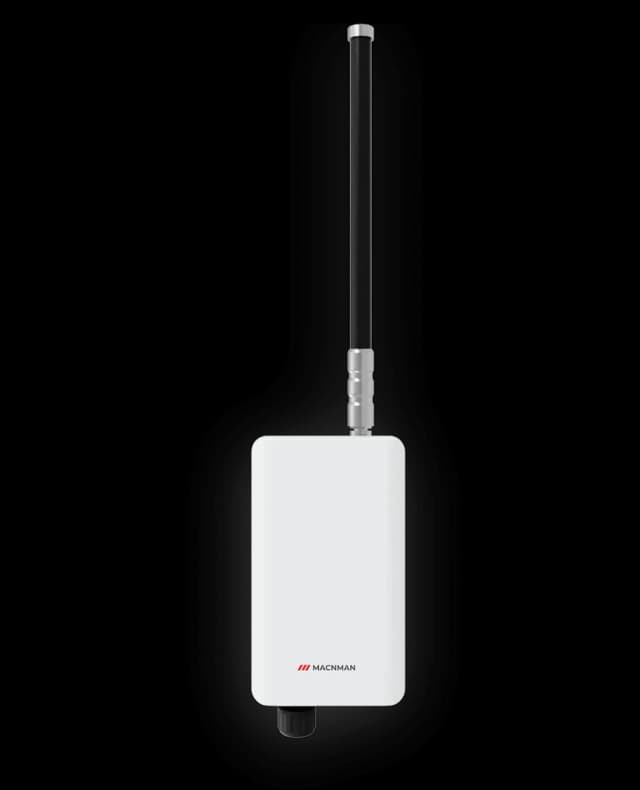 New
Maclink Gen-2
LoRaWAN Outdoor Gateways
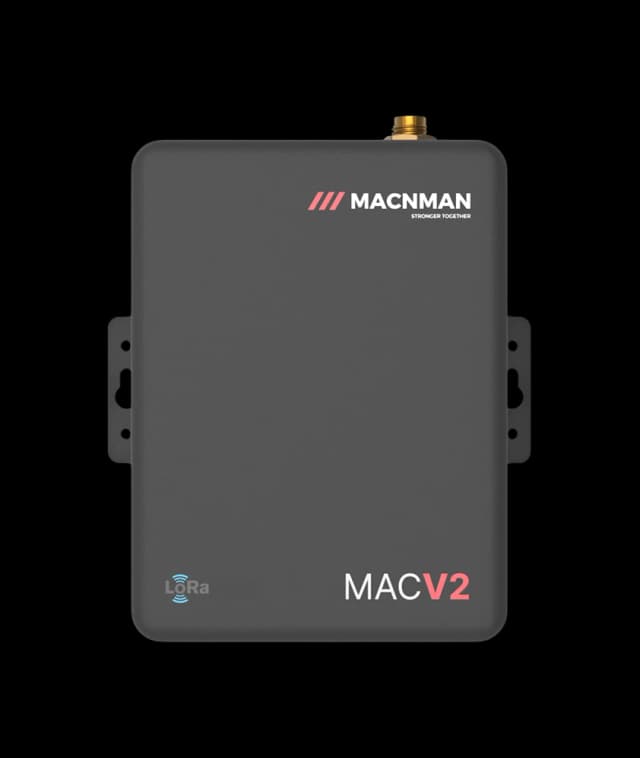
MacEge 4G Mini Gateway
4G Lte Gateways
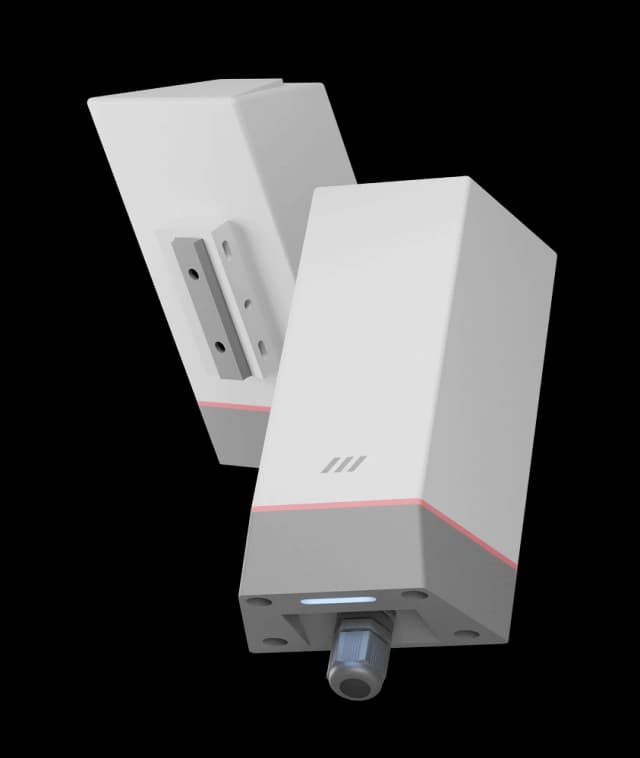 Hot Selling
MacSync LX1
RS485 Modbus to LoRaWAN Converter
MacSync LX1
Analog 4-20mA to LoRaWAN Converter
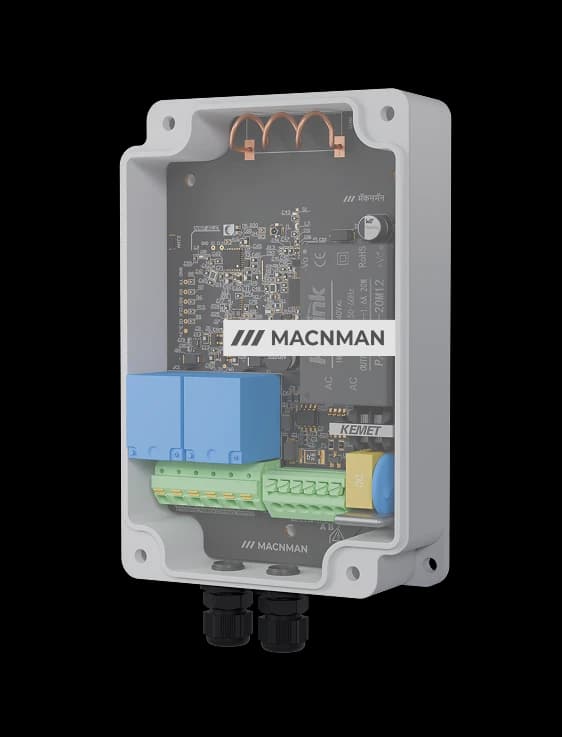 New
MacSet
RS485/Analog + Relay Output
 Hot Selling
Setu X
LoRaWAN Indoor Gateways
NewMaclink Gen-2
LoRaWAN Outdoor Gateways
MacEge 4G Mini Gateway
4G Lte Gateways
Hot SellingMacSync LX1
RS485 Modbus to LoRaWAN Converter
MacSync LX1
Analog 4-20mA to LoRaWAN Converter
NewMacSet
RS485/Analog + Relay Output
Hot SellingSetu X
LoRaWAN Indoor Gateways
Let‘s make it easy - reach out now!
Let’s bring it to life!
Let‘s Make it Easy
Reach Out Now


We are always ready
to help and
answer your
questions
Call
+91 7972856163
+91 9096830856
Location
Office-15 Bibwewadi, Pune, Maharashtra 411037
Get in Touch
Define your goals and all to value your time
Use of this website and purchase of Macnman products are subject to our Terms and Conditions.