
Product Naming & SKU Systems
This page explains how Macnman product model numbers and SKUs are structured, so you can decode a part number to its product family, connectivity, variant and generation.
Decoding Product Model Number
At Macnman, every model number is designed to communicate meaningful information about the product. Instead of relying on arbitrary product codes, our naming architecture follows a structured format that identifies the product family, communication protocol, application type, power configuration, device category, and hardware platform.
For example, MacSet L TH BS X1 immediately reveals that the device belongs to the MacSet product family, uses LoRaWAN® communication, is intended for Temperature & Humidity sensing, operates on battery power, belongs to the sensor category, and is built on the X1 hardware platform.
This approach creates a common language across engineering, manufacturing, sales, support, and deployment teams while ensuring scalability as new products and technologies are introduced.
We believe a model number should be read, not memorized. Every character serves a purpose and helps define the identity of the product.
Every Character Has a Purpose
Each segment within a Macnman model number represents a specific characteristic of the product. By reading the model number, customers and internal teams can quickly understand the device category, communication technology, application, power architecture, and hardware generation without referring to a datasheet.
As our portfolio continues to expand, this naming architecture ensures consistency, reduces ambiguity, and creates a scalable framework that can support future product families, communication technologies, and applications.
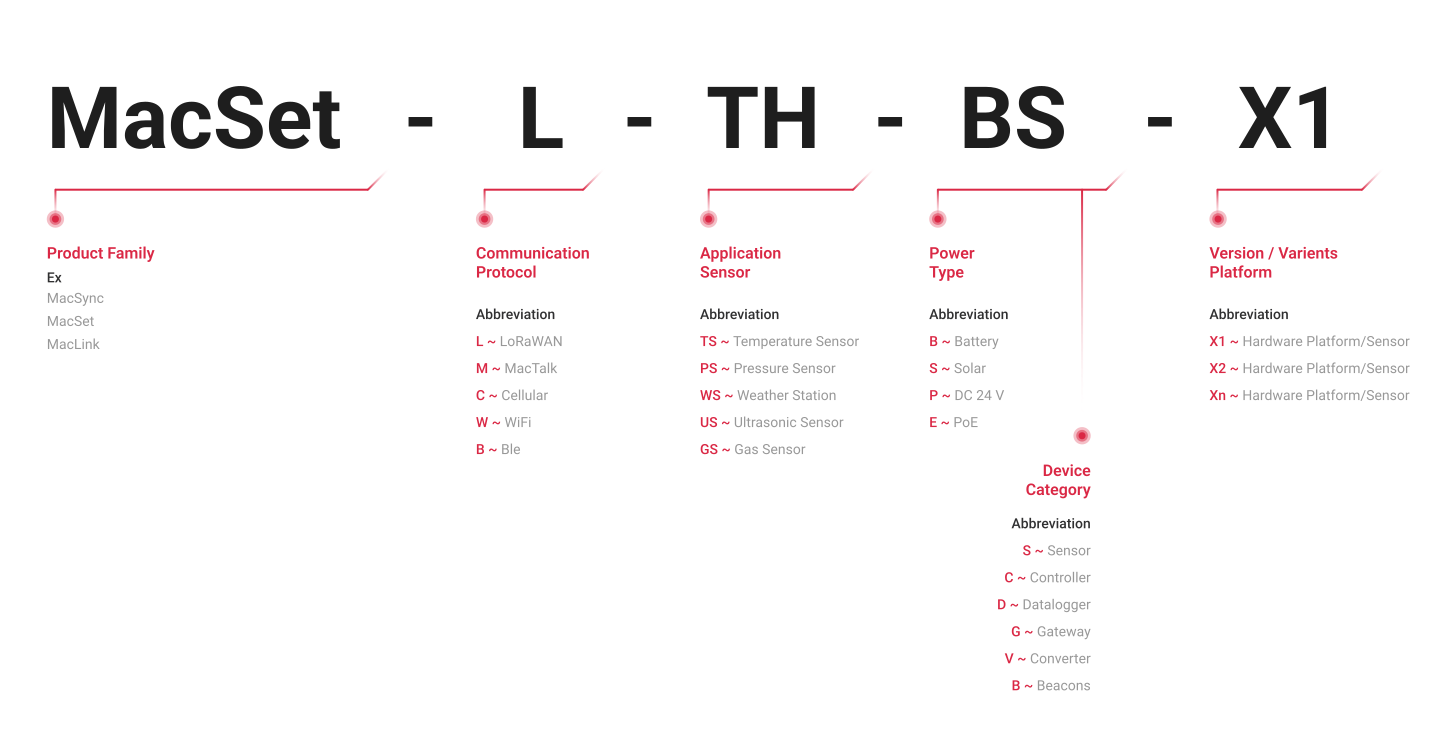
Model Number Structure
| Segment | Example | Meaning | Description |
|---|---|---|---|
| Product Family | MacSet | MacSet Product Family | Identifies the product series or ecosystem. |
| Communication Protocol | L | LoRaWAN® | Defines the primary communication technology. |
| Application | TH | Temperature & Humidity | Defines the sensing application or primary function. |
| Power + Device Category | BS | Battery Sensor | First character defines power type, second character defines device category. |
| Platform Version | X1 | Hardware Platform X1 | Represents the hardware platform, sensor generation, or product revision. |
Communication Protocol Reference
| Code | Technology |
|---|---|
| L | LoRaWAN® |
| M | MacTalk® |
| C | Cellular |
| W | Wi-Fi |
| B | Bluetooth® LE |
Application Reference Examples
| Code | Sensor |
|---|---|
| T | Temperature |
| H | Humidity |
| TH | Temperature & Humidity |
| P | Pressure |
| CO2 | Carbon Dioxide |
| VOC | Volatile Organic Compounds |
| AQ | Air Quality |
| WES | Weather Station |
| SL | Sound Level |
| RTD | Resistance Temperature Detector (RTD) |
| UL | Ultrasonic Level |
| ToF | Time of Flight |
| Odor | Odor Sensor |
| H2S | Hydrogen Sulfide |
| O2 | Oxygen Sensor |
| C2H4 | Quantitative Ethylene Sensor |
| SNPK | Soil NPK |
| SMT | Soil Moisture & Temperature |
| SEC | Soil Electrical Conductivity (EC) |
| SPH | Soil pH |
| MS7 | Multiparameter Soil Sensor (7-in-1) |
| WQEC | Water Quality EC |
| WQPH | Water Quality pH |
| HPT | Hydrostatic Pressure Transducer |
| ORM | Optical Rain Meter |
| WTS5 | Weather Station (5-in-1) |
| WTS6 | Weather Station (6-in-1) |
| DRS | Door Status |
| SDL | Sound Level |
Power Type Reference
| Code | Meaning |
|---|---|
| B | Battery Powered |
| S | Solar Powered |
| P | DC Powered |
| E | PoE Powered |
Device Category Reference
| Code | Meaning |
|---|---|
| S | Sensor |
| C | Controller |
| D | Datalogger |
| G | Gateway |
| V | Converter |
| B | Beacon |
Platform Version Reference
| Code | Meaning |
|---|---|
| X1 | Hardware Platform / Sensor Generation 1 |
| X2 | Hardware Platform / Sensor Generation 2 |
| Xn | Future Hardware Platform Generations |
Product Family Abbrivation
| Code | Meaning |
|---|---|
| MS | MacSync |
| MST | MacSet |
| NM | Narmada |
| PN | ParkoNode |
| MR | MacRay |
| ST | Setu |
| SL | MacLink |