Macnman Brand DNA
Brand DNA
Welcome to the Brand DNA of Macnman Technologies.
This section serves as the single source of truth for understanding who we are, how we think, and why we build products the way we do. As Macnman continues to grow, maintaining consistency across our products, communications, designs, and customer interactions becomes increasingly important. Brand DNA captures the principles, standards, and decisions that define our identity.
Here, you will find the meaning behind our brand, the logic behind our product naming conventions, the structure of our model numbers, our design philosophy, communication guidelines, product architecture standards, and the core values that shape every solution we create.
Whether you are a new team member, a partner, a designer, an engineer, or a leader within the organization, this knowledge base is intended to provide clarity, consistency, and alignment across all teams.
At Macnman, we believe that great brands are not built by chance—they are built through intentional decisions, repeated consistently over time. This document exists to ensure that every product, every document, every design, and every customer experience reflects the same vision, purpose, and identity.
Brand DNA is not just a record of what Macnman is today—it is a guide for what Macnman will become tomorrow.
Macnman Technologies Pvt. Ltd. (“Macnman”) designs and manufactures industrial IoT hardware products intended for professional, commercial, and industrial use.
By purchasing, installing, or operating any Macnman product, the customer acknowledges and agrees to the disclaimers, limitations, and responsibilities outlined in this document.
This policy protects Macnman from liabilities arising from factors outside our control such as improper installation, misuse, environmental conditions, or failures in external systems.
Decoding Product Model Number
At Macnman, every model number is designed to communicate meaningful information about the product. Instead of relying on arbitrary product codes, our naming architecture follows a structured format that identifies the product family, communication protocol, application type, power configuration, device category, and hardware platform.
For example, MacSet L TH BS X1 immediately reveals that the device belongs to the MacSet product family, uses LoRaWAN® communication, is intended for Temperature & Humidity sensing, operates on battery power, belongs to the sensor category, and is built on the X1 hardware platform.
This approach creates a common language across engineering, manufacturing, sales, support, and deployment teams while ensuring scalability as new products and technologies are introduced.
We believe a model number should be read, not memorized. Every character serves a purpose and helps define the identity of the product.
Every Character Has a Purpose
Each segment within a Macnman model number represents a specific characteristic of the product. By reading the model number, customers and internal teams can quickly understand the device category, communication technology, application, power architecture, and hardware generation without referring to a datasheet.
As our portfolio continues to expand, this naming architecture ensures consistency, reduces ambiguity, and creates a scalable framework that can support future product families, communication technologies, and applications.
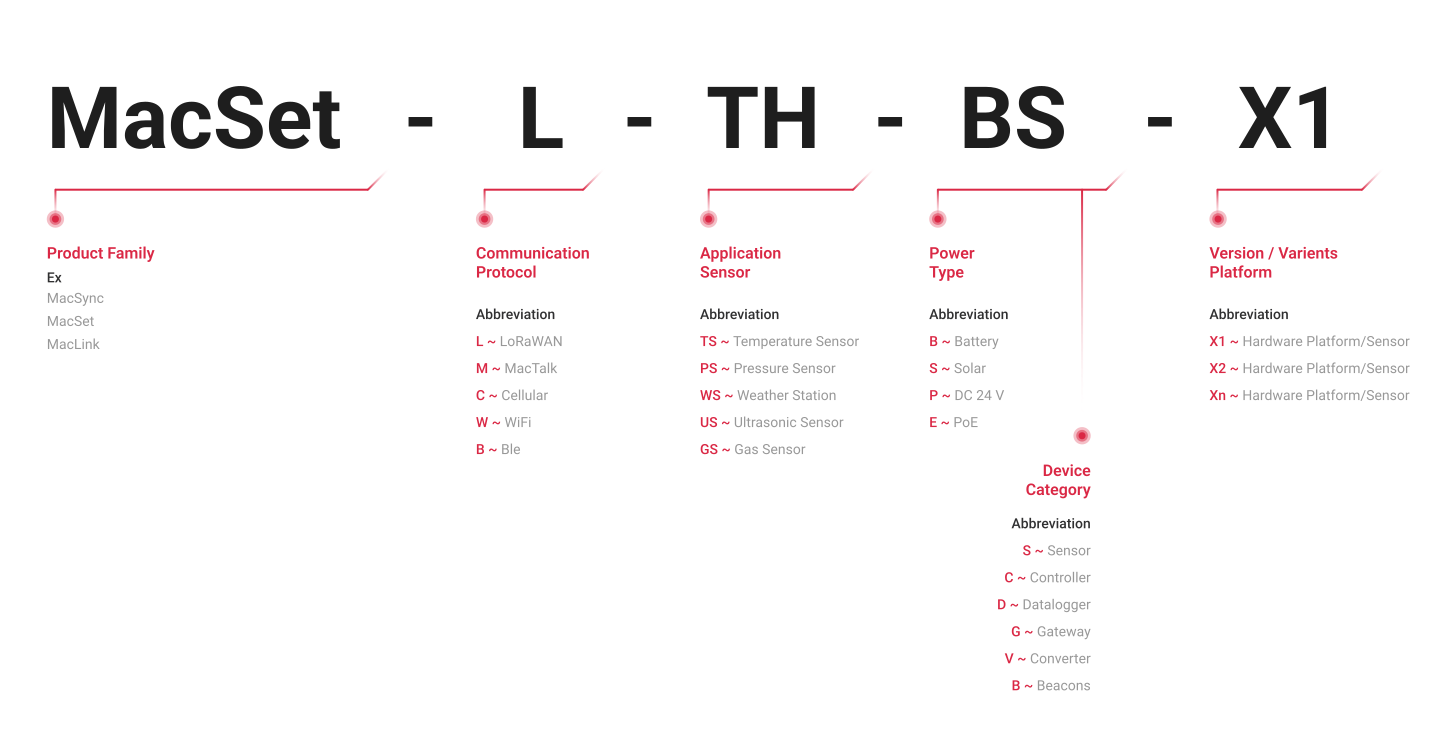
Model Number Structure
| Segment | Example | Meaning | Description |
|---|---|---|---|
| Product Family | MacSet | MacSet Product Family | Identifies the product series or ecosystem. |
| Communication Protocol | L | LoRaWAN® | Defines the primary communication technology. |
| Application | TH | Temperature & Humidity | Defines the sensing application or primary function. |
| Power + Device Category | BS | Battery Sensor | First character defines power type, second character defines device category. |
| Platform Version | X1 | Hardware Platform X1 | Represents the hardware platform, sensor generation, or product revision. |
Communication Protocol Reference
| Code | Technology |
|---|---|
| L | LoRaWAN® |
| M | MacTalk® |
| C | Cellular |
| W | Wi-Fi |
| B | Bluetooth® LE |
Application Reference Examples
| Code | Sensor |
|---|---|
| T | Temperature |
| H | Humidity |
| TH | Temperature & Humidity |
| P | Pressure |
| CO2 | Carbon Dioxide |
| VOC | Volatile Organic Compounds |
| AQ | Air Quality |
| WES | Weather Station |
| SL | Sound Level |
| RTD | Resistance Temperature Detector (RTD) |
| UL | Ultrasonic Level |
| ToF | Time of Flight |
| Odor | Odor Sensor |
| H2S | Hydrogen Sulfide |
| O2 | Oxygen Sensor |
| C2H4 | Quantitative Ethylene Sensor |
| SNPK | Soil NPK |
| SMT | Soil Moisture & Temperature |
| SEC | Soil Electrical Conductivity (EC) |
| SPH | Soil pH |
| MS7 | Multiparameter Soil Sensor (7-in-1) |
| WQEC | Water Quality EC |
| WQPH | Water Quality pH |
| HPT | Hydrostatic Pressure Transducer |
| ORM | Optical Rain Meter |
| WTS5 | Weather Station (5-in-1) |
| WTS6 | Weather Station (6-in-1) |
| DRS | Door Status |
| SDL | Sound Level |
Power Type Reference
| Code | Meaning |
|---|---|
| B | Battery Powered |
| S | Solar Powered |
| P | DC Powered |
| E | PoE Powered |
Device Category Reference
| Code | Meaning |
|---|---|
| S | Sensor |
| C | Controller |
| D | Datalogger |
| G | Gateway |
| V | Converter |
| B | Beacon |
Platform Version Reference
| Code | Meaning |
|---|---|
| X1 | Hardware Platform / Sensor Generation 1 |
| X2 | Hardware Platform / Sensor Generation 2 |
| Xn | Future Hardware Platform Generations |
Product Family Abbrivation
| Code | Meaning |
|---|---|
| MS | MacSync |
| MST | MacSet |
| NM | Narmada |
| PN | ParkoNode |
| MR | MacRay |
| ST | Setu |
| SL | MacLink |