Industrial LoRaWAN® Ultrasonic Level Sensor
for Water Tanks, Sumps, Manholes, Drains and Silos
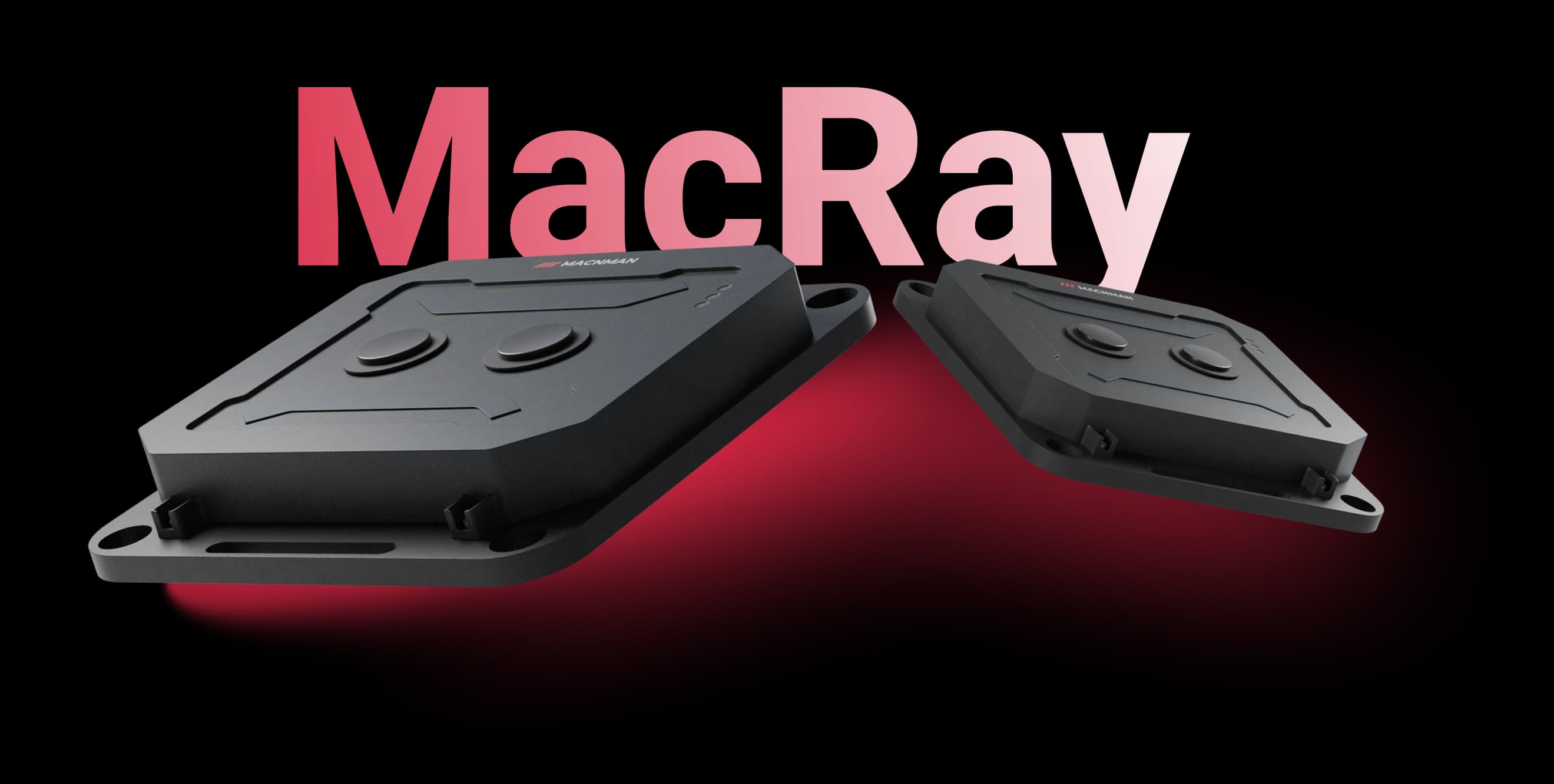
The MacRay LUS X1 measures 3 to 450 cm without touching the contents and reports over LoRaWAN® for years on one battery
Made in Pune, India · WPC compliant · IN865 ready
Made in Pune, India ·
WPC compliant · IN865 ready
MacRay LUS X1
MacRay LUS X1 Highlights
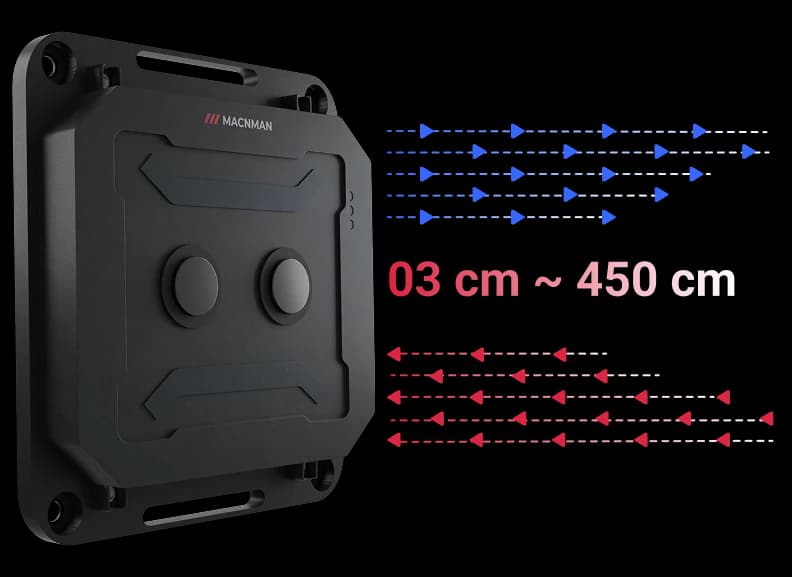
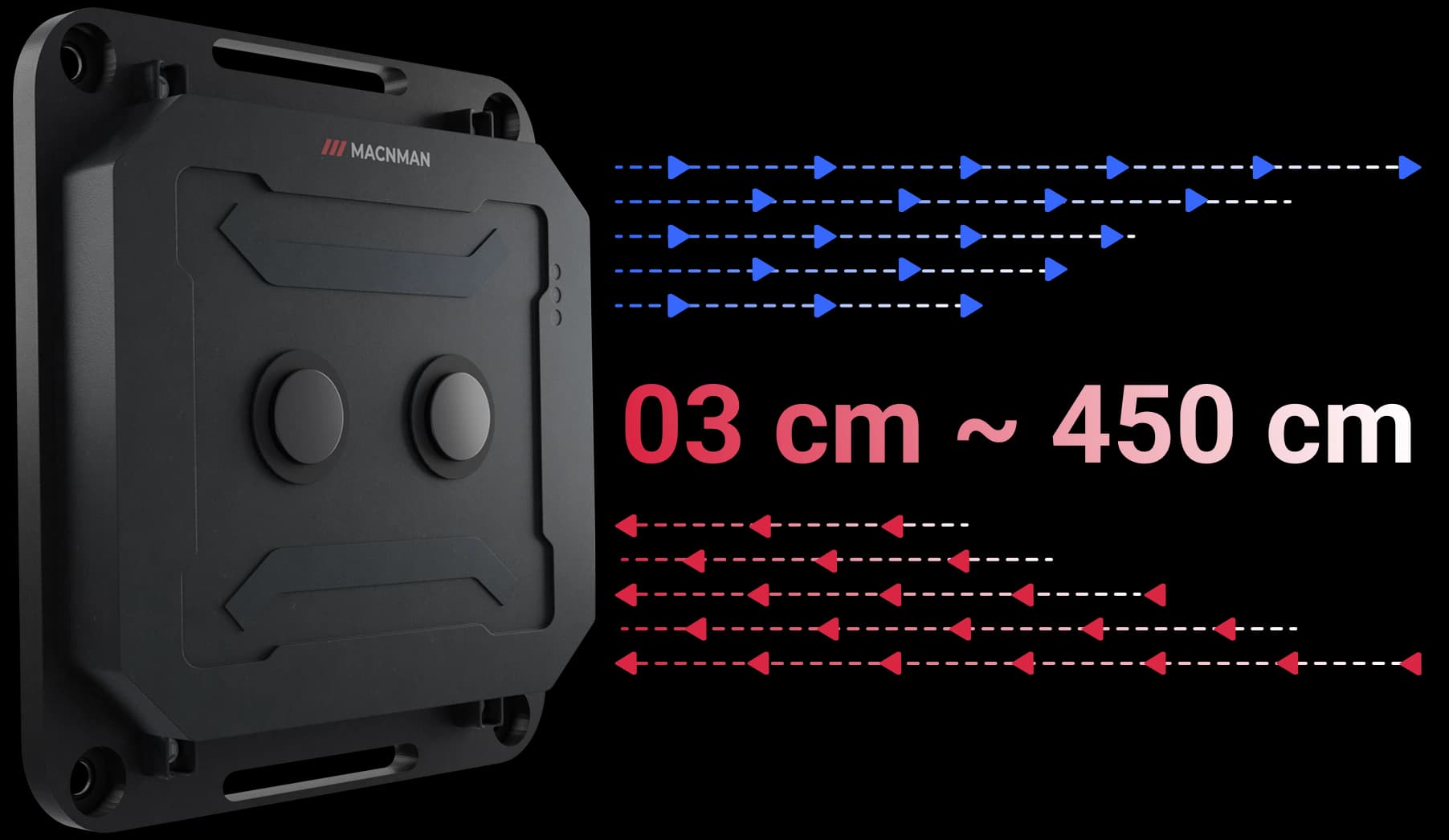
A 40 kHz transducer times an echo off the surface and reports the distance at 0.1 cm resolution, from 3 cm to 450 cm. Nothing touches the water, the diesel, the chemical or the sludge, so there is no probe to foul, corrode or clean.
LoRaWAN® reaches about 2 km across a built-up site and up to 8 km with a clear line of sight, so every tank, sump and drain on a plant or a town ward reports to one gateway.
The 8 Ah Li-SOCl₂ cell is rated for about a year at 5-minute reports, 2 years at 15 minutes and 3+ years at hourly reports; the sensor sleeps at about 100 µA between readings.
Set a high and a low level in the app and the sensor sends an event uplink the moment the reading crosses it: a sump about to overflow, a tank about to run dry, a drain rising in a storm.
Three variants on the same sensor: LoRaWAN® through a gateway, MacTalk straight to another Macnman device such as a MacSet pump controller with no gateway, or Bluetooth to a phone for local readings.
The transducer is sealed to IP67 for the spray, condensation and vapour above a tank; the glass-filled nylon body is IP55 and works from −40 to +80 °C.
The clip screws to a wall or a gantry or straps to a pole with zip ties, and the sensor slides in and locks, facing straight down at the surface. No cable into the tank, no power at the site.
The Maya app pairs over Bluetooth to enter the mounting height, the reporting interval, the level limits and the band, and shows the live distance so the aim is checked on the spot. Later changes arrive as downlinks.
Mount the face at least 3 cm above the highest level and keep the 60° cone clear of walls, ladders and inlet pipes, and the echo comes back from the surface and nothing else. The beam-pattern page in the manual shows the cone.
About 110 g, so it sits on a tank lid, under a manhole cover or on a bin without a bracket of its own; the supplied clip takes a zip tie on a pole.
In plain terms
What Is a LoRaWAN Ultrasonic Level Sensor, and How Does It Work?
The short answer
A LoRaWAN ultrasonic level sensor is mounted above a liquid or a solid, sends a short burst of sound down at the surface and times the echo. The time gives the distance, the distance subtracted from the mounting height gives the level, and the reading travels over LoRaWAN® to a gateway that may be kilometres away. Nothing touches the contents, and no cable or power is needed at the tank.
Range
- 450 cm
Maximum range
- 3 cm
Blind zone
- 0.1 cm
Resolution
Beam
- 60°
Sensing angle
- 40 kHz
Centre frequency, ± 1 kHz
- 100 ms
Sensor response time
Radio
- v1.0.4
LoRaWAN® version, Class A by default
- 23 dBm
Transmit power at 865 MHz
- −137 dBm
Receive sensitivity at 300 bps
Reporting
- 3 modes
Periodic, event-based or hybrid
- 1 min – 24 h
Sampling interval, configurable
- Threshold
Level alert for event-triggered uplinks
Build
- IP67
Ultrasonic transducer rating
- −40 to +80 °C
Operating temperature
- Pole / wall
Mounting
Setup
- Maya
Android app, configuration over BLE
- OTA
Remote configuration by downlink
- AES-128
LoRaWAN® encryption
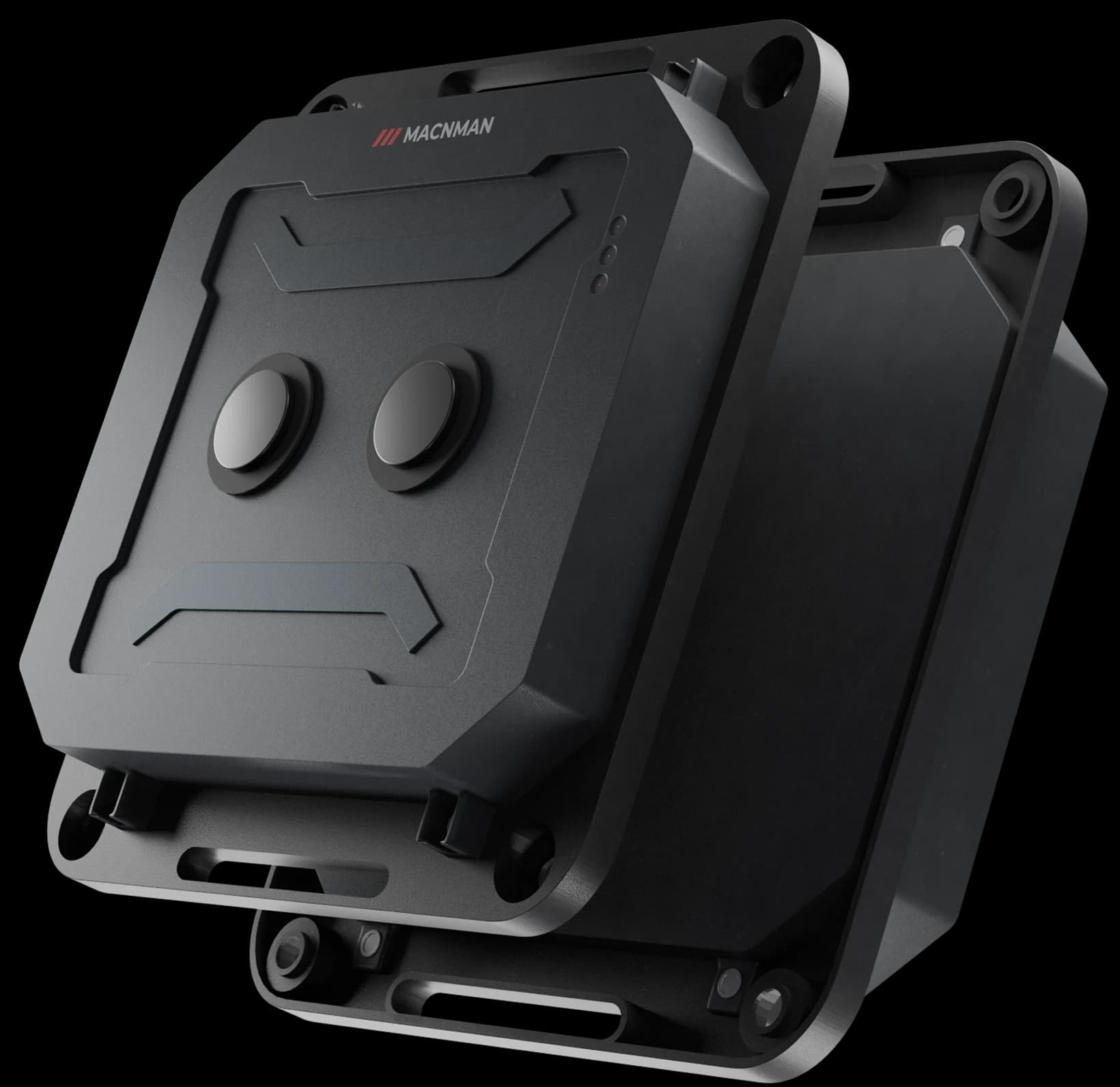

MacRay LUS X1
The MacRay LUS X1, listed earlier as the MacRay LU4, measures from 3 cm to 450 cm with a 60° beam and an IP67 transducer, runs for years on an 8 Ah battery, and reports on a schedule, on a level threshold or both. MacTalk and Bluetooth variants work with no gateway.
Measures from 3 cm to 450 cm, with a 3 cm blind zone and 0.1 cm resolution.
A 40 kHz transducer with a 60° sensing angle and a 100 ms sensor response time.
LoRaWAN® v1.0.4, Class A by default and Class C configurable, transmitting at 23 dBm.
Periodic, event-based or hybrid, with a level threshold for event-triggered uplinks.
An IP67-rated ultrasonic transducer on an enclosure rated from −40 °C to +80 °C, for pole or wall mounting.
Configured over BLE with the Maya Android app, and reconfigured remotely by downlink.
The same device is searched for as a wireless tank level sensor, a LoRaWAN water level sensor, an ultrasonic distance sensor or a smart bin fill-level sensor. It is an end device that reports to a LoRaWAN® gateway; it is not a radar transmitter, a pressure transmitter, a float switch or a hobby distance module.
Get a quote
Need a quote for the MacRay LUS X1?
Tell us how many you need and where they are going. A product engineer replies within one working day with availability, lead time and the right variant for your site.
- Reply within one working day
- Designed and built in Pune, India
- WPC compliant, RoHS conformant
Downloads
MacRay LUS X1 Datasheet, Manual, Beam Pattern and Mounting Guide
The datasheet, the online manual with the beam-pattern and mounting pages, the alert-setup guide and the decoder repository, in one place.
Product Datasheet
PDF · full technical specifications
User manual (online)
Product overview, specifications, beam pattern, mounting and FAQs
Beam pattern
Measured detection pattern of the ultrasonic cone on a 30 cm grid
Mounting guide
Bracket on a lid or wall with the drilling template; pole or rail with zip ties
Alert and sampling setup
Level thresholds and sampled uplinks in the Maya app
Payload decoders
Macnman codec repository on GitHub; ask support for the MacRay codec for your network server
In focus
What Sets the MacRay LUS X1 Apart for Level Monitoring
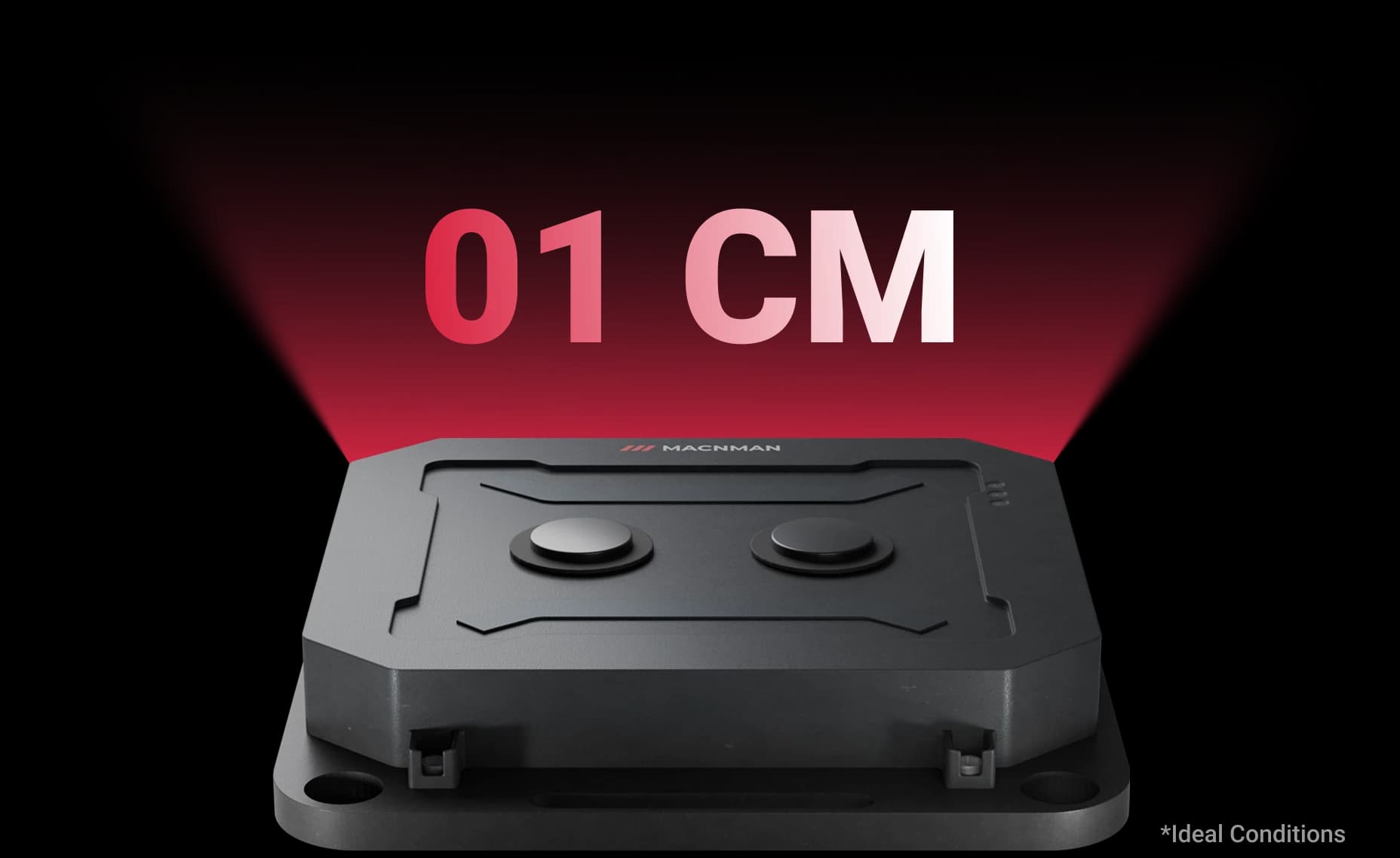
The reading comes from an echo, so a chemical tank, an effluent pit or a grain silo is measured without a probe to corrode, coat or snag. The same sensor moves from a water tank to a sump without a change of part.
01 / 05
Tanks, sumps, drains, silos and bins, measured without contact
Where a LoRaWAN Ultrasonic Level Sensor Is Installed

01 / 14
Bridge Water Monitoring
- Continuous Water Tracking
- Flood Risk Alerts
- High Reliability Monitoring
Water Tank Monitoring
- Accurate Tank Levels
- Smart Pump Automation
- Contactless Measurement
Diesel Tank Monitoring
- Fuel Theft Prevention
- Accurate Fuel Tracking
- Remote Tank Visibility
Chemical Tank Monitoring
- Corrosion-Proof Sensing
- Non-Contact Safety
- Reliable Liquid Monitoring
Sewage Pit Monitoring
- Overflow Risk Alerts
- Continuous Pit Measurement
- Contactless Waste Monitoring
Irrigation Canal Monitoring
- Canal Flow Insights
- Water Usage Planning
- Remote Canal Visibility
Silo Monitoring
- Precise Level Measurement
- Real-Time Inventory
- Maintenance-Free Operation
Farm Pond Monitoring
- Accurate Water Storage
- Efficient Farm Planning
- Zero Maintenance Operation
Open Well Depth Monitoring
- Precise Depth Reading
- Continuous Water Insight
- Safety-Focused Monitoring
Flood Level Monitoring
- Early Flood Alerts
- Continuous Level Watch
- Disaster Risk Reduction
Industrial Tank Monitoring
- Stable Industrial Readings
- Process Optimization Data
- High Reliability Sensing
Smart Dustbin Monitoring
- Real-Time Fill Levels
- Optimized Cleaning Routes
- Lower Waste Costs
Object Detection
- Instant Object Detection
- Accurate Distance Feedback
- Automation Safety Support
Car Parking Detection
- Available Spot Detection
- Improved Traffic Flow
- Smart Parking Guidance
Ready to see every tank, sump and drain on one dashboard? Ask for a quote.
Works with
Wireless Water Tank Level Monitoring Without a Probe: 3 cm to 450 cm
An echo off the surface, read at 0.1 cm, with nothing in the tankAn echo off the surface, read at 0.1 cm, with nothing in the tank
Ultrasonic in practice
What an Ultrasonic Level Sensor Reads Well, and What to Watch: Five Things
Ultrasound is the right choice for most tanks, sumps and drains. These are the cases that need a mounting decision or a different sensor.
Ultrasonic in practice
Ultrasound is the right choice for most tanks, sumps and drains. These are the cases that need a mounting decision or a different sensor.
Foam and heavy vapour absorb the echo
A foamed effluent tank or a steaming hot-water tank returns a weak or missing echo. Mount away from the aerator and the inlet, average several readings per uplink, and discuss a permanently foamed tank before ordering.
Walls and fittings inside the cone return early
A ladder, an inlet pipe or a curved tank wall inside the 60° cone gives a short reading that looks like a full tank. Centre the sensor, keep the cone clear and check the live distance in the Maya app at full and empty.
Condensation clears, but not instantly
A droplet film on the IP67 face weakens the echo until it dries, usually within minutes of sunrise. Point the face straight down and set alert limits with margin, and a wet tank reads reliably.
Air temperature moves the speed of sound
About 0.17 % per degree, so a sensor in direct sun reads differently at noon and at night. Shade it, keep the measuring range short where possible, and let the dashboard average readings.
Not through a wall, not for flow
The sensor looks down at the surface through an opening; it does not read through a tank wall, and it measures level, not flow. For a sealed plastic tank or a flow figure, a different instrument is the right answer.
Planning a LoRaWAN network across tanks and drains? Start with the gateway and coverage calculator.
Read our LoRaWAN BookPower
Battery-Powered LoRaWAN Ultrasonic Sensor for Tanks with No Supply
An 8 Ah Battery for Years on a Tank Top or in a Manhole

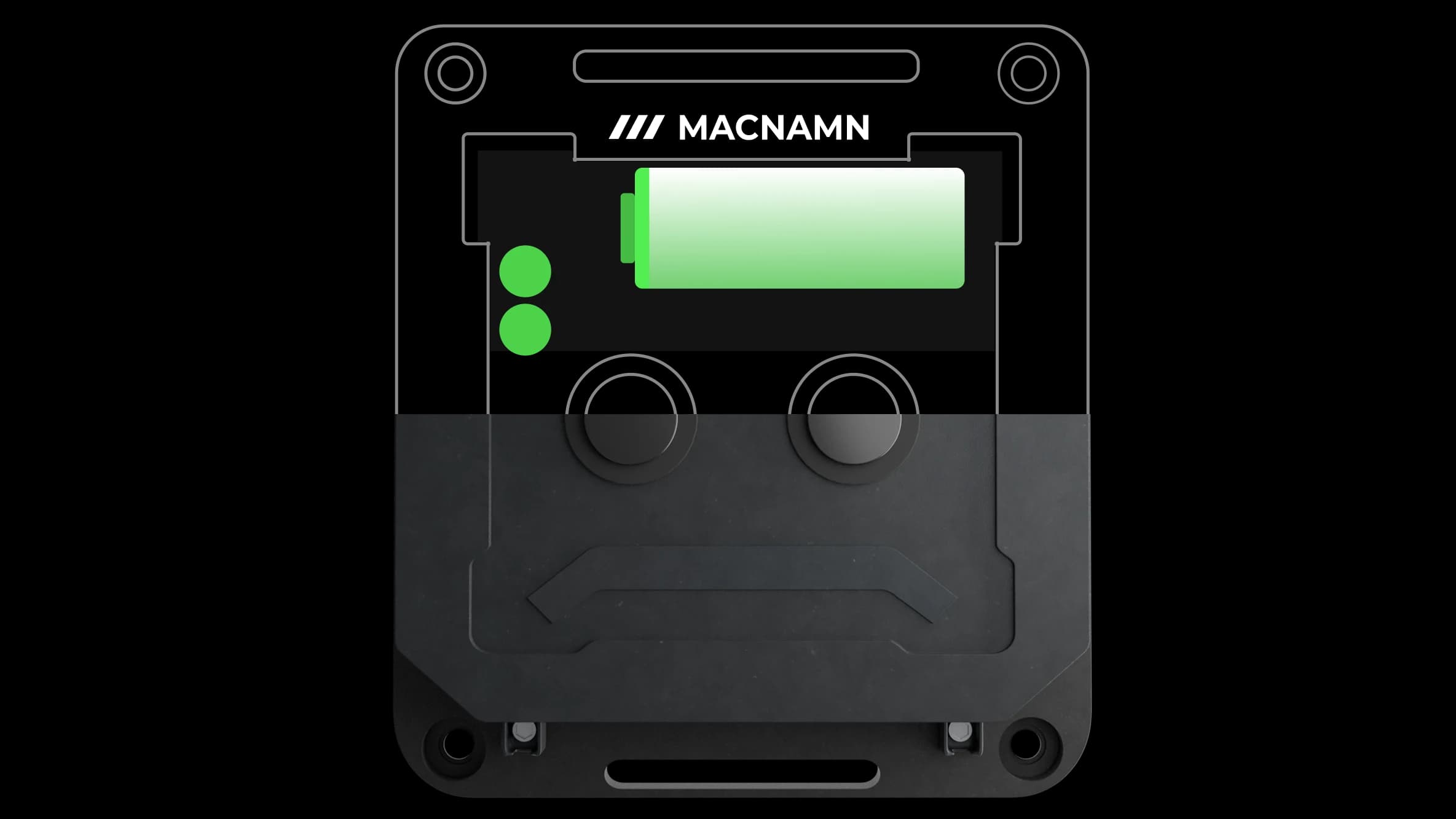
No power at the tank is the normal case, so the sensor carries an 8 Ah Li-SOCl₂ cell rated for about 3+ years at hourly reports, 2 years at 15 minutes and a year at 5 minutes. A threshold alert costs an uplink only when a limit is crossed.
Before you order
Send Us the Tank List and We Confirm the Mounting
Four details are enough for an engineer to reply with the variant for each point, the mounting method and the gateway count.
Before you order
Four details are enough for an engineer to reply with the variant for each point, the mounting method and the gateway count.
Depth and opening
The distance from the mounting point to the bottom, the maximum level, and the opening or port the sensor can look through.
Contents and surface
Water, effluent, chemical, fuel or a solid; whether there is foam, vapour, a stirrer or a fill stream in the cone.
Cover and radio path
A metal lid, a manhole cover or a basement between the sensor and the gateway, so the link is checked before the clip is fixed.
Network and action
An existing LoRaWAN® gateway and server, a new one, or MacTalk to a MacSet controller that must start a pump on the level.
Ready now: Get a quote · Request a pilot kit · Partner programme
How long will the battery last at your interval? The battery life calculator works it out.
Open the calculatorPreset modes
One Sensor, Set Up for Its Job
in the Maya app
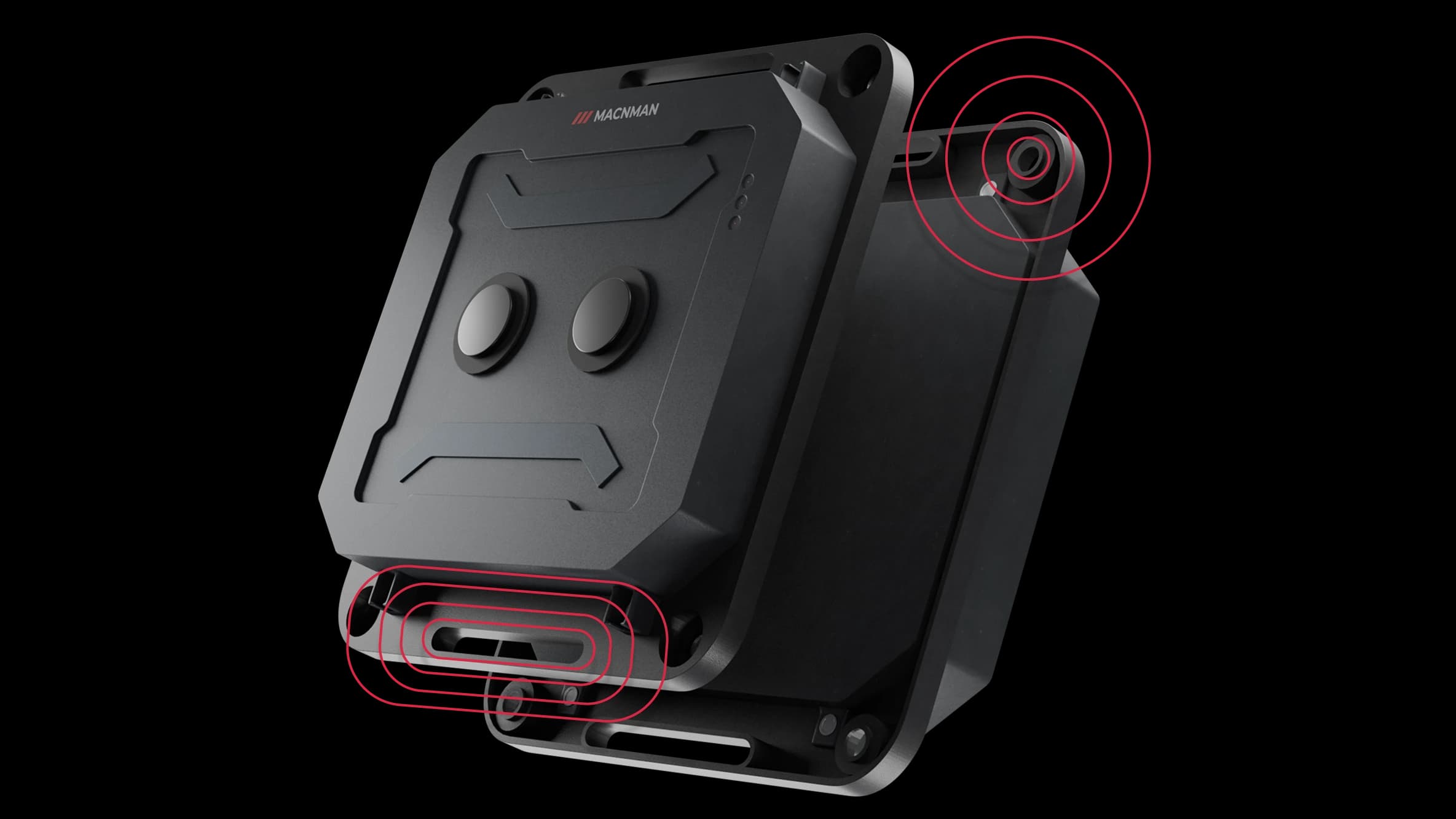
Enter the mounting height and the limits for a tank, a bin, a silo or a drain, and the same sensor reports level, fill or depth the way that job needs it
Reports bin fill-level and flags collection thresholds, so routes run on real data.
At a glance
MacRay LUS X1 LoRaWAN Ultrasonic Level Sensor Specifications
The key figures in one view: sensing, radio, power, protection and setup.
3–450 cm
measuring range
3 cm blind zone · 0.1 cm resolution
60°
sensing angle
40 kHz transducer · 100 ms response
8 Ah
battery
About 1 / 2 / 3+ years at 5 / 15 / 60-minute reports
IP67
sensor head
IP55 body · −40 to +80 °C
v1.0.4
LoRaWAN®
Class A, Class C via the app · IN865 to AU915 · 23 dBm
Maya
setup over Bluetooth
Mounting height, interval, limits, live distance
Send us the tank list and we confirm the variant, the mounting and the gateway count.
Get a quoteCloud & LNS
Works with Any LoRaWAN® Gateway and Network Server
Levels in ChirpStack, The Things Stack or Your Own Server
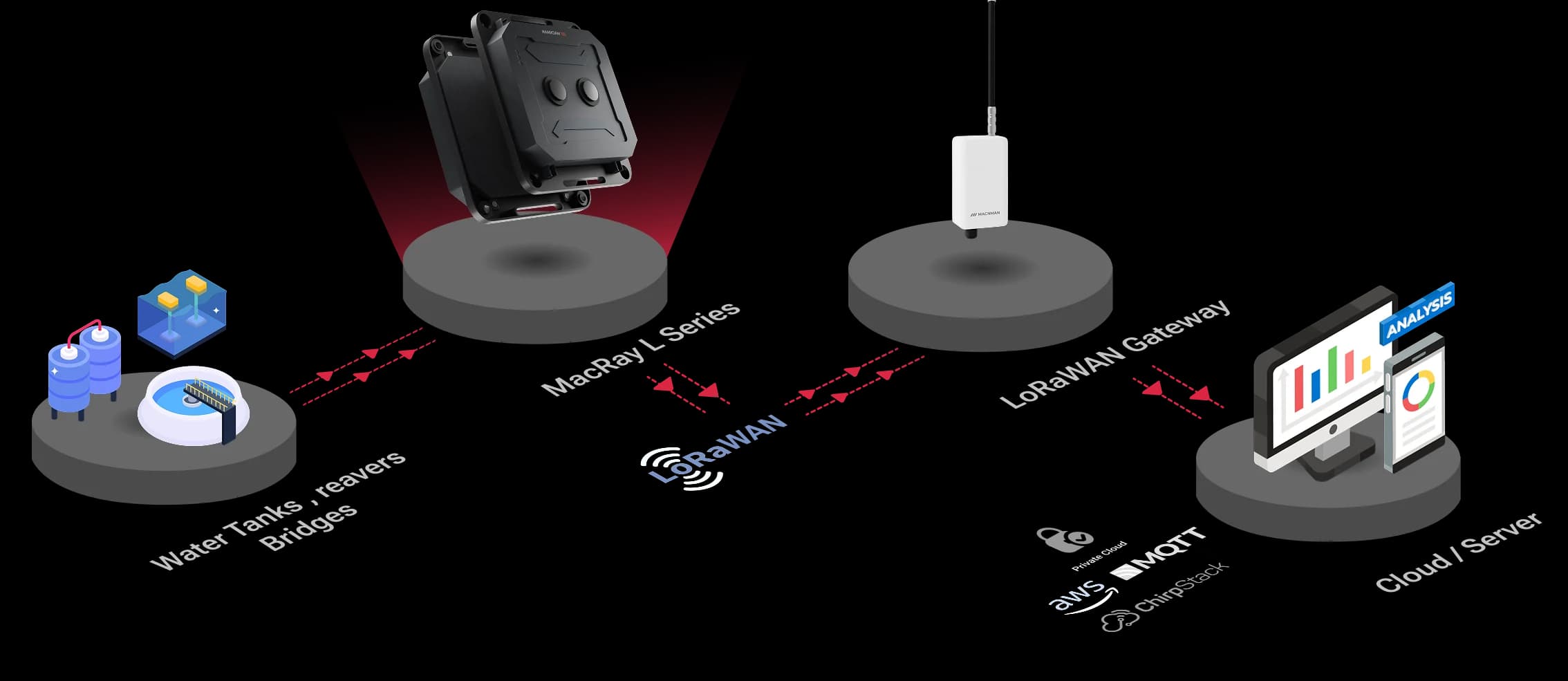
The MacRay LUS X1 is a standard LoRaWAN® v1.0.4 end device with OTAA activation. Register it on ChirpStack, The Things Stack, Orbiwise, Netmore or a private server, add the decoder, and each uplink arrives as a distance or level that MQTT or HTTPS carry on to your dashboard, SCADA or pump-control rules.
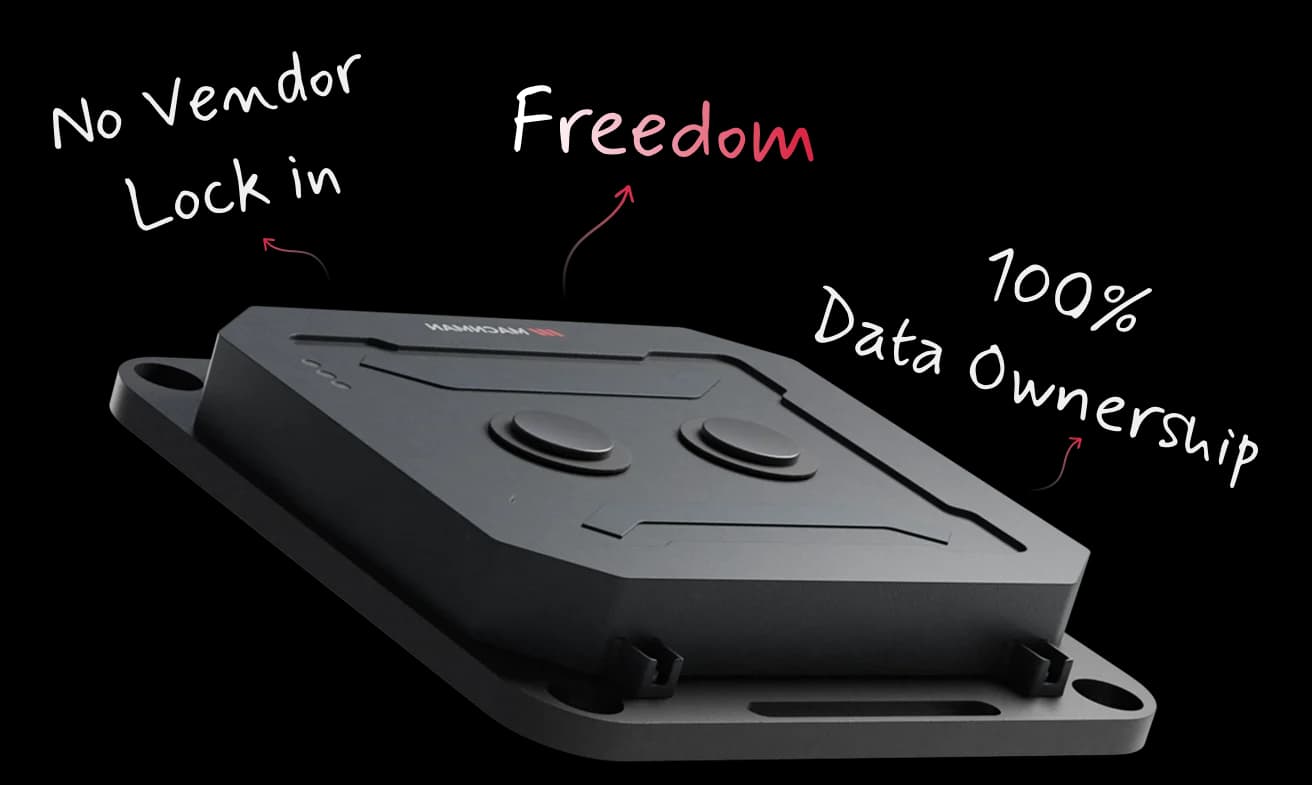

Build the network: MacLink Gen-2 outdoor LoRaWAN gateway · Setu X1 indoor LoRaWAN gateway · Gateway and coverage calculator · LoRaWAN battery life calculator
Device-to-device
No Gateway? MacTalk Level to a Pump Controller
The MacTalk variant sends the level straight to another Macnman device
With the MacTalk variant (SKU 8201) the level goes straight to a MacSet controller or another Macnman device over LoRa, with no gateway, SIM, server or internet. A tank sensor and a pump controller become a wireless float switch with kilometres between them.
With the MacTalk variant (SKU 8201) the level goes straight to a MacSet controller or another Macnman device over LoRa, with no gateway, SIM, server or internet. A tank sensor and a pump controller become a wireless float switch with kilometres between them.
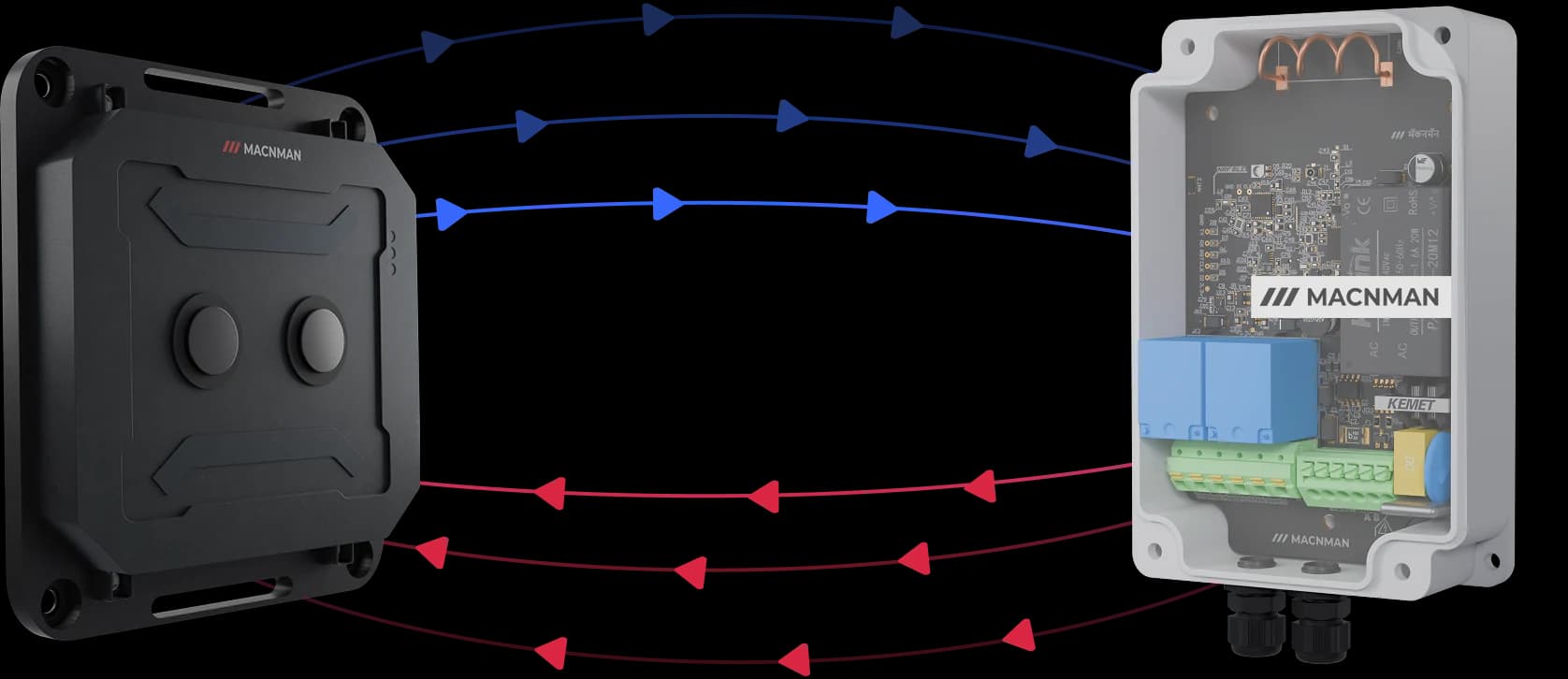
No gateway
One LoRa link, two devices, no server in between.
Pump control
A MacSet controller starts or stops the pump on the level.
Kilometres apart
Tank on the hill, pump at the well, one radio link.
A tank sensor and a pump controller, kilometres apart, with no gateway: ask about the MacTalk variant.
Why Macnman
No-Code Setup: Mounting Height, Limits and Interval from the Maya App
Pair over Bluetooth, enter the mounting height so the app shows level as well as distance, set the reporting interval and the high and low limits, and watch the live reading while you aim the sensor. Firmware updates are signed and over the air.
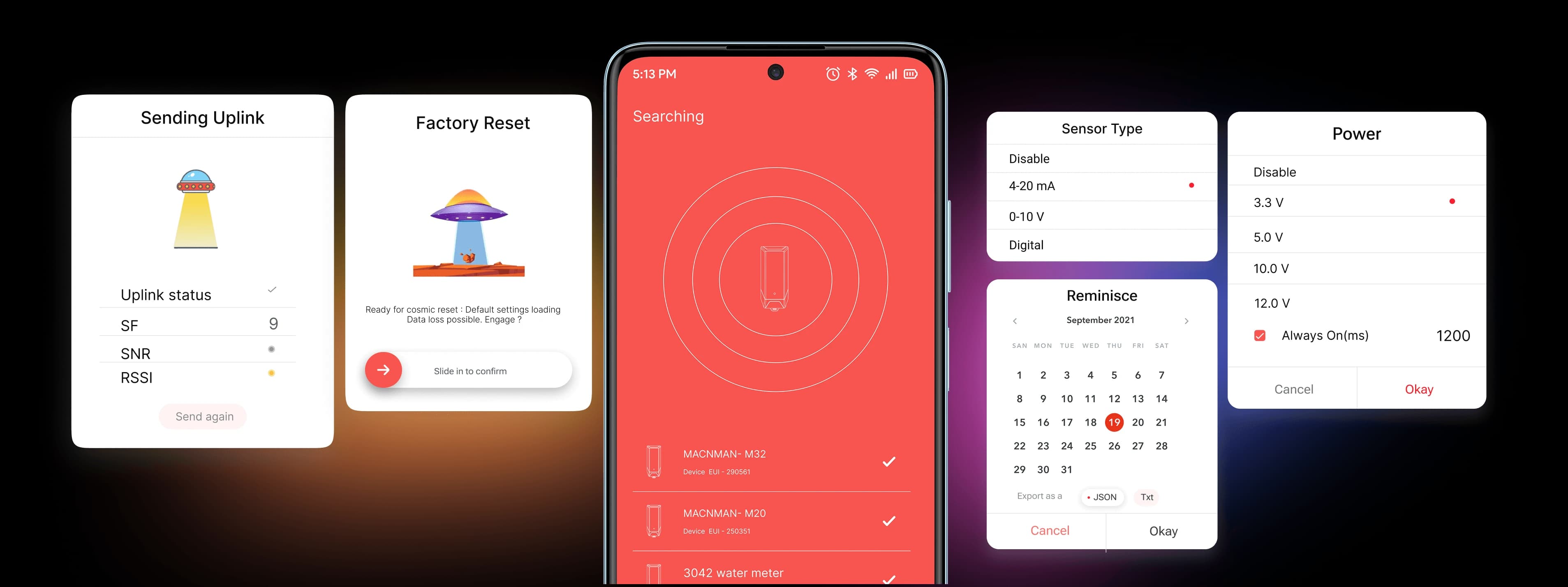
Set up a tank, a bin or a drain from a phone in the Maya app, no laptop needed.
Click to see Magic !Three reporting modes
set in the Maya app
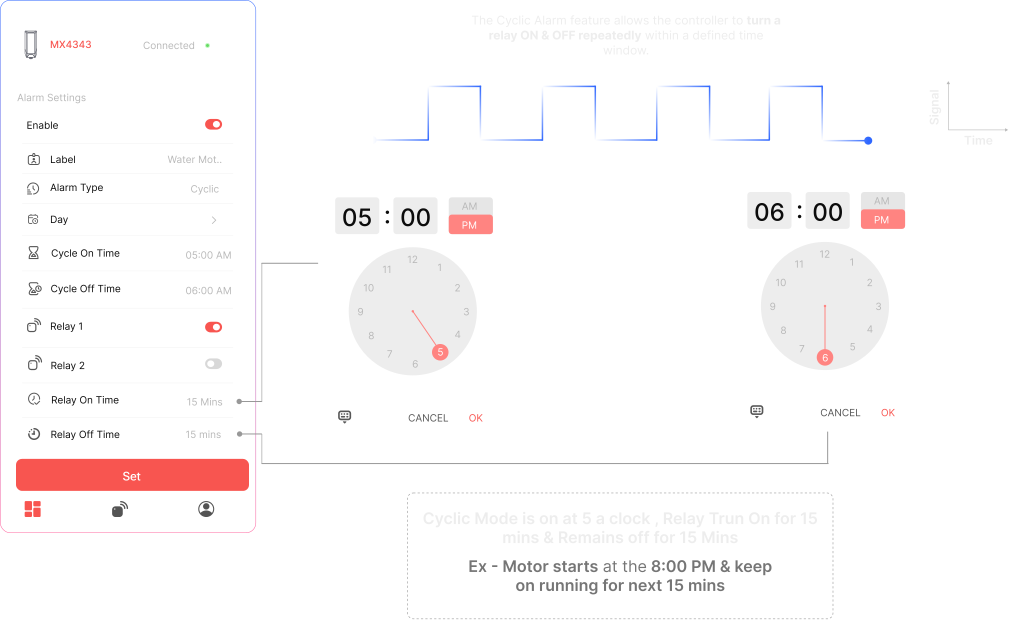
Periodic, threshold or sampling
A fixed schedule, an alert on a level limit, or several readings in one uplink.
Operating modes
Periodic, Threshold and Sampling Uplinks: Which Mode for Which Tank
report on a schedule, on a level limit, or several readings per uplink
Switch between periodic, threshold and sampling reporting in the Maya app, in seconds, over Bluetooth.

01
Set the interval
From once a minute to once a day. A storage tank runs hourly; a sump or a drain in the monsoon runs every few minutes.
02
Set it in the Maya app
Over Bluetooth, with the mounting height, so the app shows level as well as distance. No laptop, no cable.
03
A reading every interval
The sensor wakes, measures, uplinks and sleeps, giving a steady record and a predictable battery life.
Architecture
LoRaWAN Network Architecture: Level Sensor, Gateway, Network Server and Dashboard
Range & reliability
How Far Does a LoRaWAN Level Sensor Transmit from a Tank or a Manhole?
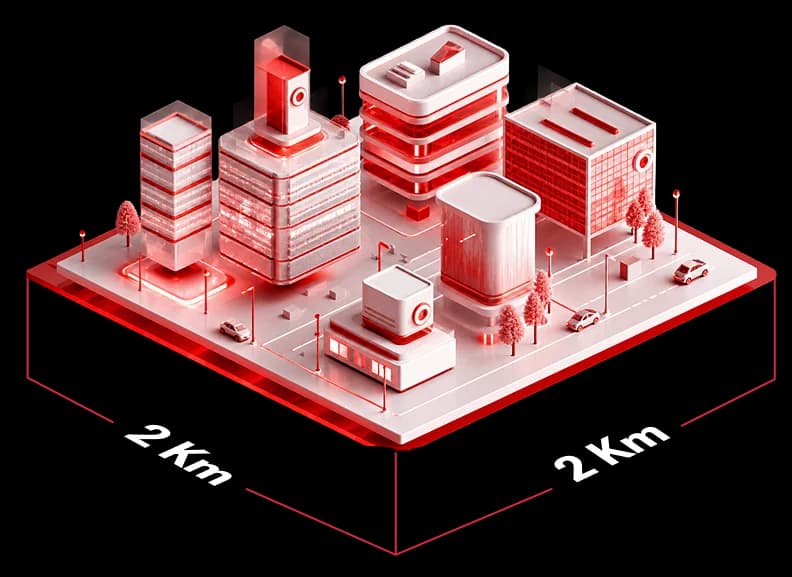
About 2 km across a built-up site and up to 8 km with a clear line of sight
From its internal antenna at 23 dBm the MacRay LUS X1 reaches a gateway on a roof or a mast from tank tops, sumps and open drains across a plant or a ward. A cast-iron manhole cover or a steel tank lid attenuates the signal, so check the link at the mounting point with the Maya app's network test before fixing the clip, and mount the gateway high.
Made in India
A LoRaWAN ultrasonic level sensor made in Pune, India
Water boards, plants and integrators in India get a sensor built for IN865 with a WPC compliant radio, and an engineer in Pune on the phone during Indian hours. Outside India the same unit is supplied on EU868, US915, AU915 or RU864.
Made in India
Water boards, plants and integrators in India get a sensor built for IN865 with a WPC compliant radio, and an engineer in Pune on the phone during Indian hours. Outside India the same unit is supplied on EU868, US915, AU915 or RU864.
IN865 as standard
Supplied on the 865–867 MHz LoRaWAN® plan used in India; a different regional plan is chosen at order time.
WPC compliant radio
The radio is WPC compliant for India and the hardware conforms to RoHS; no CE marking is claimed.
Built in Pune
The board, firmware and housing come from one site in Pune, and the engineers who answer support questions sit there too.
Next steps: Request a pilot kit · All LoRaWAN level and environment sensors · Industrial IoT manufacturer in India
Mount it once, straight down, clear of the walls: the mounting guide is in the downloads above.
Which sensor
Which Macnman Level Sensor Do You Need: Ultrasonic, Wi-Fi Ultrasonic or Capacitive Fuel Probe?
Three Macnman sensors read a level. Choose by the network the site has and by whether a non-contact reading or a probe in the tank suits the contents.
| Criterion | MacRay LUS X1 (LoRaWAN® ultrasonic) | MacRay WU4 (Wi-Fi ultrasonic) | MacSync LCS X1 (LoRaWAN® capacitive fuel probe) |
|---|---|---|---|
| Network | LoRaWAN® v1.0.4 through a gateway, or MacTalk device to device | Existing 2.4 GHz Wi-Fi to MQTT or HTTPS, with no gateway | LoRaWAN® v1.0.4 through a gateway |
| How it measures | Non-contact ultrasonic echo from above, 3 to 450 cm | Non-contact ultrasonic echo from above | Capacitive probe immersed in the fuel |
| Contents | Water, wastewater, chemicals, fuel, solids and waste | Water and liquids within Wi-Fi reach | Diesel and fuel in generator and vehicle tanks |
| Power | 8 Ah battery | Battery | See the fuel sensor page |
| Choose it for | Tanks, sumps, drains, silos and bins spread over a site, kilometres from the gateway | A few tanks inside a building or a yard that already has Wi-Fi and no LoRaWAN gateway | Fuel stock and theft alerts where a probe in the tank is wanted |
| SKUs | 8200 LoRaWAN · 8201 MacTalk · 8202 BLE | See the MacRay WU4 datasheet | See the fuel sensor page |
For short-range distance and presence inside a building, the MacRay LToF time-of-flight sensor measures 4 to 400 cm with a laser and is on its own page.
See also: Compare all MacRay LUS X1 versions · LoRaWAN capacitive fuel level sensor · LoRaWAN time-of-flight sensor
Sensing
Ultrasonic Sensing Figures and What They Mean for the Installation
The datasheet figures for the transducer, with what each one means when the sensor is mounted over a tank, a sump or a bin.
| Figure | Datasheet | What it means on site |
|---|---|---|
| Measuring range | 3 to 450 cm | The distance from the sensor face to the surface; a tank up to about 4.4 m deep is covered with the sensor just above the maximum level |
| Blind zone | 3 cm | Mount the face at least 3 cm above the highest level the contents can reach, including foam and splash |
| Resolution | 0.1 cm | The smallest change in the reading; set alert limits in whole centimetres and let the dashboard average the rest |
| Sensing angle | 60° | Keep the cone clear of walls, ladders, inlet pipes and stirrers; at 450 cm the cone is about 5.2 m across, so a narrow tank wants the sensor centred and the range used short |
| Centre frequency | 40 kHz ± 1 kHz | Air-coupled ultrasound; vapour, foam and heavy dust on the surface weaken the echo, so an open-water or a settled-solid surface reads best |
| Response time | 100 ms | The reading settles within a tenth of a second, so sampling several readings per uplink costs little battery |
| Transducer protection | IP67 | The face takes spray and condensation above a tank; the body is IP55, so mount it out of standing water |
Figures are from the MacRay LUS X1 datasheet. Ultrasound travels at the speed of sound in air, which changes with temperature, so mount the sensor out of direct sun and send us the tank details if the application needs a tight absolute figure.
Mounting geometry
Beam Width of the 60° Cone by Distance: Will It Fit Your Tank?
A 60° sensing angle means the cone widens by about 1.15 m for every metre of distance. Use the table to check that the walls, the ladder and the inlet stay outside the cone at the lowest level you need to read.
| Distance to surface | Cone width at that distance | What it means |
|---|---|---|
| 0.5 m | about 0.58 m | A domestic overhead tank or a drum: almost any opening works |
| 1 m | about 1.15 m | A 1,000-litre tank read down to the bottom wants the sensor centred |
| 2 m | about 2.3 m | A sump or a manhole: keep the sensor off the wall and clear of the pump and the ladder |
| 3 m | about 3.5 m | A storage tank or an STP tank: mount from a gantry or a rail over open water |
| 4.5 m | about 5.2 m | The end of the range: a reservoir, a silo roof or a bridge over a drain, with nothing inside the cone |
Widths are the geometry of a 60° cone (2 × distance × tan 30°), not a sensing guarantee; a strong echo from a wall or a ladder inside the cone returns an early, wrong reading. In a narrow tank, use a short range or a stilling tube wide enough to stay outside the cone, and ask us before relying on a reading from a pipe.
Battery life
Battery Life of the LoRaWAN Ultrasonic Sensor by Reporting Interval
Datasheet estimates for the 8 Ah battery. The reporting interval is the main lever; pick the interval the application needs and read across.
| Reports every | Datasheet estimate | Uplinks per day | Typical use |
|---|---|---|---|
| 5 minutes | About 1 year | 288 | Sumps, storm drains and flood points in the monsoon, where the level can rise in minutes |
| 15 minutes | About 2 years | 96 | Overhead and underground water tanks, STP and ETP tanks, diesel and chemical tanks on a routine programme |
| 60 minutes | 3+ years | 24 | Reservoirs, silos, bins and tanks that change slowly, with a threshold alert for the exceptions |
Estimates from the MacRay LUS X1 datasheet for the 8 Ah Li-SOCl₂ cell; a threshold alert adds an uplink only when a limit is crossed. Hot tank tops, confirmed uplinks and weak links shorten the figures. The LoRaWAN battery life calculator on this site estimates other intervals.
Application map
Water Tank, Sump, Manhole, Drain, Diesel Tank and Silo: How the Sensor Is Used
Each row is a measuring point found on Indian water, municipal, industrial and farm sites, with where the sensor mounts and how it is usually set to report.
| Measuring point | What is measured | Mounting | Reporting |
|---|---|---|---|
| Overhead water tank | Level, fill rate and consumption; dry-run and overflow alerts | On the lid, facing down through an opening, away from the inlet | Every 15 to 60 minutes, alerts at the reserve and the overflow level |
| Underground sump | Level and refill time; pump start and stop | Under the slab cover, clear of the pump float and the inlet | Every 5 to 15 minutes, alert at the high level; MacTalk to a MacSet pump controller where there is no gateway |
| STP or ETP tank | Level in equalisation, aeration and sludge tanks | On a gantry or a rail over the tank, out of the aerator spray | Every 5 to 15 minutes, alerts on both limits |
| Manhole or sewer chamber | Water level and surcharge before an overflow | Under the cover on the chamber wall; check the radio link through the cover | Every 5 to 15 minutes, alert at the surcharge level |
| Storm drain, nala or culvert | Depth and rate of rise for flood warning | On a bridge soffit or a post over the channel | Every 5 minutes in the season, alert at the warning level |
| Canal or open reservoir | Gauge level and drawdown | On a gauge post or a bridge, clear of the bank | Hourly, alert at the low and high gauge |
| Diesel or fuel tank | Stock and consumption; theft or leak alerts | Through a spare port on the tank top, face above the maximum fill | Hourly, alert on a sudden drop |
| Chemical or acid tank | Stock without contact with the liquid | Through a port in the lid; check the transducer material against the vapour | Hourly or every 15 minutes |
| Silo, hopper or grain bin | Fill level of a solid with a sloped surface | Centred in the roof, clear of the fill point and the dust plume | Hourly, alert at the reorder level |
| Waste bin or skip | Fill level for collection routing | Under the lid, facing down | Hourly, alert at the full level |
Limits and intervals are typical starting points, not regulatory values. Send us the list of measuring points with the depth and the opening at each one and we confirm the mounting and the variant.
Related: Smart city water and utilities · Smart industry solutions · Smart agriculture and irrigation · MacSet LX1 controller for pump control
Choosing a technology
Ultrasonic, Radar, Submersible Pressure or Float: Which Level Sensor for Which Tank?
Four ways to read a level, side by side, so the ultrasonic sensor is chosen for the tanks it suits and something else for the ones it does not.
| Criterion | Ultrasonic (MacRay LUS X1) | Radar | Submersible pressure | Float switch |
|---|---|---|---|---|
| Contact with the contents | None; mounted above the surface | None; mounted above the surface | Sensor sits on the bottom in the liquid, cable to the top | Float in the liquid |
| What it gives | Continuous distance and level, 3 to 450 cm | Continuous level, often to 10 m or more | Continuous level from hydrostatic pressure | A high or low state only |
| Power on site | None: 8 Ah battery, years | Battery or loop power, depending on the model | Usually loop or mains power for the transmitter | None, but needs a controller to read it |
| Handles foam, vapour, dust | Weakens the echo; mount and average with care | Better than ultrasound through foam and vapour | Unaffected by the surface, affected by density and sludge | Foam can lift or stick the float |
| Solids and sludge | Yes, with the sensor centred over a sloped surface | Yes | No | No |
| Typical use | Water tanks, sumps, STP tanks, drains, silos, bins, diesel and chemical tanks | Tall vessels, heavy foam, high vapour, process plants | Deep wells, boreholes, large reservoirs with power | Overflow or dry-run protection, pump cut-off |
| Cost and maintenance | Low; nothing to clean in the tank | Higher; usually a wired transmitter | Cable in the tank, fouling and cleaning | Lowest; mechanical, fouls and sticks |
For a tank farm, sumps and drains spread over a site with no power, a battery LoRaWAN® ultrasonic sensor is usually the lowest-cost route to a continuous reading. Where a float already does the job, it can stay: the ultrasonic sensor adds the trend, the alert and the record.
Compared
MacRay LUS X1 vs Milesight EM310-UDL vs Dragino DDS45-LB vs Milesight EM500-UDL
The LoRaWAN® ultrasonic level sensors most often shortlisted together, on the figures each manufacturer publishes. Checked 11 October 2026; where a page does not state a figure, the cell says so.
| Criterion | Macnman MacRay LUS X1 | Milesight EM310-UDL | Dragino DDS45-LB | Milesight EM500-UDL |
|---|---|---|---|---|
| Measuring range | 3 to 450 cm · 3 cm blind zone | 3 to 450 cm · blind zone described as ultra-short, no figure | 3 to 450 cm (flat object); below 3 cm reads zero | 0.3–5 m or 0.5–10 m (W models) · 0.25–5 m or 0.25–10 m (C models) |
| Accuracy and resolution | 0.1 cm resolution · 100 ms response; accuracy not stated on the datasheet | ±(1 + 0.3 % × distance) cm · 1 mm | ±(1 + 0.3 % × distance) cm · resolution not stated | ±1 % of full scale (W) · ±(1 + 0.3 % × distance) cm (C) · 1 mm |
| Beam | 60° sensing angle, 40 kHz | Dual beams; angle not stated | 60° measure angle | Not stated on the page checked |
| Battery | 8 Ah Li-SOCl₂ · about 1 / 2 / 3+ years at 5 / 15 / 60-minute reports | 2 × 3,500 mAh ER17505 · ≥10 years at 10-minute reports plus 20 triggers a day | 8,500 mAh Li-SOCl₂ · up to 5 years, conditions not stated | 19,000 mAh ER34615 · 10 years at 10-minute reports, 25 °C, lab conditions |
| Enclosure | IP67 head, IP55 body · −40 to +80 °C · 96 × 96 × 28 mm · ~110 g | IP67 · −15 to +60 °C · 111 × 62 × 40 mm · 168 g | IP66 · −40 to +85 °C in one section, −15 to +60 °C in another · size not stated | IP67 · −30 to +65 °C (W), −15 to +60 °C (C) · 156 × 71 × 69.5 mm · ~365 g |
| LoRaWAN | v1.0.4 · Class A, Class C via the app · OTAA | Class A · OTAA and ABP | v1.0.3 · Class A | Class A · OTAA and ABP |
| IN865 for India | Standard, WPC compliant | In the band list | In the band list | In the band list |
| Alerts | Level threshold with event uplink; sampling | Threshold and tilt status | Interrupt pin; no level alarm described | Threshold and change alarms |
| Configuration | Maya app over Bluetooth · downlink | NFC app | AT commands over Bluetooth or UART · downlink | NFC app · USB-C · downlink |
| Gateway-free option | MacTalk variant to a MacSet controller; Bluetooth variant | — | — | — |
| Manufacturer | Macnman, Pune, India | Milesight, Xiamen, China | Dragino, Shenzhen, China | Milesight, Xiamen, China |
Figures for the other products are taken from their manufacturers' product pages and documentation, checked on 11 October 2026, and may change. Milesight and Dragino are trademarks of their respective owners.
FAQ
MacRay LUS X1 LoRaWAN Ultrasonic Level Sensor: Frequently Asked Questions
It measures the level of a liquid or a solid from above, without contact, and sends the reading over LoRaWAN® to a gateway kilometres away. Water tanks, sumps, STP and ETP tanks, manholes, storm drains, canals, diesel and chemical tanks, silos and waste bins are the usual points. The MacRay LUS X1 covers 3 to 450 cm and runs for years on an 8 Ah battery.
3 cm to 450 cm from the sensor face, with a 3 cm blind zone and 0.1 cm resolution. Mount the face at least 3 cm above the highest level the contents can reach, including foam and splash, and the reading at full and empty is confirmed in the Maya app before the clip is fixed.
The datasheet gives 0.1 cm resolution, a 60° beam and a 100 ms response. The absolute figure on a site depends on the surface, the air temperature in the tank and the mounting, which is why the full and empty points are set in the Maya app on the tank itself. Tell us the tank and the contents and we say what to expect; for a reading that must hold to a fraction of a percent over a wide temperature swing, ask about the application before you order.
The sensor measures the distance from its face to the surface. Enter the mounting height in the Maya app and the level is the height minus that distance; the dashboard converts level to volume from the tank shape. Fill level in a bin or a silo is the same figure the other way round.
Enter the mounting height in the Maya app and the sensor reports level as height minus distance. On the dashboard, percentage is level divided by the usable depth, and litres is level times the tank's cross-section, or a strapping table for a horizontal cylinder. Worked example: sensor face 2.10 m above the floor, reading 0.60 m, level 1.50 m; in a tank with 1.80 m of usable depth that is 83 %, and at 3.1 m² of floor area, 4,650 litres.
Yes. The measurement is an echo from the surface, so the sensor never touches the contents and there is no probe to corrode or foul. For a chemical tank, check the transducer material against the vapour in the tank before ordering; for a fuel tank where a probe in the tank is wanted instead, the MacSync LCS X1 capacitive sensor is on its own page.
No. The MacRay LUS X1 looks down at the surface through an opening in the top, which is how a tank with a lid, a sump cover or a manhole is read. Sensors that measure through the bottom of a tank are a different product class with coupling paste and wall-thickness limits; for a sealed tank with no opening, ask us about the options.
Yes, with care. A solid settles at an angle, so the sensor is centred in the roof and kept out of the fill stream and the dust plume, and the reading is the distance to the surface under the sensor. Fine dust in the air weakens the echo, so a reading just after filling can lag.
Foam and heavy vapour absorb the echo and turbulence scatters it, so readings get noisier. Mount the sensor away from inlets, aerators and stirrers, use sampling so several readings are averaged on the server, and set alert limits with some margin. A tank that is permanently foamed is a case to discuss before ordering.
The 60° cone widens with distance: about 5.2 m across at 450 cm and about 1.2 m across at 1 m. In a narrow tank the sensor is centred and mounted so that the walls stay outside the cone over the range in use; a wall inside the cone returns an early echo and a wrong level. The beam-pattern page in the manual shows the cone.
A fixed reading of, say, 70 cm in a 3 m tank is almost always an echo from something inside the cone at that distance: a ladder rung, an inlet pipe, a tank seam or the edge of the opening. Move or aim the sensor so that nothing but the surface is inside the 60° cone, confirm with the live distance in the Maya app, and the reading follows the level again.
Three usual causes. The surface is inside the 3 cm blind zone, which happens when a tank is brim full and the sensor sits too low: mount it higher. The surface is beyond 450 cm or returns no echo, which happens over a dry, sloped solid or a foamed surface: check the mounting and the surface. Or the decoder on the network server is missing or wrong, so the raw payload is shown instead of the distance: add the codec.
A film of condensation on the transducer face weakens the echo until it clears. The face is rated IP67 for exactly this environment, and mounting the sensor so that the face points straight down lets droplets fall off. In a closed, warm tank, a short morning gap in readings is the usual symptom; sampling and a sensible alert margin cover it.
The speed of sound in air rises with temperature, by about 0.17 % per degree, so a sensor in direct sun over a tank reads slightly differently at noon and at night. Mount it shaded, keep the measuring range short where possible, and let the dashboard average readings; where a tight absolute figure matters, tell us the temperature swing on the site.
A cast-iron cover or a steel lid attenuates the signal, sometimes badly. Sumps under a concrete slab and manholes with a grating usually work; a fully closed iron cover may not. Check the link at the exact mounting point with the Maya app's network test before fixing the clip, mount the gateway high and near the chambers, and ask about the MacTalk variant where a single tank needs to reach a single controller rather than a gateway.
The mounting clip screws to a lid, a wall or a gantry using the drilling template in the box, or straps to a pole or a rail with zip ties, and the sensor slides in and locks with the face pointing straight down. Keep the face at least 3 cm above the maximum level and the 60° cone clear of walls, ladders, inlets and floats. The mounting guide is in the downloads.
The datasheet estimates for the 8 Ah Li-SOCl₂ cell are about a year at 5-minute reports, about 2 years at 15-minute reports and 3+ years at hourly reports. A threshold alert adds an uplink only when a limit is crossed, so a tank that reports hourly and alerts on its limits sits at the long end.
Heat raises the self-discharge of any lithium cell, so a sensor baking on a steel lid in the sun will not reach the datasheet figure, which assumes a moderate temperature. Mount it shaded or on the underside of the opening, and prefer hourly reports with a threshold alert for tanks that change slowly. The housing is rated to +80 °C; the battery simply lasts longer when it is cooler.
Yes. Open the housing, unplug the 8 Ah cell from the board, plug in a cell of the same type and close it again; the sensor stays in its clip over the tank. The procedure is in the user manual.
From the internal antenna at 23 dBm, about 2 km across a built-up site and up to 8 km with a clear line of sight to the gateway. Tank tops are good mounting points because they are high; sumps and chambers are the ones to test. The gateway and coverage calculator on this site works out gateway positions for a site.
Far more than a site usually has. A level reading is a few bytes every 15 minutes or an hour, and a gateway listens on several channels at once, so a water board's tanks, sumps and chambers across a ward are limited by radio coverage, not by gateway capacity. The gateway and coverage calculator on this site gives the count for an area and an interval.
The LoRaWAN® variant needs one, and any standard LoRaWAN gateway will do: Macnman's MacLink Gen-2 on a mast outdoors, the Setu X1 indoors, or a gateway you already operate. If a tank only needs to reach a pump controller and there is no network on the site, order the MacTalk variant (SKU 8201) instead and skip the gateway altogether.
Not by itself; it reads and reports. On a network, the server's rules act on the level. Without a network, the MacTalk variant sends the level to a MacSet controller, whose relays start or stop the pump on the high and low limits, kilometres from the tank, with no gateway in between.
Any standard one. The MacRay LUS X1 is a LoRaWAN® v1.0.4 device with OTAA activation and AES-128 encryption, so it joins ChirpStack, The Things Stack, Orbiwise, Netmore or a private server. From the server the decoded reading travels on by MQTT or HTTPS to your dashboard or SCADA.
Yes. Macnman supplies codecs for The Things Stack, ChirpStack and Milesight gateways; the downloads section links the Macnman decoder repository, and support sends the MacRay LUS X1 codec for your network server with the order if it is not yet listed there.
In the free Macnman Maya app over Bluetooth: pair with the sensor, enter the mounting height, set the reporting interval from 1 minute to 24 hours, choose periodic, threshold or sampling reporting, and enter the high and low level limits. The live distance shows on the phone while you aim the sensor. The interval can be changed later by a downlink from the network server.
Periodic sends a reading at a fixed interval. Threshold sends an uplink the moment the level crosses a limit you set, which is how an overflow or a dry run is caught between reports. Sampling takes several readings between uplinks and sends them together, so the record keeps a 5-minute trend while the battery pays for one uplink every half hour. Most tanks run periodic plus threshold.
It can be switched to Class C in the Maya app, but a level sensor rarely needs it: alerts go out on their own and the only common command is an interval change, which Class A delivers after the next report. Class C keeps the radio listening and would cut the 8 Ah cell's life, so leave the default unless a downlink must arrive within seconds.
Ultrasonic suits most water, wastewater, fuel and solid tanks up to about 4.5 m: non-contact, battery powered, no part in the liquid. Radar is chosen for heavy foam, vapour or very tall vessels. A submersible pressure transmitter reads from the bottom and needs a cable and power. A float switch gives only a high or low state. For a tank farm, sumps and drains spread over a site with no power, a battery LoRaWAN® ultrasonic sensor is usually the lowest-cost route to a continuous reading.
A GSM sensor needs a SIM, a data plan and operator coverage at every tank, and the modem drains a battery far faster. LoRaWAN® needs one gateway on a high point and then reaches every tank, sump and chamber in range for years on a battery, with no subscription per device. For one isolated tank with no gateway nearby, GSM can still make sense; for a ward or a plant, LoRaWAN is the cheaper network to run.
Both: it reports the distance to a surface, and with the mounting height entered it reports the level. The same unit is used as a tank level sensor, a drain depth gauge, a bin fill-level sensor and a stock-level sensor on a silo. It is not a hobby distance module, a radar transmitter or a pressure sensor.
No. A LoRaWAN ultrasonic water meter measures flow through a pipe; the MacRay LUS X1 measures the level in a tank, a sump or a channel from above. The two are often searched together because both use ultrasound and LoRaWAN®. For consumption, pair a level sensor on the tank with a Modbus meter read by the MacSync LX1 converter.
The transducer face is IP67 and the glass-filled nylon body is IP55, and the sensor works from −40 to +80 °C, so it goes over an open tank, under a lid or on a bridge soffit as it is. Mount it so the face points straight down and the body is not in standing water.
96 × 96 × 28 mm and about 110 g, in a matte white glass-filled nylon housing with an internal antenna. It sits on a tank lid, under a manhole cover or on a bin, and the supplied clip takes a zip tie on a pole.
Three, all on the 8 Ah battery with the same sensing. 8200 MacRay-L-UL-BS-X1 is the LoRaWAN® variant for tanks, sumps and drains reporting to a server through a gateway. 8201 MacRay-M-UL-BS-X1 is the MacTalk variant that talks straight to a MacSet controller or another Macnman device with no gateway. 8202 MacRay-B-UL-BS-X1 reads over Bluetooth to a phone, for spot checks and commissioning.
Yes. The sensor was listed as the MacRay LU4 on earlier pages, listings and the old datasheet; the current datasheet calls it the MacRay LUS X1, variant MacRay-L-UL-BS-X1, SKU 8200. The figures on this page are from that datasheet: 3 to 450 cm, IP67 head on an IP55 body, 8 Ah battery, 96 × 96 × 28 mm. Older listings that quote 0 to 5 m, IP65, 12 Ah or 19 Ah, or 140 g describe earlier units.
It ships on the IN865 plan (865 to 867 MHz) with a WPC compliant radio, and it is designed, assembled and tested by Macnman Technologies in Pune. RoHS conformant. The same sensor goes abroad on RU864, EU868, US915 or AU915.
The sensor, its mounting clip and screws, a printed manual and the warranty card. The IP68 cable extender and a power adapter are separate line items. Hardware is covered by Macnman's two-year limited warranty against manufacturing defects, counted from the invoice; the battery is a consumable outside the warranty.
On the figures the manufacturers publish, the EM310-UDL and the DDS45-LB are the same 3 to 450 cm class as the MacRay LUS X1; the EM500-UDL reaches 5 or 10 m on a 19 Ah cell. The MacRay LUS X1 differs around the sensing: a −40 to +80 °C operating range where the others stop at +60 or +65 °C, a level threshold with an event uplink, MacTalk and Bluetooth variants with no gateway, setup from a phone app rather than NFC or AT commands, and manufacture in India for IN865 with support from Pune. The comparison table on this page gives the figures and the full comparison page lists the sources.
More from Macnman
What Else Do We Build at Macnman
 New
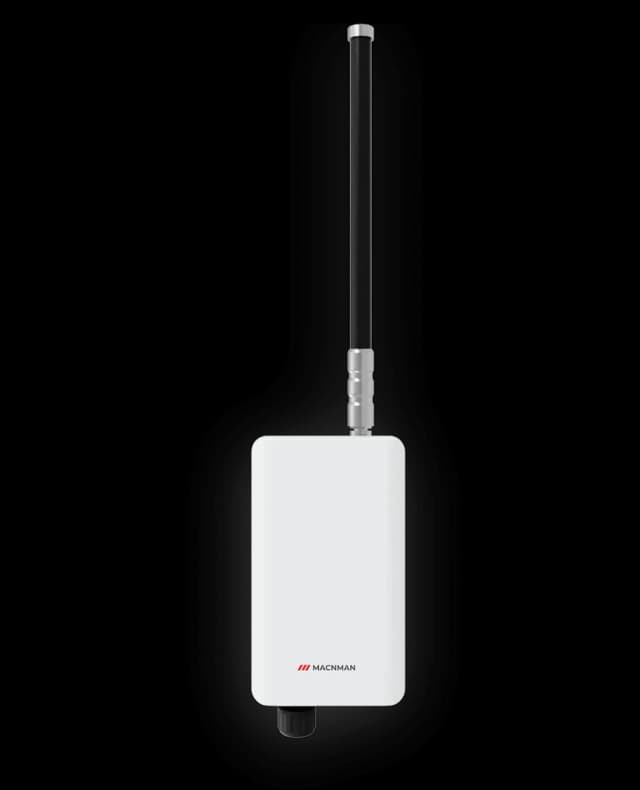
Maclink Gen-2
LoRaWAN Outdoor Gateways
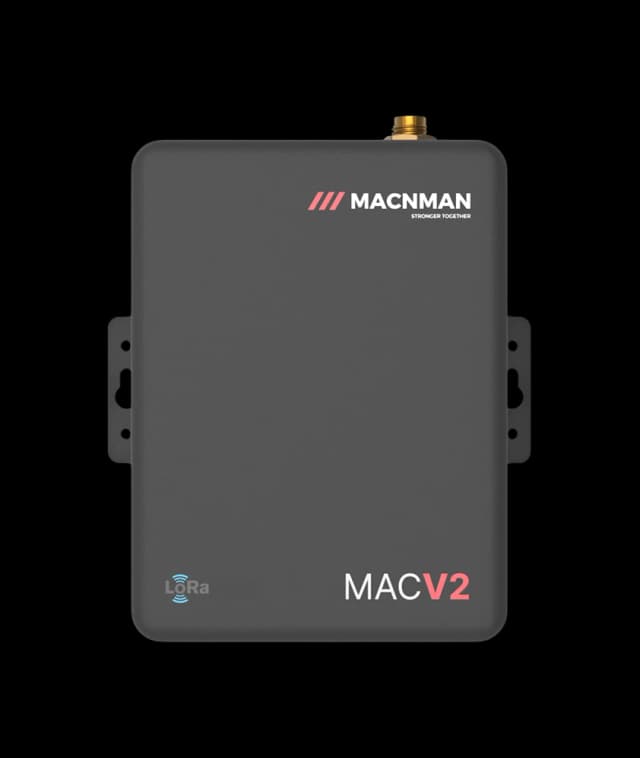
MacEge 4G Mini Gateway
4G Lte Gateways
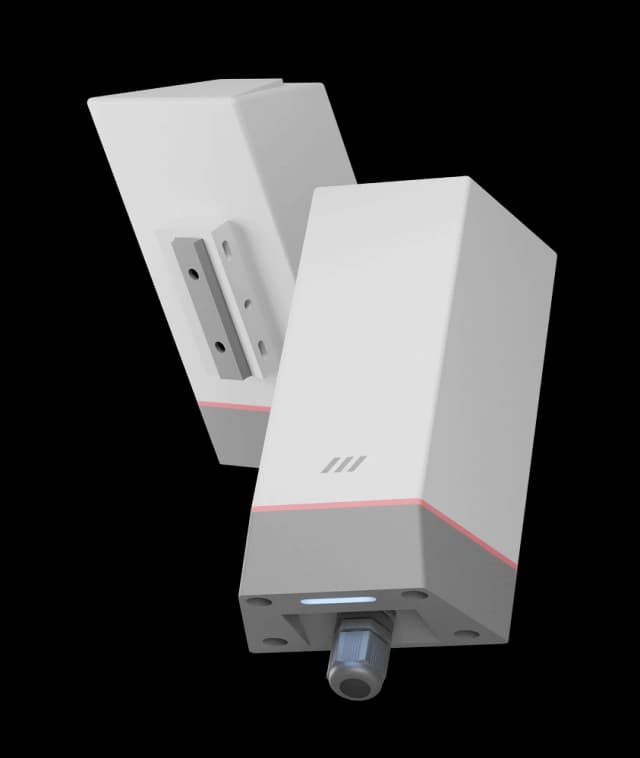 Hot Selling
MacSync LX1
RS485 Modbus to LoRaWAN Converter
MacSync LX1
Analog 4-20mA to LoRaWAN Converter
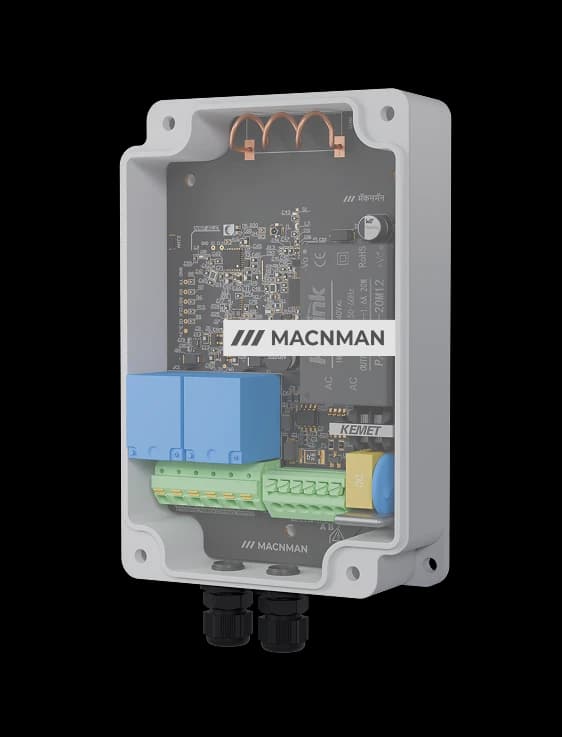 New
MacSet
RS485/Analog + Relay Output
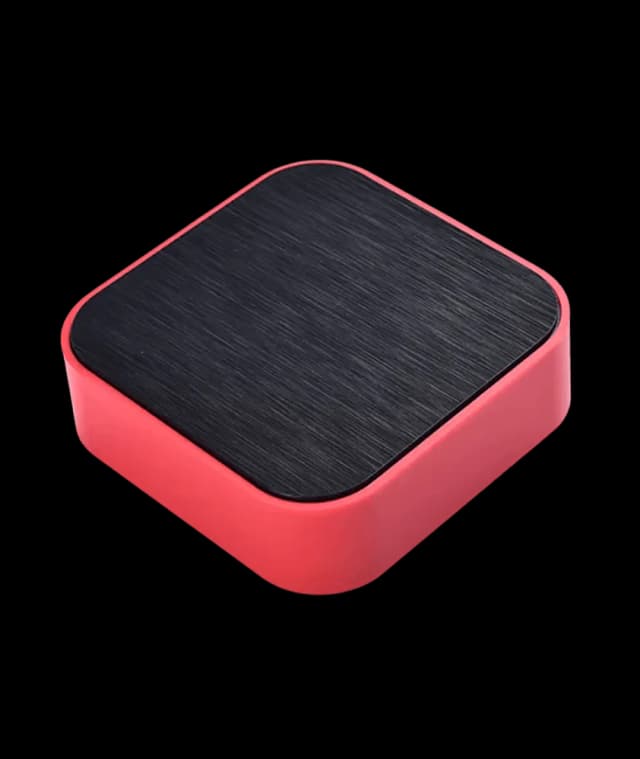 Hot Selling
Setu X
LoRaWAN Indoor Gateways
NewMaclink Gen-2
LoRaWAN Outdoor Gateways
MacEge 4G Mini Gateway
4G Lte Gateways
Hot SellingMacSync LX1
RS485 Modbus to LoRaWAN Converter
MacSync LX1
Analog 4-20mA to LoRaWAN Converter
NewMacSet
RS485/Analog + Relay Output
Hot SellingSetu X
LoRaWAN Indoor Gateways
Let‘s make it easy - reach out now!
Let’s bring it to life!
Let‘s Make it Easy
Reach Out Now


We are always ready
to help and
answer your
questions
Call
+91 7972856163
+91 9096830856
Location
Office-15 Bibwewadi, Pune, Maharashtra 411037
Get in Touch
Define your goals and all to value your time
Use of this website and purchase of Macnman products are subject to our Terms and Conditions.