LoRaWAN® Soil Moisture & Temperature Sensor
for Precision Irrigation, Greenhouses & Plantations

MacSync LSS X2 is an industrial LoRaWAN® soil moisture and temperature sensor that measures volumetric water content and temperature in the root zone, and reports them kilometres over LoRaWAN®
Smart Irrigation Built on Real Soil Data for Farms, Vineyards, Orchards & Greenhouses.
Smart Irrigation Built on Real Soil Data for
Farms, Vineyards, Orchards & Greenhouses.
MacSync LSS X2
Explore the highlights
Capacitive sensing measures 0–100% volumetric water content to ±3%, with 0.1% resolution and response in under 10 seconds.
A 19 Ah Li-SOCl₂ cell and ~100 µA sleep current deliver 7+ years at hourly uplinks — whole seasons without a site visit.
A 20 W panel with an 8000 mAh rechargeable battery lets you report as often as you like, indefinitely, in open sun.
Root-zone temperature from −40 °C to +80 °C at ±0.5 °C, alongside every moisture reading.
23 dBm transmit and −137 dBm sensitivity cover whole farms, plantations and orchards from a single gateway.
Clay, sandy, red and saline soils, cocopeat and greenhouse media — no exposed electrodes to corrode or drift.
Set moisture limits and the sensor uplinks the moment the root zone dries down or saturates.
Pair over BLE with Maya to set intervals, thresholds and bands — and reconfigure later over the air.
IP68 stainless steel probe on a 1 m cable, IP65 glass-filled nylon unit, −40 °C to +80 °C operation, pole or wall mount at ~175 g.
In plain terms
What Is a LoRaWAN Soil Moisture Sensor?
The short answer
A LoRaWAN soil moisture sensor is a battery-powered probe buried in the root zone that measures how much water the soil is holding — its volumetric water content, or VWC — and transmits those readings kilometres over a LoRaWAN® network to your dashboard or irrigation controller. One gateway can serve an entire farm, so a field can be instrumented without trenching, mains power, or cellular coverage at each point.
Probe
- 85 mm
Stainless steel probe length
- IP68
Probe rated for permanent burial
- 1 m
Standard cable, IP68 extender optional
Measurement
- 0–100%
Volumetric water content (VWC) range
- ±3%
Moisture accuracy from 0 to 53% VWC
- ±0.5 °C
Soil temperature accuracy
Sensing
- Capacitive
VWC-based sensing, no exposed electrodes
- 0.1%
Moisture resolution
- <10 s
Response time
Radio
- v1.0.4
LoRaWAN® version, Class A by default
- 7 bands
IN865, EU868, US915, AU915 and three more
- 23 dBm
Transmit power at 865 MHz
Platforms
- TTN
The Things Network and ChirpStack
- MQTT
Also Orbiwise and Netmore
- Private LNS
Your own LoRaWAN® network server
Power
- 19 Ah
Li-SOCl₂ battery
- 7+ years
Battery life at hourly uplinks
- 20 W
Solar option with 8000 mAh battery


MacSync LSS X2
The MacSync LSS X2 is the industrial version of that idea. It measures moisture by capacitive sensing and soil temperature from one buried stainless steel probe, and reads reliably in clay, sandy, red and saline soils as well as cocopeat and greenhouse media.
85 mm stainless steel, IP68 rated, supplied on a standard 1 metre cable.
Soil volumetric water content from 0 to 100% VWC, plus soil temperature from −40 °C to +80 °C.
Capacitive sensing — no exposed electrodes to corrode, and stable across soil types including saline ground.
LoRaWAN® v1.0.4, Class A by default, on IN865, EU868, US915, AU915, RU864, KR920 or AS923.
The Things Network, ChirpStack, MQTT, Orbiwise, Netmore, or your own private LoRaWAN server.
A 19 Ah Li-SOCl₂ battery for 7+ years at hourly uplinks, or a 20 W solar panel with an 8000 mAh rechargeable battery.
Used for precision irrigation, drip systems, greenhouses and polyhouses, vineyards, orchards, plantations and research farms.
Get a quote
Need a quote for the MacSync LSS X2?
Tell us how many you need and where they are going. A product engineer replies within one working day with availability, lead time and the right variant for your site.
- Reply within one working day
- Designed and built in Pune, India
- WPC compliant, RoHS conformant
Downloads
Everything You Need to Get Building
Datasheets, drawings, firmware, and tools — all in one place.
Product Datasheet
Full technical specifications
Engineered for
Built for the Realities of the Field
Clay, sandy, red and saline soils, cocopeat and greenhouse media — no exposed electrodes to corrode or drift.
01 / 04
Applications
What are the Applications of the LoRaWAN® Soil Moisture Sensor?

Precision Agriculture & Smart Farming
Real-time soil moisture and temperature monitoring for precision agriculture — irrigation scheduling and crop-health decisions based on the root zone, not the calendar.
Read case studiesSmart Irrigation Automation (Automated Valves, Threshold Alerts): Automate irrigation using live soil moisture data, cutting water consumption while keeping the root zone in its target band.
Drip Irrigation Monitoring (Emitter-Level Data, Root-Zone Depth): Monitor moisture across drip irrigation networks to confirm even distribution and catch blocked or over-running lines early.
Greenhouses & Polyhouses (Controlled Growing, Substrate Sensing): Continuous greenhouse soil and media monitoring for vegetables, herbs and flowers grown in cocopeat or soil beds under cover.
Vineyards & Orchards (Deficit Irrigation, Per-Block Zones): Track root-zone moisture in vineyards and orchards to steer deficit irrigation, fruit quality and harvest timing.
Plantations & Commercial Farming (Large Estates, One Gateway): Long-range LoRaWAN soil monitoring across tea, coffee, sugarcane, coconut and cotton estates — one gateway covers the block.
Research Farms & Soil Analysis (Hourly Logging, Any LNS): Long-term soil moisture and temperature datasets for agronomy trials, environmental studies and soil-behaviour research.
Landscape & Smart City Irrigation (Public Landscaping, Water Budgets): Automated watering for parks, campuses, golf courses and urban green zones — water only where the soil says it is needed.
Water Conservation Projects (Measured Savings, Usage Reporting): Evidence for water-saving and sustainable farming programmes, with season-long records of what each intervention actually saved.
Remote Agricultural Monitoring (20 W Solar, No Mains Power): Distributed farmland and remote plots monitored over long-range LoRaWAN, with multi-year battery or solar operation.
Browse all 10 applications
01 / 10
Works with
0-100% VWC Soil Moisture Measurement with ±3% Capacitive Accuracy
Long-Range LoRaWAN® Soil Sensor with Threshold-Based Irrigation AlertsLong-Range LoRaWAN® Soil Sensor with Threshold-Based Irrigation Alerts

Where it fits
From Drip Lines to Plantations, Wherever Roots Need Water
Open Fields & Row Crops
Probes in each irrigation zone report root-zone moisture over kilometres of LoRaWAN range, so scheduling follows the soil rather than a fixed rota.
Greenhouses & Polyhouses
Stable readings in cocopeat and growing media, with threshold alerts protecting high-value crops from both dry-down and over-watering.
Vineyards, Orchards & Plantations
Deficit irrigation steered by real root-zone data across tea, coffee, sugarcane, coconut and fruit estates — one gateway per block.
Why Macnman
How Deep Should a Soil Moisture Sensor Be Installed?
Most irrigation deployments place the probe in the active root zone — commonly around 15 cm deep and about 5 cm to the side of a drip emitter — with a second sensor deeper if you want to see water moving past the roots. Allow 10 to 14 days after installation for the soil to settle back around the probe before you trust the readings for scheduling.

Free planning tools
Size your deployment before you order the hardware
Free engineering calculators for coverage, range and battery life — built on measurements from our own deployments rather than textbook models, which is why the answers tend to be smaller and a good deal more useful. Nothing here quotes a range we have not actually achieved.
No sign-up, no email, nothing to install. More on the way for Wi-Fi and BLE.
Hardware
IP68 Stainless Steel Probe, IP65 Sensor Unit
The 85 mm stainless steel probe is IP68 rated for permanent burial, and the glass-filled nylon MacSync unit above ground is IP65. Both operate from −40 °C to +80 °C, and a standard 1 metre cable separates them — engineered to stay in the ground through irrigation cycles, monsoons and harvest.

Ready to irrigate on real soil data? MacSync makes it effortless.
At a glance
MacSync LSS X2 LoRaWAN Soil Sensor — Key Specifications
Every key specification in one view.
0-100%
VWC moisture range
±3% (0-53% VWC) capacitive sensing
±0.5 °C
soil temperature accuracy
-40 °C to +80 °C range
7+ yr
battery life
19 Ah Li-SOCl₂ @ 60-min uplinks
20 W
solar option
With 8000 mAh rechargeable battery
v1.0.4
LoRaWAN protocol
7 regional bands · Class A/C
IP68 / IP65
rugged enclosure
Buried probe / sensor unit
Features
Everything Built into One LoRaWAN Soil Sensor
Threshold Irrigation Alerts
Set moisture and temperature limits; the sensor uplinks the instant the root zone crosses one.
Fixed intervals, event-driven alerts, or both — sampling configurable from 1 minute to 24 hours.
0-100% VWC Capacitive Sensing
Volumetric water content across the full range to ±3% accuracy, with 0.1% resolution and sub-10-second response.
7+ Year Battery Life
A 19 Ah Li-SOCl₂ cell runs 7+ years at hourly uplinks — set and forget for whole seasons.
20 W Solar Variant
Solar panel with an 8000 mAh rechargeable battery for permanent installs that report as often as you like.
Soil Temperature to ±0.5 °C
Root-zone temperature alongside moisture, from −40 °C to +80 °C — useful for germination and frost risk.
Secure by Design
AES-128 LoRaWAN® encryption, OTAA activation, secure boot and signed OTA updates.
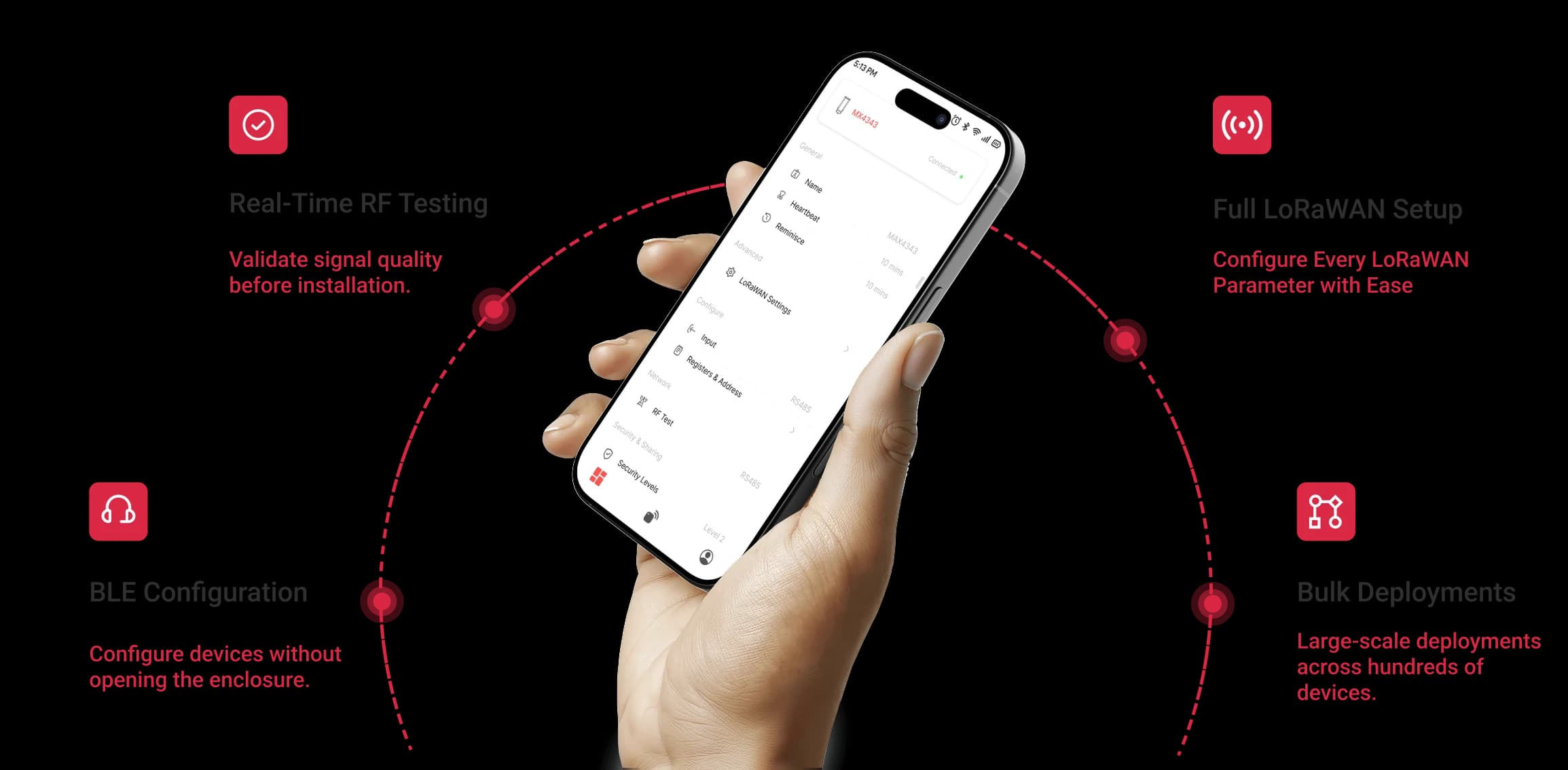
Macnman Maya App
Uplink interval, thresholds, diagnostics and over-the-air configuration from your phone.
Works with Every LoRaWAN® Network Server
TTN, ChirpStack, MQTT, Orbiwise, Netmore or a private LNS — no vendor lock-in.
Capabilities
Stable in Clay, Sand, Cocopeat and Saline Soil
Capacitive sensing has no exposed electrodes to corrode, so readings stay stable across clay, sandy and red soils, cocopeat and greenhouse media, and in saline ground where conductive probes drift. Response time is under 10 seconds.

Architecture
LoRaWAN® Soil Sensor Network Architecture

Outcomes
Irrigate on Data, Not on a Calendar.
Soil moisture readings are a trigger, not just a record — irrigation controllers, alerts and agronomy decisions all act on them in real time.
Outcomes
Soil moisture readings are a trigger, not just a record — irrigation controllers, alerts and agronomy decisions all act on them in real time.
Cut Water Use
Irrigate when the root zone actually needs it instead of on a fixed schedule — the same crop on measurably less water.
Prevent Over-Irrigation
Threshold alerts fire before saturation, protecting roots from waterlogging and stopping nutrients leaching past the root zone.
Automate Irrigation
Feed live VWC readings to your controller or platform so valves open on soil condition, not on a timer.
Prove What Worked
Season-long soil moisture and temperature history turns agronomy decisions into data you can review and repeat.
How it works
How Does a LoRaWAN® Soil Moisture Sensor Work?
Step 1 of 5
Place the probe in the root zone
Auger a hole, insert the probe at root-zone depth, and backfill so the soil sits firmly against it — no trenching and no power run.
Pair over BLE with Maya
Set the uplink interval, sampling rate and moisture thresholds from your phone — no laptop, no field engineer.
It reads VWC and soil temperature
Capacitive sensing measures volumetric water content to ±3% and soil temperature to ±0.5 °C, responding in under 10 seconds.
Readings travel kilometres over LoRaWAN®
One gateway covers a whole farm. Periodic uplinks plus instant threshold alerts reach your network server on their own schedule.
Act on the root zone, not the calendar
Dashboards, alerts and irrigation controllers respond to what the soil is actually doing — all season, unattended.
Reporting modes
Three Reporting Modes for Every Irrigation Strategy
Fixed-interval uplinks you set from 1 minute to 24 hours. Hourly suits most field irrigation and is what delivers 7+ years of battery life.
Note: Shorter intervals shorten battery life — 5-minute reporting gives roughly 2 years.
Set soil moisture and temperature thresholds; the sensor transmits the moment the root zone crosses one, so dry-down or saturation is flagged immediately. Note: Useful for frost-risk alerts as well as irrigation triggers.
Steady periodic readings for the season-long record, plus instant threshold alerts when conditions demand attention — the setup most irrigation deployments run. Note: Sampling continues between uplinks regardless of the mode you choose.
Cloud & LNS
Works with Every LoRaWAN® Network Server You Already Run
TTN, ChirpStack, MQTT, Orbiwise & Private LNS — No Vendor Lock-In
MacSync LSS X2 soil sensors join any LoRaWAN® network server — The Things Network, ChirpStack, MQTT platforms, Orbiwise, Netmore, or your own private gateway — with AES-128 encryption end to end and no vendor lock-in.

Device-to-device
Monitor Smarter with Macnman
Why Choose the Macnman LoRaWAN® Soil Moisture Sensor
Accurate climate sensing, tool-free installation, and years of maintenance-free battery life — in one rugged wireless node.

Plug & Play
Truly plug & play — no complex setup.
Real-Time Alerts
Instant threshold alerts the moment conditions drift.
Long-Range
Long-range coverage for hard- to-reach places.
RF performance
Stable Readings Across Clay, Sand and Saline Soils
Capacitive sensing measures the soil's dielectric response rather than its conductivity, so readings stay consistent in heavy clay, free-draining sand, cocopeat and fertigated ground where resistive probes drift as salts build up. The optimized internal antenna holds the LoRaWAN® link through dense canopy, polyhouse structures and pump-house interference.
Capabilities
Real-Time Soil Moisture Monitoring over LoRaWAN®
Threshold Alerts, Event-Based Uplinks and Season-Long Records
Installation
Wireless Soil Sensor Installation, No Trenching Required
The MacSync LSS X2 goes in with an auger and a mounting clip — the probe sits in the root zone and the radio unit mounts on a pole or wall. With no cabling, mains power or civil work a block can be instrumented in an afternoon.
The MacSync LSS X2 goes in with an auger and a mounting clip — the probe sits in the root zone and the radio unit mounts on a pole or wall. With no cabling, mains power or civil work — a block can be instrumented in an afternoon.
Choosing a soil sensor
Solar vs Battery Soil Moisture Sensor — Which Should You Deploy?
All three variants share the same 85 mm stainless steel IP68 probe, the same accuracy and the same LoRaWAN® radio. The difference is how they are powered, and that decides where each one belongs.
| Criterion | Solar (SS) | Battery (BS) | BLE variant |
|---|---|---|---|
| Probe | 85 mm stainless steel, IP68, 1 m cable | 85 mm stainless steel, IP68, 1 m cable | 85 mm stainless steel, IP68, 1 m cable |
| Power source | 20 W panel + 8000 mAh rechargeable | 19 Ah Li-SOCl₂ cell | 19 Ah Li-SOCl₂ cell |
| Service interval | Effectively none in open sun | 7+ years @ hourly uplinks | 7+ years @ hourly uplinks |
| Best reporting rate | Frequent — minutes if you want it | Hourly, to protect battery life | Local reads on demand |
| Connectivity | LoRaWAN® to any network server | LoRaWAN® to any network server | BLE to the Maya app only |
| Best for | Open fields, plantations, permanent installs | Shaded plots, greenhouses, quick rollouts | Commissioning, spot checks, trials |
| Mounting | Pole mount with panel | Pole or wall mount | Pole or wall mount |
Battery estimates assume the stated uplink interval; frequent reporting shortens them — roughly 2 years at 5-minute uplinks.
Installation
In the ground in minutes, reporting for years.
Auger the hole
Open a hole at root-zone depth — around 15 cm for most row crops, deeper for tree crops — sized to take the 85 mm probe.
Insert and backfill
Seat the full 85 mm of the stainless steel probe against undisturbed soil and backfill firmly so there are no air gaps around it.
Pair with Maya over BLE
Set the uplink interval, sampling rate and moisture thresholds from your phone.
Let it settle, then schedule
Readings stabilise as the soil re-consolidates — allow 10 to 14 days before driving irrigation decisions from them.
Range & reliability
Long-Range LoRaWAN® Coverage Across the Whole Farm
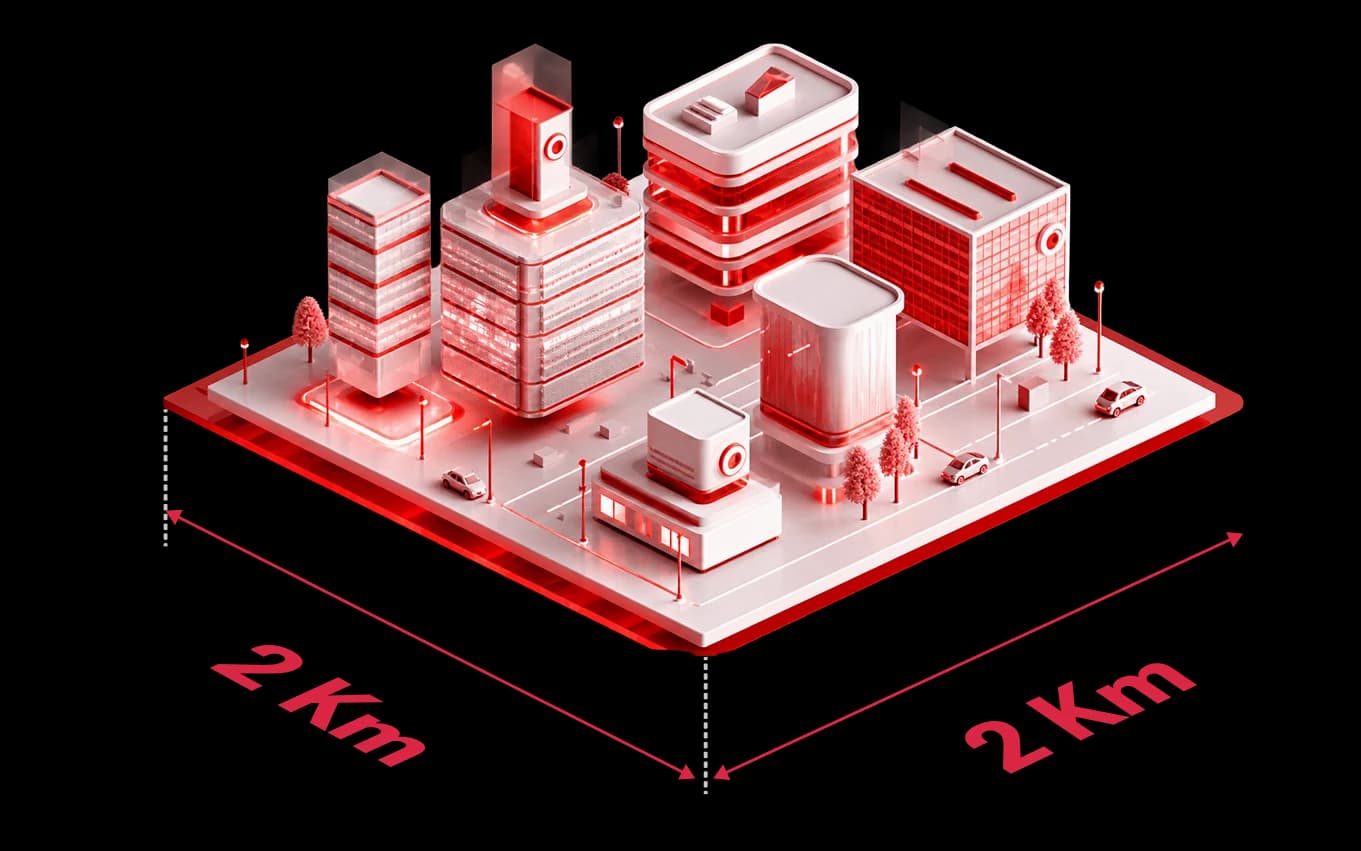
Reliable communication up to 15 km line-of-sight range for large sites and campuses
One gateway reaches sensors spread across fields, plantations and orchards — kilometres of range at 23 dBm with −137 dBm sensitivity, so a single installation covers ground that would need dozens of Wi-Fi access points or SIM cards.
FAQ
Frequently asked questions
Place the probe in the active root zone — commonly around 15 cm deep for row crops and about 5 cm to the side of a drip emitter, deeper for tree crops. Many growers add a second sensor below the root zone to see whether water is draining past the roots. Allow 10 to 14 days after installation for the soil to re-consolidate around the probe before using the readings to schedule irrigation.
The MacSync LSS X2 probe is 85 mm long and machined from stainless steel, rated IP68 for permanent burial. It connects to the sensor unit on a standard 1 metre cable, so the probe sits in the root zone while the radio and battery stay above ground; longer IP68 cable extenders are available for deeper placements. Seat the full 85 mm against undisturbed soil and backfill firmly so no air gaps remain around it.
VWC is the proportion of a soil volume that is water — 25% VWC means a quarter of that soil volume is water. It is the measurement irrigation scheduling actually uses, because it tells you how much water is available to the roots. The MacSync LSS X2 measures 0–100% VWC to ±3% accuracy between 0 and 53% VWC.
The MacSync LSS X2 runs 7+ years on its 19 Ah Li-SOCl₂ cell at hourly reporting, about 4 years at 15-minute reporting, and roughly 2 years at 5-minute reporting. For sites that need frequent readings indefinitely, the solar variant pairs a 20 W panel with an 8000 mAh rechargeable battery.
Yes. It uses capacitive sensing with no exposed electrodes, so it stays stable in clay, sandy and red soils, in cocopeat and greenhouse media, and in saline ground where conductive probes tend to drift or corrode.
Yes — LoRaWAN sensors report through a gateway, but you only need one for a very large area. A single gateway typically covers an entire farm, plantation or orchard, and Macnman supplies both indoor and outdoor LoRaWAN gateways if you do not already have coverage.
It works with The Things Network (TTN), ChirpStack, MQTT platforms, Orbiwise, Netmore and private on-premise LoRaWAN servers. It supports LoRaWAN® v1.0.4, Class A by default with Class C configurable, OTAA activation and AES-128 encryption.
Soil temperature is measured to ±0.5 °C across a −40 °C to +80 °C range, with response in under 10 seconds — accurate enough for germination windows, frost-risk alerts and root-zone temperature studies.
Yes. Configure soil moisture and temperature thresholds in the Maya app and the sensor sends an immediate uplink when the root zone crosses one. Your platform or irrigation controller acts on that event, so valves open on soil condition rather than on a timer.
It depends on how uniform the field is. A common starting point is one sensor per irrigation zone or management block, placed in a representative spot, with additional sensors where soil type, slope or crop stage differ. Because one gateway serves many sensors, adding more points costs only the sensor.
Pair over Bluetooth with the free Macnman Maya Android app to set uplink interval, sampling rate, reporting mode and thresholds — no laptop needed. Devices already in the field can be reconfigured over the air with downlink commands, and firmware updates are signed.
Yes. It performs in cocopeat and other growing media as well as field soil, and the battery variant suits covered structures where a solar panel would see little light. Threshold alerts are commonly used to protect high-value crops from both dry-down and over-watering.
Five: solar-powered and battery-powered versions on LoRaWAN® (SKUs 8805 and 8806), the same two on Macnman's MacTalk device-to-device protocol (8807 and 8808), and a BLE variant for local monitoring and commissioning (8809).
More from Macnman
What Else Do We Build at Macnman
 New
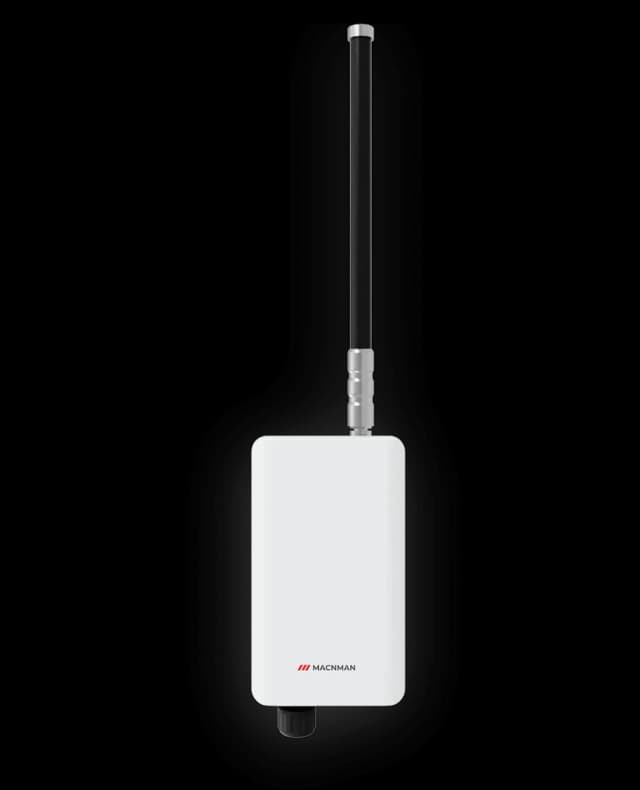
Maclink Gen-2
LoRaWAN Outdoor Gateways
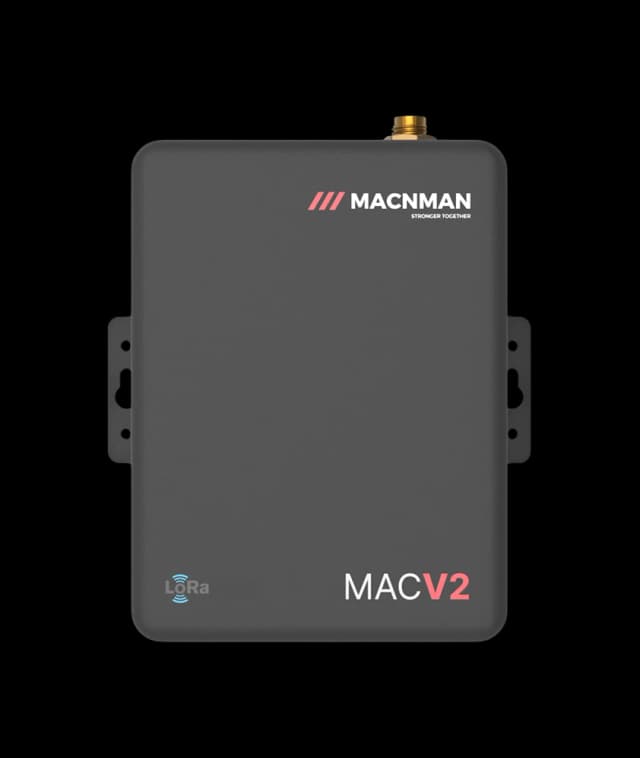
MacEge 4G Mini Gateway
4G Lte Gateways
 Hot Selling
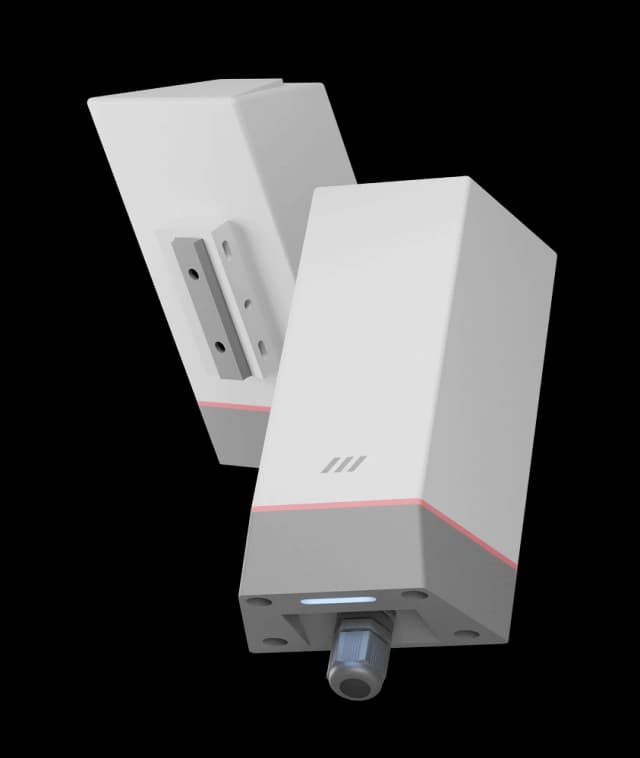
MacSync LX1
RS485 to LoRaWAN Dataloggers
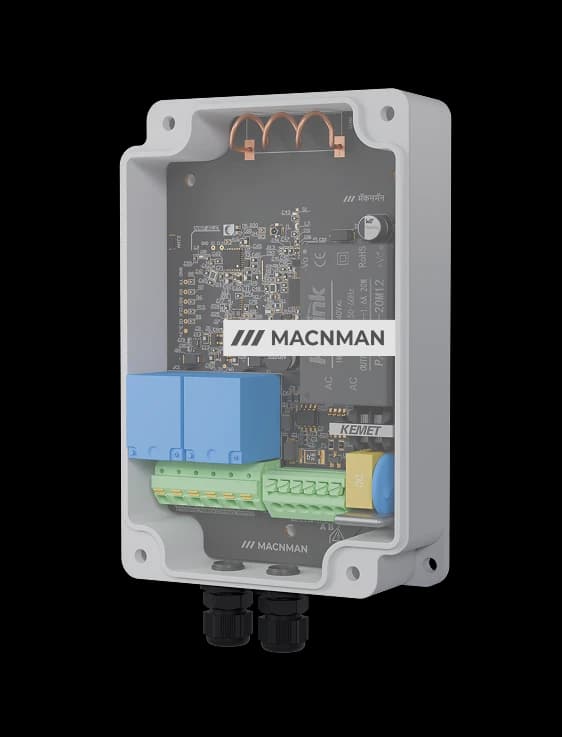 New
MacSet
RS485/Analog + Relay Output
 Hot Selling
Setu X
LoRaWAN Indoor Gateways
NewMaclink Gen-2
LoRaWAN Outdoor Gateways
MacEge 4G Mini Gateway
4G Lte Gateways
Hot SellingMacSync LX1
RS485 to LoRaWAN Dataloggers
NewMacSet
RS485/Analog + Relay Output
Hot SellingSetu X
LoRaWAN Indoor Gateways
Let‘s make it easy - reach out now!
Let’s bring it to life!
Let‘s Make it Easy
Reach Out Now


We are always ready
to help and
answer your
questions
Call
+91 7972856163
+91 9096830856
Location
Office-15 Bibwewadi, Pune, Maharashtra 411037
Get in Touch
Define your goals and all to value your time
Use of this website and purchase of Macnman products are subject to our Terms and Conditions.