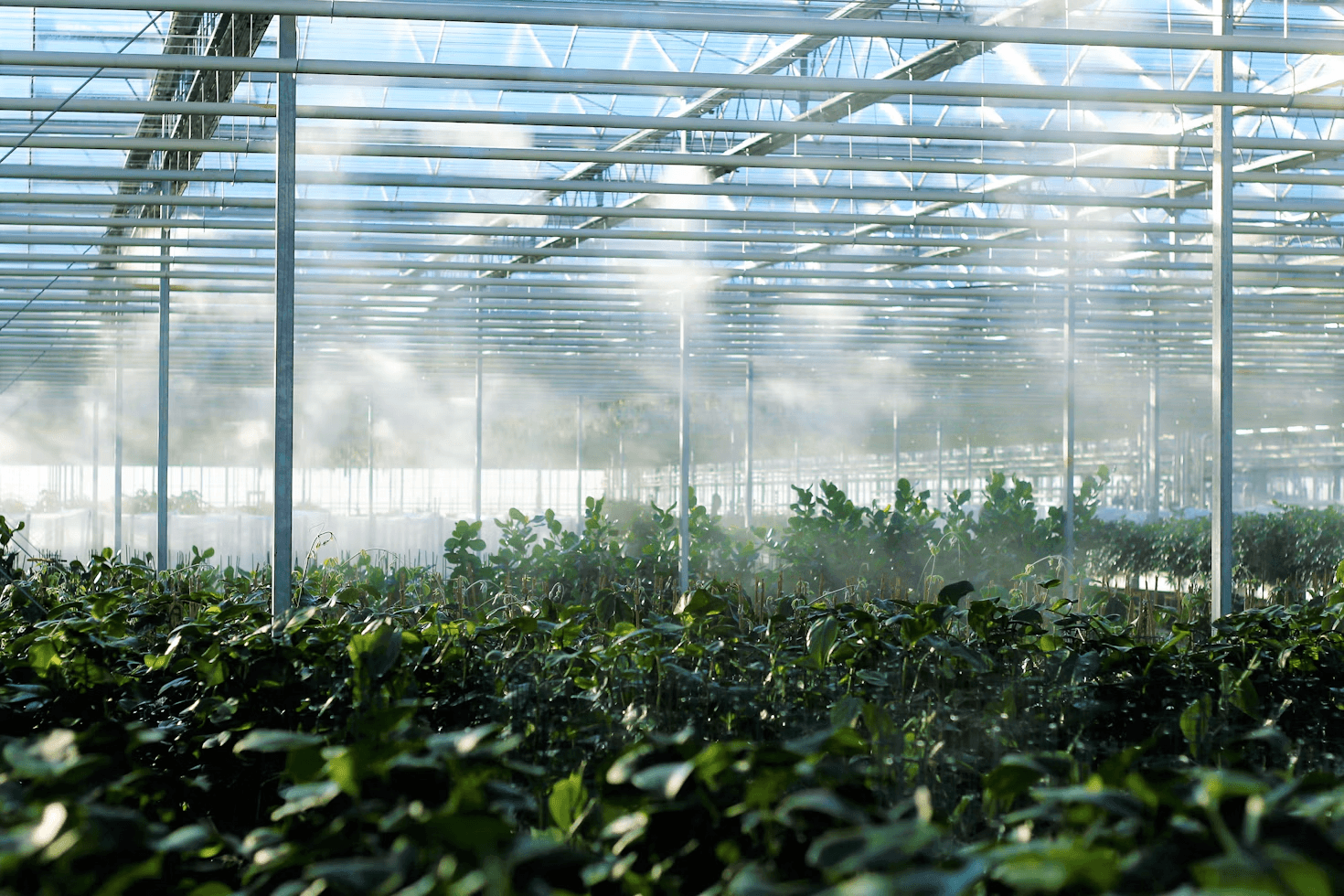
Polyhouse and Farm Monitoring with LoRaWAN: Microclimate, Soil Moisture and Irrigation, Parameter by Parameter
Short Answer
A LoRaWAN monitoring system for a polyhouse or a drip-irrigated farm measures four things: the air the crop grows in (temperature, humidity and the vapour pressure deficit they produce), the water in the root zone (soil or substrate moisture), the nutrient status of the water (EC and pH), and the weather outside (rain, wind, temperature) that drives irrigation demand. Battery or solar sensors report over kilometres to one gateway at the packhouse, with no Wi-Fi and no SIM per sensor, which is why LoRaWAN fits farms where nothing else does.
| What to measure | Why it matters | Sensor | Act when |
|---|---|---|---|
| Air temperature and humidity → VPD | Decides transpiration, disease risk and fogger/vent timing | Temperature and humidity sensor at canopy height | VPD leaves the 0.8–1.2 kPa band |
| Soil or substrate moisture (VWC) | Decides when and how much to irrigate | Soil moisture and temperature probe in the root zone | Moisture falls to the refill point for the crop and soil |
| EC and pH | Salt build-up and nutrient availability in fertigation | Soil EC/pH or multi-parameter probe | EC drifts above the crop’s limit; pH leaves 5.5–6.5 |
| Rain, wind, outside temperature | Skip or shorten irrigation; spray and venting decisions; heat and cold alerts | Weather station | Rain recorded; wind over spray limit; night temperature falls |
| Tank level and pump run | Water availability and pump hours | Ultrasonic level sensor, energy meter via RS485 | Tank below reserve; pump running outside schedule |
The rest of this guide takes each parameter in turn, then covers network design, power, existing equipment, and starter kits by farm type.
Why Farms Are Where LoRaWAN Fits Best
Fields and polyhouses have no Wi-Fi, patchy 4G, no mains at the sensor, and dozens of points spread over hectares. LoRaWAN was designed for exactly that.
- Range. A gateway on a mast at the packhouse reaches sensors kilometres away across open land; see How Far Can a LoRaWAN Sensor Transmit?
- Power. Battery sensors run for years; solar variants run indefinitely. No cabling to the field.
- Cost per point. One gateway serves hundreds of sensors, and there’s no SIM or subscription per device, which is what makes a sensor every half-acre affordable.
- Independence. The gateway needs backhaul (a 4G SIM where there’s no broadband); the sensors need nothing. A gateway with a built-in network server keeps logging and alarming when the internet drops.
For the comparison with Wi-Fi and cellular sensors, see LoRaWAN vs 4G vs NB-IoT vs BLE and Do I Need a Gateway for LoRa?
Polyhouse Microclimate: Temperature, Humidity and VPD
The number that matters inside a polyhouse is not temperature or humidity on its own but the vapour pressure deficit (VPD) they produce together. VPD is the drying power of the air: how much more water vapour the air could hold at its current temperature. It decides how fast the crop transpires, whether stomata stay open, and whether fungal spores find a wet leaf.
| VPD (kPa) | What it means | Typical response |
|---|---|---|
| Below 0.4 | Air nearly saturated; leaves stay wet; disease risk (botrytis, downy mildew); poor transpiration and calcium uptake | Vent, run fans, stop foggers |
| 0.4–0.8 | Low stress; good for propagation and young plants | Normal |
| 0.8–1.2 | Target band for most fruiting and flowering crops | Normal |
| 1.2–1.6 | Plants transpire hard; stomata start closing in heat | Fog or mist, shade, increase irrigation frequency |
| Above 1.6 | Stress; flower drop, tip burn, reduced fruit set | Fog, shade nets, reduce vent heat load |
VPD is calculated from temperature and relative humidity (saturation vapour pressure at the leaf, minus actual vapour pressure of the air). At 28 °C and 70% RH, VPD is about 1.1 kPa, inside the target band; at 34 °C and 50% RH it’s about 2.7 kPa, well into stress. Most platforms can compute it from the sensor’s two readings, and Macnman’s decoders expose temperature and humidity so the calculation is a one-line formula in the dashboard.
Placement. A naturally ventilated polyhouse has a gradient from the shaded, humid centre to the hot edges and roof; a fan-and-pad house has a gradient from the cool pad wall to the hot fan wall. One sensor at the centre tells you the average, not the risk. For a 1,000–4,000 m² house, use two to four sensors at canopy height (not at the roof), shielded from direct sun, including one near the hottest end and one in the densest canopy. Outside, add one sensor in a radiation shield as the ambient reference.
The MacSync LTS X1 is rated for this environment (±0.3 °C, ±3% RH, IP65/67, 100% RH non-condensing), with threshold triggers so a VPD excursion raises an alarm rather than waiting for the next heartbeat. Add a CO₂ sensor in closed houses where CO₂ depletes below ambient on bright mornings and limits growth.
Soil and Substrate Moisture: When and How Much to Irrigate
A soil moisture sensor reports volumetric water content (VWC), the percentage of the soil’s volume that is water. Irrigation decisions come from where that number sits between field capacity and the refill point.
- Field capacity is the moisture the soil holds after drainage: roughly 20% VWC in a sandy loam, 30–35% in a clay loam, and 40–60% in cocopeat or other substrates.
- Permanent wilting point is where the crop can no longer extract water: roughly 8% in sandy loam, 15–20% in clay loam.
- The refill point is where you irrigate, usually when about half the available water between those two is used. For a sandy loam that’s around 14%; for a clay loam around 25–27%. Substrate crops run much tighter, often irrigating on a 5–10% drop.
Those are starting points. Every soil is different, so calibrate once: irrigate to saturation, log the drainage curve for two days, and read field capacity off it. Then set the refill threshold and let the sensor tell you when the root zone reaches it.
Placement. Put the probe in the active root zone, 15–20 cm deep for vegetables and 30–40 cm for orchards, between emitters and a third of the way along the lateral, in a representative (not the wettest) spot. A second probe at double the depth shows whether water is draining past the roots, which is the most common waste on drip. In grow bags, place the probe mid-bag between the dripper and the drain hole.
Sensor choice. Capacitive probes are the right technology for continuous use; cheap resistive probes corrode in weeks. The MacSync LSS X2 soil moisture and temperature sensor reads 0–100% VWC (±3% up to 53%, ±5% above) and soil temperature to ±0.5 °C with a corrosion-resistant probe, in battery (about 4 years at 15-minute reporting) and solar variants, with thresholds for moisture and temperature.
Soil temperature is worth having on the same probe: germination, root growth and nutrient uptake all slow when the root zone is cold, and soil above 35 °C under black mulch in May stresses roots regardless of moisture.
EC and pH: Keeping Fertigation Honest
In cocopeat and soilless systems, salts accumulate and pH drifts, and neither shows until the crop does. An EC and pH probe in the substrate or drain water turns a weekly hand-meter check into a continuous trend.
- EC (electrical conductivity) tracks total dissolved salts. Each crop has a range it tolerates; capsicum and tomato in cocopeat typically run 2–3.5 mS/cm (2,000–3,500 µS/cm) in the root zone, with leafy crops lower. Rising root-zone EC with constant feed EC means salts are building up and a flushing irrigation is due.
- pH controls nutrient availability. Most crops want 5.5–6.5 in the root zone; outside that band, iron, phosphorus and manganese lock up even though they’re in the feed.
- NPK sensors estimate nutrient trends from conductivity-type measurements. They are useful for spotting a change, not for replacing a soil test. Treat them as trend indicators and calibrate decisions against lab analysis.
The MacSync LSS X5 multi-parameter soil sensor combines moisture, temperature, EC (0–10,000 µS/cm), pH (3–9) and NPK trend in one stainless-steel probe; dedicated EC and pH sensors are available where only one is needed.
Weather: The Outside Drives the Inside
A weather station on the farm turns irrigation scheduling from a calendar into a calculation, and gives the alerts a phone forecast can’t.
- Rain recorded at the farm (not at the district station 30 km away) lets the controller skip or shorten the next irrigation.
- Temperature, humidity, wind and solar input feed reference evapotranspiration (ETo), the basis of crop-coefficient irrigation scheduling. Even without a full ETo calculation, hot, dry, windy afternoons mean higher demand, and the station shows them.
- Wind above about 3 m/s wastes spray; the station tells the operator when to stop.
- Night temperature gives frost warnings for fruit in the north and heat-stress warnings for flowering in May, with time to act.
The MacSync LWS X2 6-in-1 weather station reports rainfall (optical, 0–200 mm/h), wind speed and direction, temperature, humidity and pressure over LoRaWAN, solar-powered with a 20 W panel. One station per farm is usually enough; large or hilly farms benefit from a rain sensor per block.
Water and Pumps
Irrigation fails quietly: a tank runs dry, a pump trips, a valve sticks. Two sensors make it visible.
- An ultrasonic level sensor on the storage tank or sump reports level and alarms below reserve.
- An energy meter or pump controller connected through an RS485 to LoRaWAN converter reports run hours, current and trips, so a stuck valve or a dry run shows up the same day, not at the electricity bill.
From Readings to Actions
Monitoring pays when a reading changes what someone does. Configure the system so it does.
- Set thresholds in the sensors (moisture refill point, VPD limits, EC ceiling, tank reserve) so alarms arrive immediately, independent of the reporting interval. See How to Configure a LoRaWAN Sensor.
- Route alarms to the people who act: the supervisor’s phone for VPD and moisture, the pump operator for tank and pump alerts.
- Automate where the rule is simple. A soil-moisture-triggered valve or a VPD-triggered fogger is a two-line rule; LoRaWAN Class C controllers with relay outputs can close that loop, with the sensor thresholds as inputs. Keep a manual override, and start with alerts for a season before automating.
- Review the trends weekly. The drainage curve, the VPD daily cycle and the EC drift tell you more about the house than any single alarm.
For the latency between a change and an alert, see Why Is My LoRaWAN Temperature Sensor Slow to Update?
Network Design for a Farm
One outdoor gateway on a mast usually covers a farm of a few square kilometres; the polyhouses themselves are the only coverage question.
- Gateway placement. At the packhouse or pump house, where there is power and either broadband or a 4G signal, on a 10–15 m mast. Open-terrain range from a mast reaches 5–8 km; see the range guide for planning figures.
- Polyhouses. Plastic film and shade net barely attenuate 865 MHz; steel frames and wet foliage do more. A sensor inside a polyhouse 1 km from the gateway normally works; test the far corner of the furthest house during a wet week before finalising.
- Soil sensors. The transmitter sits above ground on a stake, with the probe cable to the root zone; don’t bury the transmitter.
- Backhaul. A 4G SIM at the gateway where there’s no broadband; a second SIM from another operator where coverage is marginal. A gateway with a built-in network server keeps alarms running on site when the link drops; see What Happens When a LoRaWAN Gateway Goes Offline?
- Power at the gateway. Solar plus battery for a remote pump house; the gateway draws around 4.5 W.
The MacLink Gen-2 outdoor gateway carries Ethernet, Wi-Fi and dual-SIM 4G with a built-in ChirpStack server, which is the usual farm choice. Placement detail is in the gateway and sensor placement guide.
Bringing Existing Equipment In
Many farms already own RS485 instruments: Modbus soil probes bought with a fertigation controller, a wired weather station, a flow meter, a pump panel with an energy meter. None of them have to be replaced.
An RS485 to LoRaWAN converter polls the instrument over Modbus and sends the registers as a LoRaWAN uplink, so the existing probe joins the same dashboard as the new sensors. Typical cases:
| Existing device | Converter setting | What you get |
|---|---|---|
| Modbus soil probe at the fertigation head | Poll holding registers every 15 min | Root-zone data without re-trenching |
| Wired weather station | Poll the station’s register map hourly | Weather on the same platform |
| Flow meter with RS485 output | Poll totaliser register | Litres per block per irrigation |
| Pump energy meter | Poll kWh, current, voltage | Run hours, dry-run detection, cost per block |
| Fertigation controller | Poll status registers; downlink set-points (Class C) | Remote visibility and adjustment |
The converter needs DC power (usually available at the controller or panel) and a register map from the instrument’s manual. The step-by-step is in Modernise Legacy Equipment with RS485 to LoRaWAN.
Power: Battery or Solar?
Battery for sensors you’ll move; solar for sensors that stay.
- Battery variants (19 Ah Li-SOCl₂) run about 2 years at 5-minute reporting, 4 years at 15 minutes and 7+ at hourly. For soil moisture, 15–30 minutes is plenty, so a probe lasts several seasons and can be moved between blocks. Battery figures and the heat effect are in How Long Do LoRaWAN Sensor Batteries Last?
- Solar variants (20 W panel, 8,000 mAh battery) suit weather stations, tank sensors and anything reporting every few minutes. Mount the panel clear of shade net and wipe it during the dust months; the battery carries the sensor through overcast monsoon weeks.
Starter Configurations by Farm Type
| Farm | Sensors | Gateway | Reporting |
|---|---|---|---|
| One 1-acre polyhouse (capsicum, cucumber, gerbera) | 3 × temperature/humidity at canopy height; 2 × soil moisture (two depths or two zones); 1 × EC/pH in substrate; 1 × outdoor reference | Indoor gateway at the packhouse if within ~500 m; outdoor otherwise | T&H 5 min with VPD triggers; soil 15 min with refill triggers |
| Polyhouse cluster (5–10 houses) | 2 × T&H per house; 1 × soil per house; 1 × weather station; tank level | Outdoor gateway on a mast | As above; weather hourly |
| 10–50-acre open-field drip (vegetables, cotton, sugarcane) | 1 × soil moisture per irrigation block, two depths on the largest; 1 × weather station; tank level; pump meter via RS485 | Outdoor gateway at the pump house, solar + 4G | Soil 30 min; weather hourly; pump 5 min |
| Orchard (grapes, pomegranate, citrus) | Soil moisture at 30–40 cm per block; T&H in the canopy for disease models; weather station with rain | Outdoor gateway | Soil 30–60 min; T&H 15 min |
| FPO or cluster of small farms | One soil and one T&H sensor per member farm; one shared weather station | One outdoor gateway covering the cluster, or one per village | 30–60 min |
Mistakes We See
One sensor in the middle of the polyhouse. It reads the average and misses the hot end where the crop drops flowers.
Soil probe at the dripper. It reads saturated after every irrigation and never reaches the refill point. Place it between emitters.
Trusting factory VWC thresholds. Calibrate to your soil with one drainage curve; the refill point for cocopeat is nothing like the one for black cotton soil.
Treating NPK readings as a soil test. They show trends. Use them to decide when to send a sample, not what to apply.
Buried transmitters. The probe goes in the ground; the radio stays above it on a stake.
Burying the gateway in the office. It belongs on a mast with a clear view of the fields, with a UPS.
Measure the Crop’s Environment, Not the Calendar
Macnman designs and manufactures LoRaWAN agriculture sensors in India for the IN865 band, built for the sites described here: the soil moisture and temperature sensor, EC, pH and multi-parameter soil sensors, the 6-in-1 weather station, the MacSync LTS X1 temperature and humidity sensor, the ultrasonic level sensor, the RS485 to LoRaWAN converter for existing instruments, and outdoor gateways with solar and 4G options. For the cold-store end of horticulture, see our floriculture cold storage case study.
Planning a polyhouse or a drip block? Send us the layout, the crop and where the power and signal are, and a product engineer will come back within one working day with a sensor count, placement plan and gateway position: contact Macnman. To prove coverage and calibrate your soil before scaling, start with a pilot kit.
Frequently Asked Questions
What should a polyhouse monitoring system measure?
Air temperature and humidity at canopy height (to calculate VPD), root-zone or substrate moisture, EC and pH in fertigated crops, and outside weather. CO₂ is worth adding in closed houses, and tank level and pump status catch irrigation failures.
What is VPD and why does it matter in a greenhouse?
Vapour pressure deficit is the drying power of the air, calculated from temperature and humidity. It controls transpiration, nutrient uptake and disease risk. Most fruiting crops do best around 0.8–1.2 kPa; below 0.4 kPa leaves stay wet and fungal disease rises; above 1.6 kPa plants are stressed.
What soil moisture level should trigger irrigation?
The refill point, usually when about half the available water between field capacity and wilting point is used: roughly 14% VWC in sandy loam, 25–27% in clay loam, and a 5–10% drop from saturation in cocopeat. Calibrate to your soil with one drainage curve rather than relying on generic figures.
How deep should a soil moisture sensor be placed?
In the active root zone: 15–20 cm for vegetables, 30–40 cm for orchards, between emitters rather than at the dripper. A second probe at double the depth shows whether water is draining past the roots.
Can LoRaWAN sensors work on a farm with no internet?
Yes. The sensors need no internet at all; only the gateway needs backhaul, typically a 4G SIM. A gateway with a built-in network server keeps logging and alarming on site when the link drops, and the cloud catches up later.
How far can a LoRaWAN soil sensor transmit?
Over open land, several kilometres to a gateway on a mast; plan on 3–5 km for reliable coverage and test the furthest corner. Polyhouse film barely affects the signal; steel frames and wet foliage reduce it.
Are NPK sensors accurate?
They indicate trends from conductivity-type measurements and are useful for spotting change. They don’t replace a laboratory soil test; use them to decide when to sample.
Should I choose battery or solar sensors?
Battery for probes you’ll move between blocks and for 15–60-minute reporting; solar for weather stations, tank sensors and anything reporting every few minutes that stays in place.
Can I connect my existing Modbus soil probes or weather station?
Yes. An RS485 to LoRaWAN converter polls the instrument’s Modbus registers and sends them over LoRaWAN, so existing probes, flow meters and pump energy meters appear on the same dashboard as new sensors.
Can the system control irrigation automatically?
Yes, with LoRaWAN Class C controllers driving valves or foggers from sensor thresholds. Run the system as alerts for a season first, calibrate the thresholds, then automate the simple rules with a manual override.





