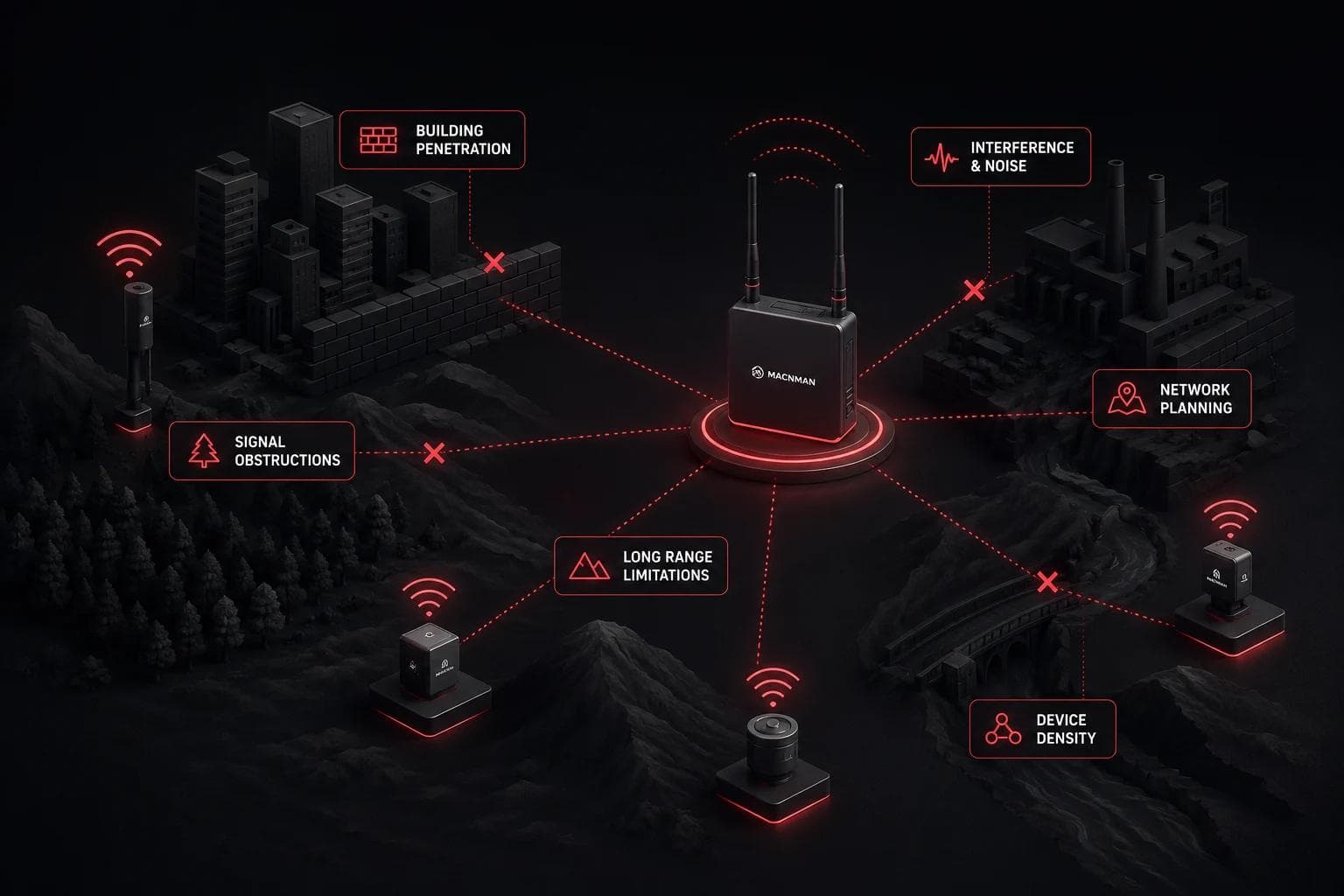
The Real Challenges of Deploying a LoRaWAN Network (and How to Design Around Them)
LoRaWAN is one of the easiest low-power wide-area networks to start with and one of the easiest to underestimate. A single gateway can cover several kilometres and serve hundreds of devices, which makes a pilot look effortless. The problems arrive later — at scale, indoors, in dense RF environments, or when the finance team asks what the network actually costs to own.
This guide walks through the real challenges in deploying a LoRaWAN network: not a textbook list of pros and cons, but the constraints that bite in the field, why each one exists at an architectural level, and how to design around it. If you're still choosing between protocols, start with our LoRaWAN vs NB-IoT vs LTE-M vs BLE vs Wi-Fi comparison. If you've already committed to LoRaWAN, this is the piece that de-risks your rollout.
TL;DR — the seven constraints that matter
- Coverage isn't guaranteed by range specs. Buildings, terrain, and gateway height decide real coverage, not the "up to 15 km" number on the datasheet.
- The duty cycle is a hard ceiling. Regulatory airtime limits — not bandwidth — cap how often your devices can talk.
- Capacity is finite and non-obvious. A gateway's "thousands of devices" figure collapses fast under large payloads, high spreading factors, and downlink traffic.
- Interference is a reliability problem, not just a coverage one. Good signal strength with poor signal-to-noise ratio still drops packets.
- Total cost of ownership is where public-vs-private gets decided. Subscription models and infrastructure both have traps.
- Security depends on how you provision, not just the spec. Key management and join procedures are where real deployments leak.
- Operations at scale is the silent killer. Provisioning, firmware updates, and monitoring turn a working pilot into an unmanageable network if ignored.
1. Coverage and gateway placement: why "up to 15 km" is misleading
Coverage is the single most common LoRaWAN deployment challenge, and it rarely matches the datasheet. Published range figures assume open, line-of-sight conditions. In a real deployment — urban blocks, industrial plant, multi-storey building — walls, terrain, and physical obstructions collapse that range dramatically. Indoor and deep-interior coverage is where most pilots fail their first field test.
What actually determines coverage :
Three things dominate real-world coverage far more than the radio's rated range:
- Gateway height. Elevating the gateway is the highest-leverage decision you'll make. A common field guideline is mounting the gateway antenna roughly 5–7 metres above the rooftop, or 16–23 feet above nearby obstructions, to clear signal shadows. A gateway installed low, behind parapets or HVAC units, will underperform a cheaper gateway mounted correctly.
- Antenna selection. Higher gain is not automatically better. A 12–15 dBi antenna focuses energy outward in a narrow horizontal beam and starves the area directly below it — bad for balanced urban coverage. A ~6 dBi antenna usually gives a more useful radiation pattern with both range and downward penetration.
- Density and placement. Coverage relies on gateway density and positioning, especially where obstructions are heavy. Space gateways too far apart and you get dead zones; pack them too tightly and you increase self-interference. Redundant, overlapping coverage matters so a single gateway failure doesn't blind a whole area.
The coverage gaps and dead zones problem :
A coverage gap typically shows up as an RSSI (received signal strength) consistently below about −100 dBm, or packet loss above roughly 10% in a given zone. Deep building interiors are the classic offender: edges of a building benefit from multiple surrounding gateways, while the core stays poorly covered.
How to design around it: run a proper site survey before deployment, not after. Test at the lowest data rate (DR0 / SF12) to map the maximum achievable range and penetration, then work backward to real payload settings. Map RSSI and SNR across the coverage area, identify gaps and interference zones, and adjust gateway height and position before the network goes live. Field-testing theoretical plans against real RF behaviour is the difference between a network that works and one you're forever patching.
For a converter-specific example of this in practice, see our RS485-to-LoRaWAN deployment guide.
2. The duty cycle: LoRaWAN's hard ceiling on airtime
The duty cycle is the constraint most teams discover too late. LoRaWAN operates in unlicensed ISM bands, and regulators cap how long any device may occupy a channel to keep the band fair. This is a legal airtime limit, not a bandwidth limit — and it quietly decides whether your network scales.
How the duty cycle works :
In the European EU868 band, sub-bands carry duty-cycle limits commonly ranging from 0.1% to 10%, with 1% being the typical figure. A 1% duty cycle translates to roughly 36 seconds of transmit time per hour per sub-band. Put differently: a device that spends 0.5 seconds sending a message on a 1% channel can't reuse that channel for the next ~49.5 seconds.
Framed as daily airtime budgets:
| Duty cycle | Approx. airtime per day |
|---|---|
| 0.1% | ~86 seconds |
| 1% | ~864 seconds |
| 10% | ~8,640 seconds |
These are airtime budgets, not message counts — and that distinction is where deployments get caught out.
Regional note: the duty-cycle model above is EU868. Regions differ. US915 uses a dwell-time / frequency-hopping model rather than a strict duty cycle; IN865 (India) and other regional plans have their own rules. Confirm your target region's spectrum regulation before you do any capacity math — the numbers change.
Why airtime, not message count, is what you spend :
Time-on-air depends mainly on payload size, bandwidth, coding rate, and spreading factor. A short SF7 packet fits comfortably within budget. The same device sending larger payloads at SF12, with retries, can burn through its airtime budget many times faster, because higher spreading factors keep the radio transmitting longer. Higher SF buys range and receiver sensitivity — but it costs airtime and battery.
If you use a public network, the limits are often stricter still. The Things Network's fair-use policy, for example, caps uplink airtime at around 30 seconds per day per device and downlink at roughly 10 messages per day per device. Private networks escape the fair-use policy but still have to obey regulatory and LoRaWAN limits — and now you own the capacity planning.
How to design around it: budget airtime, not messages. Keep payloads small (filter and compress at the edge before transmitting), use the lowest spreading factor your link budget allows, and stagger transmissions to avoid synchronised bursts. Model worst-case airtime at your highest realistic SF, not the average.
3. Scalability and capacity: how many devices can one gateway really handle?
LoRaWAN scalability limitations are real, and the "thousands of devices per gateway" claim is a theoretical ceiling you'll almost never reach. The honest answer to "how many devices can one gateway handle" is: it depends entirely on how often they talk, how big the messages are, and what spreading factors they use.
The capacity math nobody shows you :
A rough worked example: with a 1.5-second transmission time and a 1% duty cycle, one channel handles roughly 576 messages per day. Across 8 channels that's about 4,608 messages per day. If each device sends 10 messages per day, that gateway supports around 460 devices — a long way from "thousands." Theoretical maximums for an 8-channel gateway range from several thousand to tens of thousands of devices, but only under favourable, low-airtime conditions. Real capacity is always lower due to device distribution, interference, and packet collisions.
Collisions and the downlink trap :
LoRaWAN uses a star topology and doesn't listen before transmitting, so as device density rises, packet collisions rise with it — and at the channel's saturation point, the vast majority of packets can collide. Two design realities make this worse:
- Confirmed traffic drains capacity. Reliability in LoRaWAN comes from downlink acknowledgements. But gateways are subject to their own duty-cycle limits, so heavy confirmed/downlink traffic starves the network. Adding gateway density helps but does not eliminate this — downlink opportunity stays constrained.
- Spreading factor imperfections. Different SFs are only quasi-orthogonal, so inter-SF interference still occurs even across "separate" spreading factors.
How to design around it: minimise confirmed uplinks — use them only where a lost packet genuinely matters. Add gateways to spread load and reduce collisions (new gateways can be added without reconfiguring existing devices, which is a genuine LoRaWAN advantage). In high-density scenarios, time-slotted / TDMA-style scheduling can lift throughput substantially by assigning transmission windows and cutting collisions.
4. Interference and reliability in real RF environments
Interference is a reliability problem, not only a coverage one — and it's easy to misdiagnose. A device can show strong signal strength and still drop packets. The tell is the relationship between RSSI and SNR:
- Low RSSI → a coverage/range problem (device too far, too obstructed).
- Good RSSI but poor SNR → an interference problem, often from Wi-Fi, Bluetooth, or other devices sharing the unlicensed band.
In dense environments — campuses, industrial sites, urban cores — interference from Wi-Fi, cellular, and other wireless systems degrades signal quality, particularly indoors. This produces the frustrating class of failures where coverage maps look fine but packet delivery is unreliable.
Common reliability failures and their signatures :
- Join failures often surface in network-server logs as MIC mismatch, DevNonce issues, or "uplink channel not found" errors — usually credential, frequency-plan, or replay-protection problems rather than RF problems.
- Packet loss from collisions in congested networks (see §3), distinct from loss caused by weak signal.
- Missing or incomplete sensor readings from data-transmission errors under marginal link conditions.
How to design around it: diagnose with RSSI and SNR together, never RSSI alone. Do channel planning and site surveys to identify interference sources up front. Where interference is localised, repositioning gateways or adjusting antenna height often does more than adding hardware. Use ADR (adaptive data rate) to let the network tune data rate and transmit power to each device's link conditions — but validate it, because ADR behaviour isn't fully specified and implementations vary.
5. Cost and the private-vs-public decision
Cost is where the public-vs-private LoRaWAN decision is actually made, and both paths have traps. LoRaWAN is comparatively cheap to deploy — one gateway covers a lot of ground and there are no spectrum licence fees in the ISM band — but "cheap to start" and "cheap to own" are different questions.
Public vs private LoRaWAN at a glance :
| Dimension | Public network | Private network |
|---|---|---|
| Upfront cost | Low — no infrastructure to buy | Higher — gateways + network server |
| Ongoing cost | Subscription per device; scales up with fleet size | Maintenance, but no per-device operator fees |
| Coverage control | Limited to operator's footprint; fair-use limits apply | Full control; add gateways where needed |
| Indoor / specific-site coverage | May be inadequate | Can guarantee it — you own placement |
| Security & data control | Limited control over infrastructure and policy | Total control; data stays in-house |
| Technical burden | Low | Requires in-house RF and network expertise |
The public-network trap: subscription models scale with device count. A large fleet can turn a "low upfront cost" into a steep recurring bill, and fair-use policies may throttle you regardless.
The private-network trap: higher initial investment and recurring maintenance, plus the technical knowledge to plan, deploy, and operate the network correctly. Indoor gateways can start around $70 and basic network-server subscriptions around $85/month, so entry isn't prohibitive — but capacity planning and lifecycle ops are now your problem.
How to design around it: model total cost of ownership over 3–5 years, not upfront cost. Public tends to win for small fleets, wide geography, and limited in-house RF skills. Private tends to win for large device counts, guaranteed indoor coverage, data-sovereignty requirements, and sites where you need to tune the network yourself.
6. Security realities
LoRaWAN security is solid on paper but depends on how you provision and manage keys in practice. The spec provides symmetric-key encryption and authentication, but LPWAN devices deliberately avoid heavier cellular-grade security to save cost and energy — which leaves specific exposure points that real deployments have to close.
Where the risk actually is :
- Over-the-air security gaps. Authentication and other OTA security features aren't uniformly strong across the ecosystem, which can expose nodes to eavesdropping and replay attacks over long device lifetimes.
- OTAA vs ABP. Over-the-Air Activation (OTAA) generates fresh session keys at each join and is generally the safer choice. Activation-by-Personalisation (ABP) hardcodes session keys into the device — simpler to provision, but far weaker against replay if not managed carefully.
- Key management at scale. The weak link is usually operational: how root keys are stored, provisioned, and rotated across a large fleet — not the cryptography itself.
How to design around it: prefer OTAA over ABP unless you have a specific reason not to. Protect and rotate root keys, and treat the network server and join server as security-critical infrastructure. For sensitive data, a private deployment keeps traffic within your organisational boundary and gives you control over security policy — a recurring reason organisations choose private over public.
7. Operations at scale: provisioning, updates, and monitoring
The challenge that kills more deployments than RF ever does is day-2 operations. A ten-device pilot hides all of these; a ten-thousand-device rollout exposes every one.
- Provisioning at scale. Onboarding thousands of devices — credentials, keys, frequency plans — is a logistics problem, not a radio problem. Manual provisioning that worked in the pilot becomes the bottleneck.
- Firmware updates. Updating device firmware over a low-bandwidth, duty-cycle-limited network (FUOTA) is slow and airtime-expensive by design. Plan for it before you have a field full of devices with a bug.
- Monitoring and management. Without monitoring and documentation, troubleshooting becomes guesswork and scaling turns chaotic. Regular monitoring catches coverage and capacity problems early, before they compound.
- Backhaul reliability. Gateways need reliable power and backhaul (Ethernet, Wi-Fi, or cellular). A gateway with a flaky cellular backhaul or missing time synchronisation undermines the whole cell regardless of RF quality.
How to design around it: build provisioning, monitoring, and update workflows into the plan from day one, and keep accurate records of gateway placement and configuration. Use network-planning and monitoring tools rather than spreadsheets once you pass a few hundred devices. Google Search Console won't help here — this is network telemetry, so lean on your network server's diagnostics and a proper NMS.
8. When LoRaWAN is the wrong choice (the honest section)
LoRaWAN is excellent for low-power, low-data-rate, long-range sensing. It is the wrong tool when your use case needs:
- High bandwidth or large payloads — video, images, or rich telemetry. The duty cycle and low data rate make this impractical.
- Low latency or frequent downlink — real-time control loops. Downlink is constrained and receive windows are limited (especially Class A). Confirmed traffic drains capacity fast.
- Very high device density with frequent reporting — collisions and airtime limits cap you well before the theoretical device count.
If any of those describe your application, NB-IoT, LTE-M, Wi-Fi HaLow, or a hybrid model may fit better. Choosing the right tool up front is cheaper than discovering the ceiling mid-deployment.
Frequently asked questions
- Why is LoRaWAN deployment difficult? LoRaWAN is easy to pilot but hard to scale. The main challenges are real-world coverage falling short of datasheet range, regulatory duty-cycle limits on airtime, finite gateway capacity, interference in unlicensed bands, total-cost-of-ownership trade-offs between public and private networks, and day-2 operations like provisioning and firmware updates.
- What are the limitations of LoRaWAN? Low data rate, strict duty-cycle airtime limits, constrained downlink capacity, susceptibility to collisions at high device density, and dependence on gateway placement for coverage. It's unsuited to high-bandwidth, low-latency, or heavy-downlink applications.
- How many gateways do I need for LoRaWAN coverage? It depends on terrain, obstructions, and required indoor penetration — not on range specs alone. Plan with a site survey. In open areas one well-placed, elevated gateway can cover several kilometres; dense urban or indoor environments need multiple overlapping gateways to eliminate dead zones and provide redundancy.
- How many devices can one LoRaWAN gateway handle? Practically, from a few hundred to several thousand, depending on message frequency, payload size, and spreading factor. A common worked example lands around 460 devices sending 10 small messages per day. Theoretical maximums reach tens of thousands but are rarely achievable in the field.
- What is the LoRaWAN duty cycle and why does it matter? It's a regulatory limit on how long a device may transmit in unlicensed bands. In EU868, a typical 1% duty cycle gives roughly 36 seconds of airtime per hour per sub-band. It matters because it caps how often devices can talk — and it's an airtime budget, not a message count, so large payloads and high spreading factors consume it faster.
- Why does my LoRaWAN device keep losing connection? Common causes are weak signal (low RSSI), interference (good RSSI but poor SNR), packet collisions in congested networks, or join failures such as MIC mismatch and DevNonce errors in the network-server logs. Diagnose with RSSI and SNR together, and check server logs for join issues.
- Does LoRaWAN work indoors? Yes, but coverage degrades sharply in deep building interiors and dense RF environments. Gateway height, antenna choice, and gateway density determine indoor performance. A private network with controlled gateway placement usually gives more reliable indoor coverage than a public one.
- Is LoRaWAN secure? LoRaWAN provides symmetric-key encryption and authentication, but security in practice depends on using OTAA over ABP, protecting and rotating root keys, and securing the network server. Long device lifetimes and lighter OTA security can expose nodes to eavesdropping or replay if key management is weak.
- Should I use a public or private LoRaWAN network? Public suits small fleets, wide geography, and limited in-house RF expertise, but subscription costs scale with device count and fair-use limits apply. Private suits large fleets, guaranteed indoor coverage, and data-sovereignty needs, at the cost of higher upfront investment and operational responsibility.
- How much does it cost to deploy a LoRaWAN network? Entry is modest — indoor gateways from around $70 and basic network-server subscriptions from around $85/month — but total cost of ownership over 3–5 years is the number that matters. Public networks add per-device subscription costs; private networks add infrastructure and maintenance.
Key takeaways
Deploying LoRaWAN successfully is less about the radio and more about respecting its constraints. Treat coverage as something you prove with a site survey, budget airtime rather than messages, plan capacity for your worst-case spreading factor, diagnose reliability with RSSI and SNR, model total cost of ownership before choosing public or private, provision securely with OTAA, and build operations in from day one. Do that, and LoRaWAN's simplicity becomes an advantage instead of a trap.


