How LoRaWAN Geomagnetic Parking Sensors Transform Smart City Parking Revenue Generation Through Real-Time Visibility
Municipal parking is one of the few public assets capable of generating predictable, recurring revenue every day. Yet many cities continue to operate parking infrastructure with limited visibility into what is actually happening on the street. Vehicles overstay without detection, enforcement teams patrol empty blocks while violations occur elsewhere, and parking prices remain fixed despite significant fluctuations in demand throughout the day.
These inefficiencies quietly reduce municipal income. Every undetected violation, every underpriced premium parking space, and every minute spent searching for an available parking bay contributes to revenue leakage. For finance departments, this translates into lower collections. For traffic engineers, it creates unnecessary congestion. For urban mobility planners, it limits the ability to make informed, data-driven decisions.
The challenge is not a lack of parking demand—it is a lack of actionable intelligence.
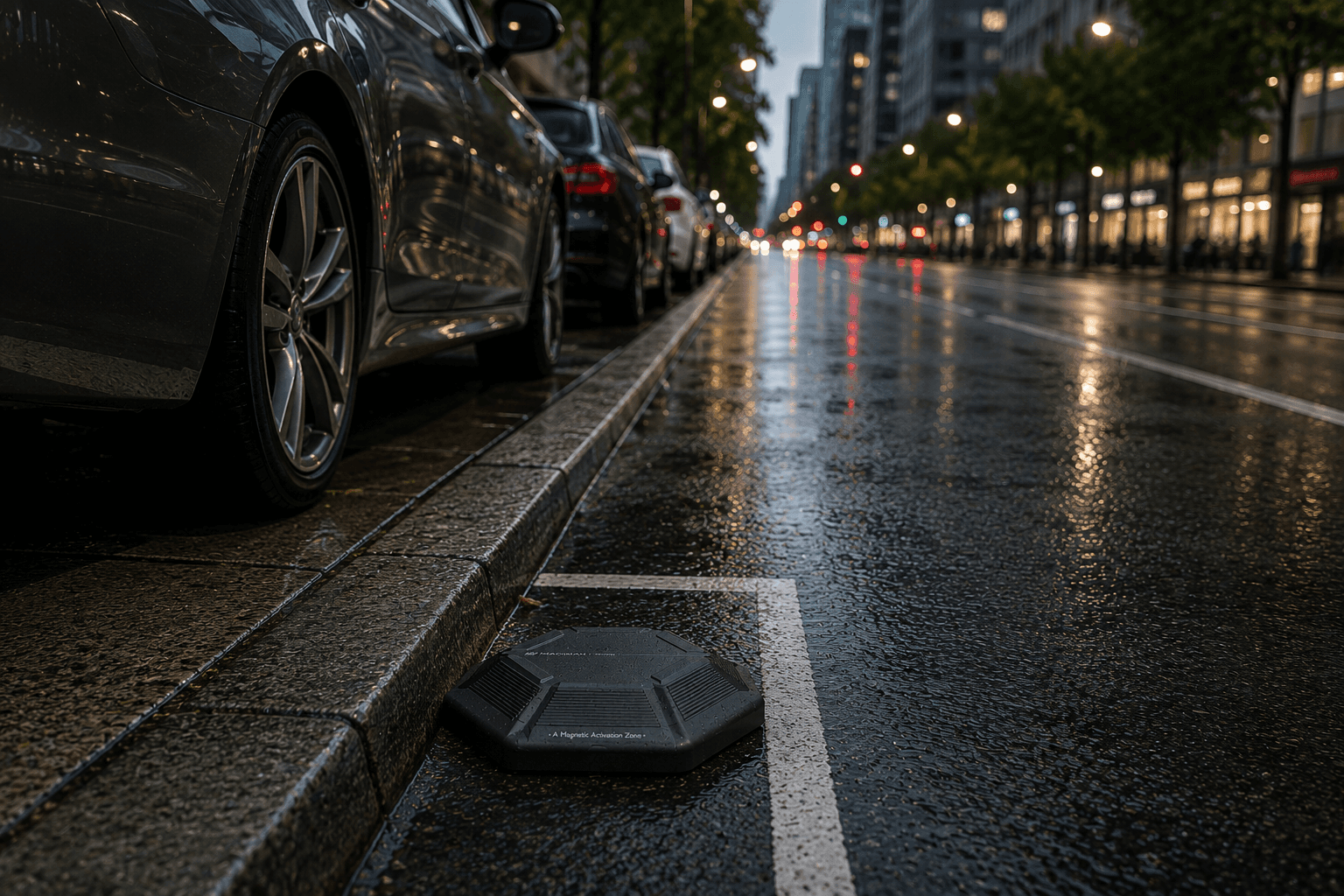
Modern LoRaWAN geomagnetic parking sensors address this challenge by converting individual parking bays into connected digital assets. Installed directly on or beneath the road surface, these low-power sensors continuously detect vehicle occupancy and transmit real-time status updates through a LoRaWAN network. Instead of relying on periodic manual inspections, municipalities gain continuous visibility into parking occupancy across every monitored location.
This stream of real-time parking occupancy analytics enables a fundamental shift in how curbside parking is managed. Enforcement teams receive live violation alerts rather than following fixed patrol routes. Pricing policies can respond dynamically to changing demand. Drivers can be guided directly to available spaces, reducing congestion caused by unnecessary circulation. Historical occupancy trends become valuable planning data for infrastructure investments, policy development, and commercial partnerships.
The result is a parking ecosystem that generates higher revenue, improves operational efficiency, and supports broader smart city initiatives without requiring extensive civil infrastructure or high-maintenance hardware.
This article explores how LoRaWAN parking sensors help municipalities reduce parking leakage, improve operational performance, and unlock new opportunities for smart city parking revenue generation through continuous real-time visibility.
Plugging Revenue Leaks with Real-Time Parking Occupancy Analytics
Revenue leakage rarely occurs because parking regulations are inadequate. More often, it occurs because violations remain undetected.
Most municipal parking enforcement still follows predetermined patrol schedules. Officers move street by street regardless of whether violations are actually occurring. During a typical shift, considerable time is spent inspecting compliant vehicles or empty parking bays while overstays continue unnoticed several blocks away.
The consequences extend beyond missed citations.
Delayed enforcement encourages repeat violations, reduces parking turnover, and decreases the availability of premium parking spaces for legitimate users. Over time, this undermines public confidence in the parking system while steadily reducing municipal revenue.
A LoRaWAN geomagnetic parking sensor changes this operating model entirely.
Every sensor continuously detects vehicle arrival and departure by monitoring changes in the Earth's magnetic field. Occupancy events are securely transmitted through nearby LoRaWAN gateways to a centralized parking management platform, where each parking session is monitored in real time.
When integrated with digital payment systems or parking management software, the platform continuously compares occupancy duration against payment records and local parking regulations.
Examples include:
- Paid parking session has expired.
- Maximum permitted parking duration has been exceeded.
- Unauthorized parking within restricted zones.
- Loading bays occupied outside permitted delivery windows.
- Reserved parking spaces occupied by unauthorized vehicles.
Instead of discovering violations during routine patrols, enforcement officers receive live notifications identifying the exact location, violation type, and elapsed violation time.
This transforms parking enforcement efficiency IoT from reactive inspection into intelligent response.
Rather than walking several kilometres each day searching for violations, officers are directed only to locations where enforcement action is required. Patrol routes become shorter, enforcement coverage increases, and response times improve significantly.
The operational benefits extend well beyond manpower optimisation.
Because violations are addressed sooner, parking turnover increases. High-demand spaces become available more frequently, allowing additional motorists to access commercial districts without unnecessary delays. Businesses benefit from improved customer accessibility, while municipalities benefit from increased parking utilisation.
A Practical Revenue Scenario
Consider a municipality operating 6,000 paid parking bays across its central business district.
Average daily vehicle turnover:
- 3 vehicles per parking bay
Average parking violation rate:
- 10%
Average parking fine:
- ₹500
Without real-time occupancy monitoring, enforcement officers detect approximately 55% of all violations.
Daily detected violations:
6,000 × 3 × 10% × 55%
= 990 citations
Daily enforcement revenue:
990 × ₹500
= ₹4,95,000
After deploying LoRaWAN parking sensors integrated with intelligent enforcement software, citation detection increases to 72%.
Updated calculations:
6,000 × 3 × 10% × 72%
= 1,296 citations
Daily revenue:
1,296 × ₹500
= ₹6,48,000
Daily revenue increase:
₹1,53,000
Annual increase (300 operational days):
₹4.59 Crore
No additional officers are hired.
No parking fees are increased.
No new regulations are introduced.
The additional revenue is generated entirely by reducing parking leakage with geomagnetic sensors and improving enforcement efficiency through real-time occupancy intelligence.
This is one of the fastest paths to improving LoRaWAN parking sensor ROI, as revenue gains begin immediately after deployment.
Dynamic Pricing: Maximising Yield Through Demand-Responsive Smart Parking
Fixed parking tariffs assume that every parking space has the same economic value throughout the day.
Reality tells a different story.
A parking bay located outside a railway station at 9:00 AM has significantly higher demand than the same bay at 8:00 PM. Likewise, curbside parking in front of a busy commercial district commands greater value than parking on adjacent side streets.
Yet traditional parking systems often charge identical rates regardless of occupancy or demand.
This creates two costly outcomes.
Premium locations remain consistently oversubscribed while lower-demand areas remain underutilised. Drivers spend additional time searching for available parking, increasing congestion and reducing the efficiency of the entire transportation network.
Modern dynamic pricing for smart parking municipalities addresses this imbalance by using live occupancy data rather than static assumptions.
With LoRaWAN geomagnetic parking sensors continuously reporting parking status, municipalities gain a live view of occupancy across every monitored block.
Instead of adjusting tariffs annually or seasonally, pricing policies can respond automatically to changing demand throughout the day.
A common objective adopted by leading smart cities is maintaining approximately 85% parking occupancy.
Why 85%?
At this utilisation level:
- Parking assets generate strong revenue.
- Drivers can still find available parking without excessive searching.
- Traffic caused by vehicles cruising for parking is significantly reduced.
- Businesses experience healthier customer turnover.
When occupancy consistently exceeds the target threshold, the parking management platform can automatically increase parking rates for that specific zone.
For example:
- Occupancy below 60% → Reduced tariff to stimulate demand.
- Occupancy between 60% and 85% → Standard parking rate maintained.
- Occupancy above 85% → Premium pricing activated until occupancy stabilises.
Unlike blanket city-wide price increases, this approach is hyper-local. Each street, commercial district, or parking zone responds independently based on real-time demand.
Financial Impact of Demand-Responsive Pricing
Consider a high-demand commercial corridor containing 120 paid parking spaces.
Standard tariff:
₹40 per hour
Peak demand:
Six hours each weekday with occupancy consistently above 90%
The municipality introduces dynamic pricing during these periods, increasing the tariff to ₹60 per hour.
Incremental hourly revenue:
120 spaces × ₹20
= ₹2,400
Additional daily revenue:
₹2,400 × 6 hours
= ₹14,400
Annual revenue (300 operating days):
₹43.2 lakh
This additional income is generated from a single street without expanding parking capacity or investing in new infrastructure.
At the same time, some motorists naturally choose nearby side streets or municipal parking structures where prices remain lower. Demand becomes more evenly distributed across the city, reducing pressure on premium curbside locations while increasing utilisation of existing parking assets.
For municipal finance teams, this creates a dual benefit: higher revenue per premium parking space and improved occupancy across the wider parking network. For traffic engineers, it reduces unnecessary circulation. For drivers, it shortens the time required to find legal parking.
Real-time occupancy data transforms parking from a fixed public utility into a responsive, data-driven asset capable of continuously optimising both revenue and urban mobility.
Monetizing Real-Time Parking Data Beyond Parking Fees
The financial value of a smart parking system extends well beyond parking meters and enforcement.
Once every parking bay continuously reports occupancy, municipalities begin building one of the most valuable urban datasets available—real-time parking occupancy data.
This data supports an entirely new category of municipal revenue opportunities.
Navigation Platform Integration
Drivers increasingly rely on digital navigation platforms to plan journeys.
Using secure APIs, municipalities can share real-time parking visibility with navigation providers, enabling motorists to view available parking before reaching their destination.
The result is improved user experience while creating opportunities for commercial licensing agreements.
Commercial Fleet Services
Delivery operators, ride-sharing companies, and logistics providers depend on predictable curbside access.
Real-time parking data allows fleet operators to:
- Locate available loading zones
- Schedule deliveries more efficiently
- Reduce vehicle idle time
- Improve route planning
Cities can monetize these premium data services through subscription-based API access for commercial fleet operators.
Merchant and Retail Applications
Retail districts benefit when customers spend less time searching for parking.
Municipal parking platforms can integrate with local business applications, shopping centres, and visitor portals to display nearby parking availability.
Improved accessibility encourages greater foot traffic while supporting local economic activity.
Urban Planning and Infrastructure Investment
Historical occupancy analytics provide planners with objective evidence rather than assumptions.
Cities can identify:
- Streets operating beyond capacity
- Underutilized parking assets
- Peak occupancy periods
- Seasonal demand variations
- Future infrastructure requirements
Instead of relying on periodic manual surveys, planning decisions are supported by continuous, high-resolution operational data collected throughout the year.
This transforms parking infrastructure into a strategic source of intelligence for transportation planning, capital investment, and long-term smart city development.
The Secondary Economic Impact of Real-Time Parking Visibility
The financial return from a smart parking deployment extends well beyond parking fees and enforcement. Real-time occupancy data influences traffic flow, environmental performance, commercial activity, and long-term infrastructure planning.
One widely cited estimate suggests that a significant share of congestion in busy urban districts is caused by drivers circulating in search of available parking. Every unnecessary minute spent cruising increases fuel consumption, vehicle emissions, travel time, and road congestion.
With real-time parking occupancy analytics, drivers can navigate directly to available parking spaces through mobile applications, digital wayfinding signs, or third-party navigation platforms. Instead of circling multiple blocks, motorists are guided to an available bay before entering the busiest sections of the city.
The benefits compound across the entire transportation network.
Reduced parking search time leads to:
- Lower traffic congestion on city streets.
- Reduced fuel consumption and carbon emissions.
- Improved emergency vehicle access.
- Better public transport reliability.
- Lower road wear caused by unnecessary vehicle circulation.
- Faster access to commercial districts.
For local businesses, improved parking availability often translates into higher customer turnover. Drivers who can quickly find legal parking are more likely to visit retail stores, restaurants, healthcare facilities, and commercial centres.
For municipal planners, continuous occupancy data provides objective evidence for future transportation investments. Instead of relying on periodic parking surveys, cities gain year-round insight into parking demand, enabling more accurate infrastructure planning and policy decisions.
Ultimately, real-time parking visibility revenue uplift extends beyond direct parking income. It contributes to a more efficient transportation network, stronger local economies, and improved urban mobility.
Smart City Executive Checklist: Calculating Your Parking Revenue Opportunity
Before investing in a smart parking system, municipal teams should establish a baseline assessment of their current parking operations. This allows decision-makers to accurately estimate the potential financial return and operational improvements.
Evaluate the following metrics:
Parking Inventory
- Total number of on-street parking bays
- Number of paid and free parking spaces
- Average occupancy rate by location
- Peak occupancy hours
- Average parking duration
- Vehicle turnover per parking bay
Revenue Performance
- Annual parking meter revenue
- Citation revenue
- Violation frequency
- Citation collection rate
- Average revenue generated per parking space
- Revenue leakage estimates
Enforcement Operations
- Number of enforcement officers
- Daily patrol distance
- Average violations detected per shift
- Average response time to violations
- Officer productivity
- Coverage gaps across enforcement zones
Infrastructure Assessment
- Existing parking technology
- Network infrastructure availability
- Maintenance expenditure
- Annual infrastructure repair costs
- Average installation cost per parking bay
Financial Analysis
- Projected deployment cost
- Expected annual operating cost
- Estimated increase in parking revenue
- Dynamic pricing revenue potential
- Expected operational savings
- Projected payback period
- Five-year Return on Investment (ROI)
A structured assessment provides finance teams with a clear business case before procurement begins and helps prioritize deployment in high-value parking corridors.
Frequently Asked Questions (FAQs)
What is a LoRaWAN geomagnetic parking sensor?
A LoRaWAN geomagnetic parking sensor is a wireless IoT device installed on or within a parking bay that detects vehicle presence by measuring changes in the Earth's magnetic field. The sensor transmits occupancy data over a LoRaWAN network to a parking management platform, enabling real-time parking monitoring, enforcement, guidance, and analytics without requiring wired infrastructure.
How do LoRaWAN parking sensors detect parked vehicles?
Geomagnetic parking sensors continuously monitor changes in the Earth's magnetic field. When a vehicle enters or leaves a parking bay, the disturbance in the magnetic field is detected and processed by onboard algorithms. Many industrial-grade sensors also combine magnetic sensing with motion or accelerometer data to improve detection accuracy and reduce false positives caused by nearby traffic or environmental interference.
Why are LoRaWAN parking sensors better than camera-based parking systems?
Camera-based systems require continuous power, high-bandwidth connectivity, mounting infrastructure, and regular cleaning. They can also be affected by poor lighting, weather conditions, and visual obstructions.
LoRaWAN parking sensors offer several advantages:
- No continuous power at each parking bay
- No image processing or privacy concerns
- Lower installation and maintenance costs
- Reliable operation in rain, fog, or darkness
- Long battery life, typically 8–10 years
- Scalable deployments across thousands of parking spaces
These characteristics make LoRaWAN sensors particularly suitable for large municipal deployments.
What is the typical battery life of a LoRaWAN parking sensor?
Battery life depends on reporting intervals, environmental conditions, and network configuration. Most industrial-grade LoRaWAN geomagnetic parking sensors are designed to operate for approximately 8 to 10 years on a single internal battery under normal parking occupancy reporting conditions.
How accurate are geomagnetic parking sensors?
Modern industrial geomagnetic parking sensors typically achieve greater than 99% vehicle detection accuracy when properly installed and calibrated. Accuracy is influenced by installation quality, sensor design, and the algorithms used to distinguish parked vehicles from passing traffic.
What is the communication range of a LoRaWAN parking sensor?
Communication range depends on the surrounding environment and gateway placement.
Typical coverage includes:
- Urban areas: 1–3 km
- Suburban areas: 3–8 km
- Open environments: 10 km or more
A single LoRaWAN gateway can often support thousands of parking sensors, making the network highly scalable for city-wide deployments.
Can LoRaWAN parking sensors integrate with existing parking management software?
Yes. Most modern smart parking platforms provide REST APIs, MQTT, or other standard interfaces that enable integration with:
- Parking management systems
- Mobile parking payment applications
- Parking enforcement software
- Digital signage
- Smart city platforms
- GIS systems
- Traffic management platforms
- Business intelligence dashboards
Open integration capabilities help municipalities leverage existing software investments rather than replacing them.
How do LoRaWAN parking sensors improve parking enforcement?
Instead of relying on fixed patrol routes, enforcement officers receive live notifications when parking violations occur. This enables faster response times, shorter patrol routes, increased citation capture, and improved operational efficiency while reducing unnecessary inspections of compliant vehicles.
How does dynamic parking pricing work?
Dynamic pricing uses real-time parking occupancy analytics to adjust parking fees based on actual demand. When occupancy exceeds a predefined threshold—often around 85%—parking rates increase within that specific zone. During lower demand periods, rates may decrease to encourage greater utilisation. This demand-responsive approach helps maximize parking revenue while maintaining parking availability.
What is the ROI of a LoRaWAN smart parking system?
Return on investment depends on factors such as parking occupancy, enforcement efficiency, pricing strategy, and deployment scale. Municipalities typically realize financial benefits through a combination of:
- Increased parking enforcement revenue
- Reduced revenue leakage
- Dynamic pricing
- Higher parking turnover
- Lower maintenance costs
- Reduced infrastructure expenditure
Well-planned deployments often achieve positive returns within a few years while continuing to generate operational savings throughout the sensor's service life.
Why are LoRaWAN parking sensors ideal for smart cities?
LoRaWAN parking sensors combine low-power operation, long battery life, wide-area wireless communication, and real-time occupancy monitoring. These characteristics make them well suited for large-scale municipal deployments where cities require reliable parking intelligence without the cost and complexity of wired infrastructure.
Final Thoughts
Parking infrastructure has traditionally been viewed as a municipal service—necessary to maintain but limited in its ability to generate measurable returns. Connected parking changes that perspective.
By combining LoRaWAN geomagnetic parking sensors, real-time parking occupancy analytics, intelligent enforcement, and demand-responsive pricing, municipalities can transform every parking bay into a continuously monitored digital asset. Revenue leakage is reduced, enforcement becomes data-driven, operational costs decline, and parking spaces are utilized more efficiently.
The value extends beyond parking operations. Live occupancy data supports traffic management, improves urban mobility, strengthens local commerce, and provides the foundation for data-driven planning across the broader smart city ecosystem.
As cities continue investing in digital infrastructure, parking is emerging as one of the most practical and financially compelling starting points. With relatively low deployment complexity, long sensor lifecycles, and multiple revenue streams, LoRaWAN-based smart parking systems offer a scalable path toward smarter, more efficient, and financially sustainable urban mobility.
Explore Macnman's Smart Parking Solutions
If your municipality, system integration firm, or smart city project is evaluating intelligent parking infrastructure, Macnman Technologies offers industrial-grade surface-mounted LoRaWAN geomagnetic parking sensors designed for long-term outdoor deployment. Combined with open integration capabilities, long battery life, and seamless connectivity to LoRaWAN networks and parking management platforms, they provide a reliable foundation for modern curbside parking management and smart city initiatives.


