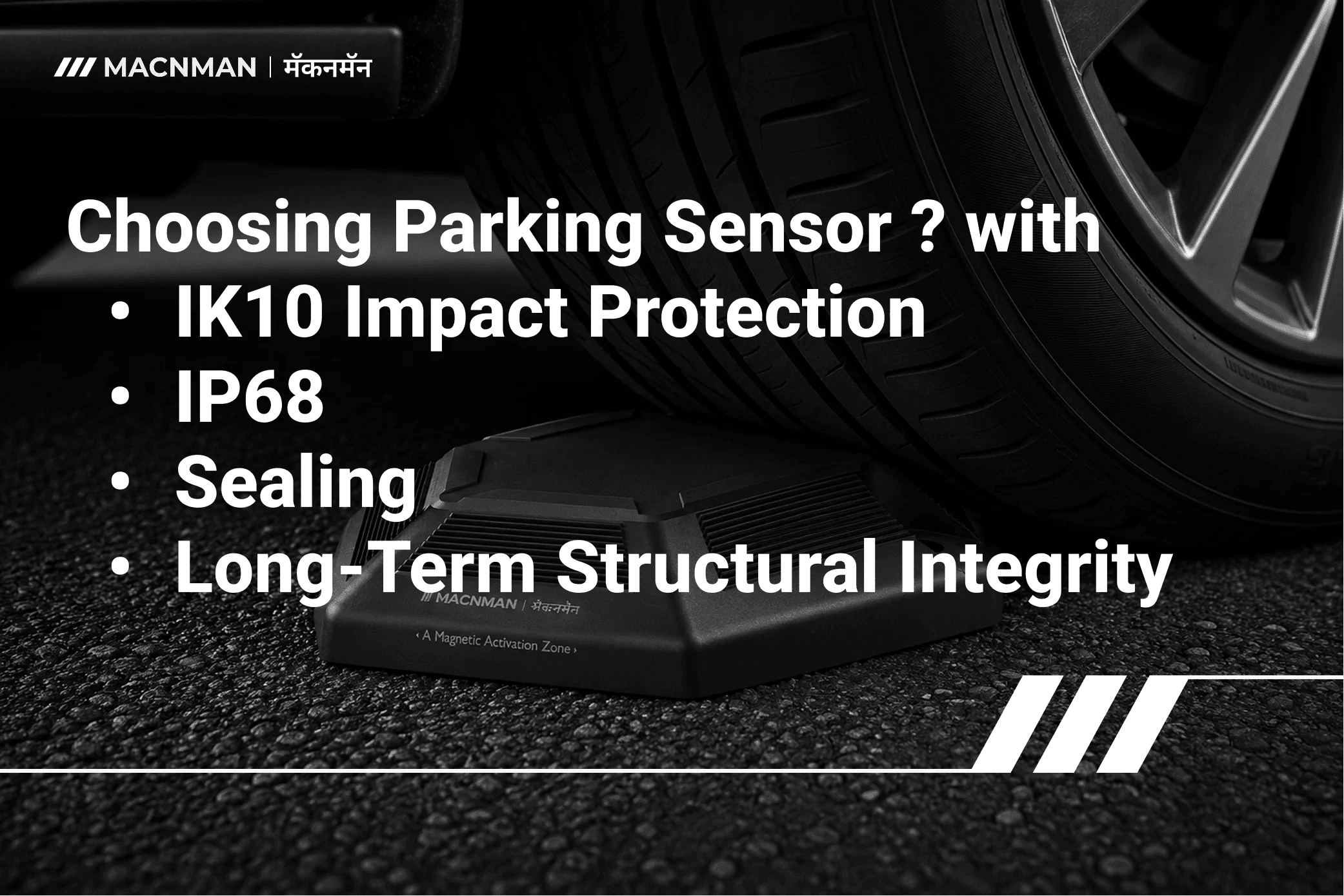
Surface-Mounted LoRaWAN Parking Sensors: Load-Bearing Capacity, Material Engineering, and Structural Design for Long-Term Urban Deployments
Surface-mounted parking sensors eliminate one of the largest cost drivers in smart parking projects: pavement excavation. Without core drilling, trenching, or extensive road restoration, municipalities can deploy hundreds or thousands of parking bays in a fraction of the time required for flush-mounted alternatives. The engineering trade-off is straightforward—every sensor now sits directly in the tire path and must survive years of repeated mechanical loading.
A parking sensor is no longer just an electronic device; it becomes a structural component of the roadway. Every vehicle that enters or exits a parking space transfers compression forces, shear forces, rolling impacts, and torsional stress directly into the enclosure. The surface mount parking sensor load capacity therefore becomes one of the primary indicators of network longevity, maintenance costs, and return on investment.
For infrastructure owners planning deployments expected to operate for eight to ten years, evaluating wireless performance alone is insufficient. Mechanical engineering determines whether the sensor continues transmitting data—or fails after only a few months of daily traffic.
Decoding the Spec Sheet: Understanding Load Resistance Ratings
Among all LoRaWAN parking sensor specifications, mechanical load resistance is one of the most misunderstood values. Procurement teams often compare pressure ratings without considering how forces are distributed in real-world parking environments.
The weight of a vehicle is rarely applied uniformly across its chassis. Instead, loads are concentrated at the tire contact patches, meaning the pressure transferred into the sensor enclosure is significantly higher than many expect.
Typical parking environments include:
Vehicle Type
Approximate Vehicle Weight >> Compact passenger cars
1–1.5 metric tons >> SUVs and electric vehicles
2–3 metric tons >> Commercial delivery vans
3–5 metric tons >> Municipal maintenance vehicles
5–8 metric tons >> Utility trucks and service vehicles
8–12 metric tons >> Overall
Because parking sensors experience localized wheel loading rather than evenly distributed vehicle weight, manufacturers build substantial safety margins into their designs.
Standard commercial geomagnetic parking sensor load resistance ratings generally specify:
- Up to 10 metric tons (22,000 lbs) for standard urban deployments
- 15 metric tons for high-traffic commercial facilities
- 20 metric tons (44,000 lbs) for industrial logistics yards, municipal service areas, airports, and freight terminals
These ratings do not imply that the sensor continuously carries the full vehicle weight. Instead, they represent the maximum compressive loading the enclosure can withstand without permanent deformation, structural cracking, or degradation of sensing performance.
For municipal deployments, selecting a higher-rated sensor provides additional protection against abuse scenarios that rarely appear during laboratory testing, including:
- Delivery trucks partially mounting the parking bay
- Street sweeping equipment
- Snow removal machinery
- Garbage collection vehicles
- Emergency response vehicles
- Construction equipment temporarily crossing parking zones
A higher industrial smart parking sensor durability rating reduces unexpected hardware failures over the operational life of the network while lowering replacement and maintenance costs.
Material Science: Engineering an Enclosure That Survives Years of Traffic
The enclosure of a parking sensor functions as both an environmental barrier and a structural load-bearing component. Material selection therefore determines whether the sensor maintains its integrity after thousands of impact cycles.
High-performance surface-mounted parking sensors commonly use engineered polymers such as:
- UV-stabilized polycarbonate (PC)
- Glass-fiber reinforced PA66 (Nylon 66)
- High-density engineered polyethylene (HDPE)
- Specialized composite polymer blends for heavy industrial applications
These materials are selected because they combine several critical mechanical properties.
High Tensile Strength :
The housing must resist permanent deformation when subjected to concentrated compression forces from vehicle tires.
High tensile strength prevents the enclosure from stretching, cracking, or developing stress fractures that eventually propagate through the casing.
Controlled Micro-Elasticity :
A perfectly rigid housing transfers nearly all impact energy directly into the internal electronics.
Engineering polymers are intentionally designed with controlled elasticity, allowing the enclosure to flex microscopically during impact before returning to its original geometry.
This elastic deformation absorbs sudden dynamic loading and significantly reduces stress transmitted to:
- Magnetometers
- Radar modules
- PCB solder joints
- Battery assemblies
- RF antennas
The result is substantially improved fatigue resistance over millions of load cycles.
IK10 Mechanical Protection Is More Than a Marketing Label
An IK10 IP68 smart parking sensor combines two complementary protection standards that directly influence long-term reliability.
The IK10 mechanical rating verifies that the enclosure can withstand a 20-joule impact, equivalent to the energy generated by a 5 kg object dropped from 400 mm.
Although originally developed for vandal resistance, IK10 certification also demonstrates the enclosure's ability to absorb repeated mechanical shocks encountered in public parking environments.
Without sufficient impact resistance, even minor casing damage can initiate progressive structural failure.
IP68 Protection Depends on Structural Integrity
Environmental sealing is only effective while the enclosure maintains its geometry.
Once a housing develops microscopic cracks from repeated compression or impact loading, moisture begins entering the electronics compartment.
Water ingress rapidly causes:
- PCB corrosion
- Battery degradation
- Sensor drift
- RF performance loss
- Complete electrical failure
For this reason, the IP68 rating cannot be evaluated independently from the enclosure's mechanical strength.
An enclosure that cracks under repeated traffic effectively loses its environmental protection regardless of laboratory certification.
Thermal Stability Across Real Pavement Conditions
Urban parking surfaces experience surprisingly wide temperature fluctuations.
Typical deployment conditions include:
- Winter temperatures approaching −40°C in cold regions
- Summer ambient temperatures exceeding 45°C
- Asphalt surface temperatures frequently surpassing 60°C
- Direct solar exposure for extended periods
The enclosure material must preserve its wireless parking sensor pressure rating across this entire operating range.
If the polymer becomes brittle during freezing conditions, impact resistance declines sharply.
Conversely, excessive softening during high-temperature exposure allows permanent deformation under vehicle loading, reducing structural stability and potentially altering sensor alignment.
Material engineering therefore focuses on maintaining consistent mechanical performance regardless of seasonal conditions.
The Geometry of Survival: Converting Crushing Loads into Controlled Forces
Material selection alone cannot withstand years of heavy traffic.
The external geometry of the sensor plays an equally important role in determining long-term durability.
Most surface-mounted parking sensors are designed with a low-profile dome between 20 mm and 40 mm in height.
This geometry is carefully engineered to redirect forces rather than absorb them directly.
Instead of allowing tires to apply purely vertical compression, the curved surface transforms much of the incoming load into rolling vector forces.
As the tire climbs the dome, the force direction gradually shifts from vertical compression toward angular glancing motion.
This significantly reduces peak stress concentrations at the highest point of the enclosure.
The result is:
- Lower instantaneous compression
- Reduced shear stress
- Less impact energy transferred to internal electronics
- Improved fatigue life over repeated loading cycles
Small geometric adjustments can produce significant improvements in structural performance without changing the enclosure material.
Internal Structural Ribbing: The Hidden Load Distribution System
The visible enclosure is only part of the structural design.
Inside the housing, dense rib networks reinforce the casing much like structural members in bridge construction.
Rather than allowing concentrated wheel loads to press directly onto the electronics, these ribs redistribute forces across a much larger area.
The remaining downward load is transferred outward into the surrounding pavement through the enclosure base.
This prevents localized stress concentrations that would otherwise damage:
- Magnetometer packages
- RF modules
- PCB mounting points
- Battery compartments
Proper rib geometry transforms the enclosure from a simple plastic shell into a lightweight structural framework capable of surviving years of repeated compression.
Installation Determines Load Capacity: The Bridge Analogy
Even the strongest enclosure can fail if installed incorrectly.
A sensor rated for 20 metric tons may fracture under a much lighter vehicle if the pavement beneath it does not provide full structural support.
The simplest way to understand this is through a bridge analogy.
Imagine placing a steel plate across two supports with empty space underneath.
Even though the steel is strong, a heavy load applied in the center causes the plate to bend because it is effectively acting as a bridge.
The same principle applies to surface-mounted parking sensors.
If an installer leaves even a small air gap beneath the enclosure, vehicle loads are no longer transferred into the pavement.
Instead, the housing begins carrying bending forces it was never designed to withstand.
Repeated traffic quickly produces:
- Base cracking
- Fastener loosening
- Adhesive failure
- Sensor displacement
- Complete structural failure
The published surface mount parking sensor load capacity only applies when the sensor maintains continuous support across its entire base.
Engineering Best Practices for Maximum Structural Performance
Installation quality directly influences service life.
Professional deployments typically follow several mechanical best practices:
Prepare the pavement surface thoroughly.
Wire-brush the asphalt or concrete to remove dust, loose aggregate, oils, moisture, and contaminants that reduce adhesive strength.
Create a perfectly flat mounting surface.
Grinding high spots ensures the sensor achieves complete contact with the pavement rather than resting on isolated points.
Use high-strength two-component (2K) structural epoxy.
The adhesive should completely fill microscopic voids within the pavement surface, creating 100% contact beneath the enclosure.
Partial adhesive coverage leaves unsupported regions that become failure points under traffic loading.
Secure the sensor with mechanical anchor bolts.
Expansion anchors provide additional resistance against vibration, braking forces, accidental impacts, and long-term fatigue.
Mechanical fastening complements the adhesive rather than replacing it, producing a far more durable installation.
Structural Durability Directly Influences Detection Accuracy
Mechanical performance and sensing accuracy are closely linked.
A parking sensor continuously establishes a magnetic baseline for its surrounding environment.
Repeated impacts, enclosure movement, or gradual positional shifts can alter that baseline over time.
When this occurs, the system may experience:
- False occupied readings
- Missed detections
- Increased calibration drift
- Reduced long-term accuracy
Heavy vehicles, nearby steel structures, and persistent vibration can further complicate magnetic measurements.
For this reason, many infrastructure owners increasingly specify dual detection technology parking sensor designs.
These systems combine geomagnetic sensing with complementary technologies such as:
- Microwave radar
- Infrared detection
- Millimeter-wave sensing (on advanced platforms)
Sensor fusion allows occupancy decisions to be validated using multiple independent measurement methods.
Even if traffic vibration temporarily affects magnetic readings, the secondary detection technology helps maintain occupancy accuracy above 99%, reducing false events and improving confidence in parking availability data.
Procurement Checklist: What to Verify Before Selecting a Surface-Mounted Parking Sensor
Before approving hardware for municipal or commercial deployments, procurement teams should verify that the datasheet clearly specifies:
- Mechanical Protection: Confirm an IK10 IP68 smart parking sensor enclosure to ensure both impact resistance and long-term environmental sealing.
- Load Rating: Select a sensor with at least 10 metric tons of verified load capacity, with 15–20 metric tons recommended for heavy-traffic urban, airport, logistics, or municipal installations.
- Installation Method: Ensure the manufacturer specifies full-base structural epoxy bonding, complete substrate contact, and mechanical anchor fastening rather than adhesive-only installation.
- Enclosure Materials: Verify the housing uses UV-stabilized engineering polymers such as reinforced PA66, polycarbonate, or equivalent materials capable of maintaining their wireless parking sensor pressure rating between −40°C and +85°C.
- Detection Architecture: Choose dual detection technology parking sensor models that combine geomagnetic sensing with radar or infrared validation to maintain high detection accuracy under vibration, shifting magnetic environments, and long-term roadway wear.
Selecting a surface-mounted parking sensor extends far beyond wireless range or battery life. The enclosure functions as a structural element embedded within the roadway, continuously absorbing compression, impact, vibration, temperature cycling, and environmental exposure. Evaluating LoRaWAN parking sensor specifications through the combined lens of material science, mechanical engineering, installation methodology, and sensing architecture enables municipalities and parking operators to deploy infrastructure that remains mechanically stable and operational for years, minimizing maintenance while preserving reliable occupancy data across demanding urban environments.


