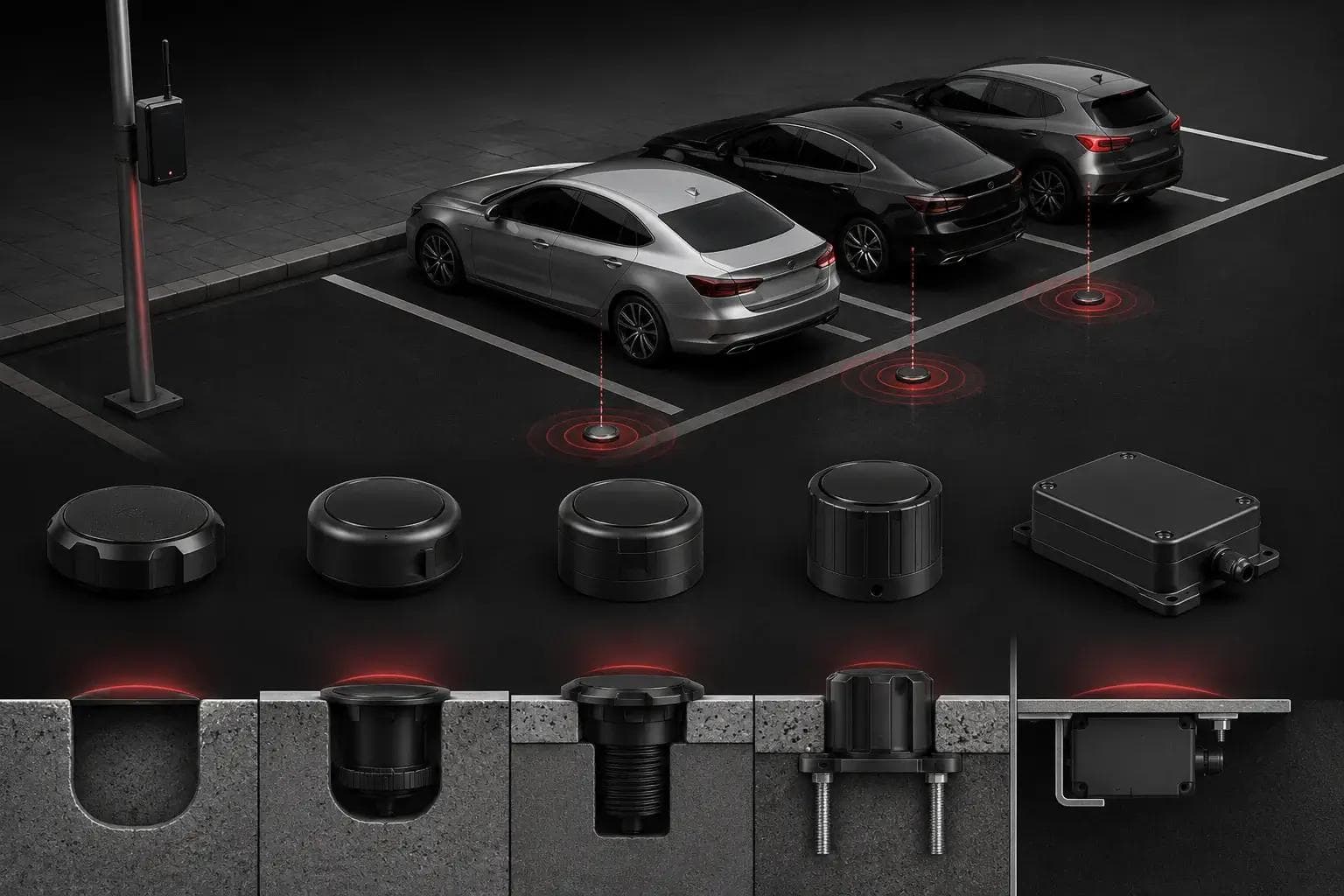
Parking Sensor Selection Guide: Which Sensor to Use for Every Case
Choosing a smart parking sensor looks simple until you open a dozen vendor datasheets and realise every one claims to be the best. The truth is that there is no single best parking sensor — there is only the right sensor for your surface, climate, traffic, and budget. Pick well and you get years of accurate, maintenance-free occupancy data. Pick badly and you inherit false readings, dead batteries, and a car park full of sensors that need re-coring.
This guide is built to prevent that. It is a vendor-neutral parking sensor selection guide that walks through the two decisions you are actually making, compares the real options on each, and then gives you a use-case matrix so you can match a sensor to your exact deployment.
One quick scope note before we start: this is about smart parking and vehicle detection sensors — the IoT devices that sit in a parking bay and report whether it is occupied. It is not about the ultrasonic reversing sensors in a car bumper. Different problem, different hardware.
The two decisions behind every parking sensor
Most buyers ask "which parking sensor should I use?" as if it were one question. It is really two, and they are independent of each other:
- Which sensing technology detects the vehicle? Magnetometer, radar, ultrasonic, infrared, a dual-mode combination, or an overhead camera.
- How is the sensor mounted? Surface-mount on top of the road, in-ground embedded in the road, or flush-mount sitting level with the surface.
You choose one from each list. A magnetometer sensor can be surface-mounted or in-ground; a dual-mode sensor can be flush-mounted. Keeping these two axes separate is the single most useful habit when specifying a parking occupancy sensor, so we will tackle them one at a time.
Sensing technologies compared
Magnetometer (geomagnetic) sensors
A magnetometer parking sensor measures the Earth's magnetic field and watches for the distortion a vehicle's metal mass creates directly above it. When a car parks over the sensor, the local field bends — much like a magnet deflecting a compass needle — and the sensor reads "occupied." When the car leaves, the field returns to normal.
Geomagnetic detection is cheap, extremely low-power, and reliable for the vast majority of vehicles, which is why it has been the workhorse of smart parking for years. Its weakness is interference. A large metal object nearby, an adjacent parked vehicle, or a high-clearance vehicle with a lot of ground clearance can occasionally confuse a magnetometer working alone, and stray magnetic fields can trigger false readings. On its own, a well-tuned magnetometer sensor typically lands around 95% accuracy.
Radar sensors
A radar parking sensor sends a short pulse upward and measures what bounces back. If something solid sits close above it, the reflection confirms a vehicle. The big advantage is environmental immunity: radar is largely unaffected by temperature, light, vibration, or magnetic fields, so it holds up in glare, darkness, rain, and snow. Modern pulsed-coherent and millimetre-wave (mmWave) radar modules are also small and low-power, a major improvement over the power-hungry radars of a decade ago. Crucially, radar can work from inside a sealed sensor casing, which matters for durability.
Dual-mode sensors (magnetometer + radar)
This is where the market has settled for high-accuracy deployments, and for good reason. A dual-mode parking sensor fuses geomagnetic and radar detection. Because each method fails in different conditions, using both together removes almost every false reading — when the magnetometer and the radar agree, the reading is certain. Dual-mode sensors routinely advertise around 99% accuracy or higher, versus roughly 95% for magnetometer-only units. If accuracy directly affects enforcement revenue or driver trust, the extra cost of dual-mode usually pays for itself.
Ultrasonic sensors
An ultrasonic sensor measures the distance to whatever is above it. It can be accurate, but it needs an open-air view of the target — it does not work well under a cover plate — and it is comparatively power-hungry with a larger physical footprint. Outdoors, snow or debris settling on the sensor face can obstruct it. Ultrasonic detection is more common in covered garages, often ceiling-mounted, than in exposed in-ground street applications.
Infrared and camera-based detection
Infrared sensors detect vehicles by heat or reflected light but tend to have weaker environmental tolerance. The more significant alternative is camera-based, AI-driven detection: a single well-placed camera can monitor dozens or even hundreds of spaces, with deep-learning models reaching accuracy above 99%. Cameras win on scalability — one install covers a large area, cutting per-space infrastructure — but they require mounting height (poles or ceilings), careful setup, and ongoing maintenance, and they raise privacy considerations that in-ground sensors avoid.
Here is how the ground-based sensing technologies stack up:
| Technology | Accuracy (typical) | Power | Strengths | Watch-outs |
|---|---|---|---|---|
| Magnetometer | ~95% | Very low | Cheap, tiny, long battery life | Magnetic interference, high-clearance vehicles |
| Radar (mmWave) | ~97–99% | Low–moderate | Immune to light/temp/magnetics; works sealed | Slightly higher cost |
| Dual-mode | ~99%+ | Low | Best accuracy, very few false reads | Higher unit cost |
| Ultrasonic | ~90–98% | High | Good in covered garages | Needs open-air view; snow/debris |
| Camera/AI | ~99% | N/A (powered) | One unit covers many bays | Mounting, setup, privacy |
Mounting types compared
Now the second axis. You named surface and in-ground, but there are really three ground-based options, and the third one — flush-mount — is often the right answer for tough climates.
Surface-mount sensors
A surface-mount parking sensor is fixed directly on top of the asphalt or concrete using industrial adhesive, and sometimes mechanical fasteners. On gravel or soft ground, installers often set a small concrete cylinder first to create a stable base. The appeal is speed: a surface-mount unit can be deployed in minutes, with no digging, no wiring, and no facility shutdown — ideal for retrofits and pilot projects. Good casings are surprisingly tough, withstanding tonnes of plate load from vehicle tyres.
The trade-off is exposure. Sitting proud of the road, surface-mount sensors are more vulnerable to shocks, snow ploughs, and vandalism, and they can be a minor obstruction for two-wheelers or pedestrians.
In-ground (embedded) sensors
An in-ground parking sensor is installed inside the road surface. Installers core a hole — commonly around 4.5 inches — and embed the sensor in epoxy. Because the unit sits within the pavement, it is protected from vehicles, cleaning machines, and vandalism, and it keeps the walking surface clear. The cost is installation effort: coring is civil-engineering work, and on some structural decks drilling risks compromising a waterproof membrane, letting in moisture or salt, so it is not always appropriate for multi-storey concrete.
Flush-mount sensors
Flush-mount is the middle path: an in-ground installation where the sensor sits level with the road surface. You get the protection and discretion of embedding plus a smooth top that snow ploughs can pass straight over — which is exactly why cold-climate cities choose it. It needs the same coring work as a standard in-ground install, but for heavy-snow or high-vandalism sites the durability is worth it.
| Mounting | Install effort | Durability | Vandal resistance | Best for |
|---|---|---|---|---|
| Surface-mount | Minutes, no digging | Good | Lower | Retrofits, pilots, indoor garages |
| In-ground | Coring + epoxy | High | High | Permanent outdoor deployments |
| Flush-mount | Coring + epoxy | Highest | High | Snow regions, heavy traffic, heritage areas |
Best parking sensor for each case
This is where the two axes come together. Below is the practical part — which combination to reach for in the situations you will actually face.
Outdoor on-street parking (mixed climate). The default workhorse. A dual-mode (magnetometer + radar) sensor gives you enforcement-grade accuracy, and an IP68 rating handles rain and temperature swings. Surface-mount for a fast rollout or pilot; in-ground once you commit to permanent infrastructure.
Underground or covered car parks. Steel structures and reinforced concrete create magnetic interference, so a magnetometer alone struggles here — lean on radar or dual-mode. At scale, a ceiling-mounted camera system can be more economical than one sensor per bay, and it sidesteps the GPS-free, signal-blocked environment that complicates wireless in basements.
Snow and cold climates. Avoid surface-mount, which snow ploughs will shear off, and avoid ultrasonic, which snow can obstruct. Flush-mount is the answer: level with the road, plough-proof, and available with wide temperature ratings down to around −40 °C.
High-traffic lanes and heavy vehicles. Prioritise mechanical robustness. In-ground or flush-mount casings rated for high plate loads survive constant truck and bus traffic far better than exposed units.
Vandalism-prone or high-theft areas. Hidden hardware is safe hardware. In-ground and flush-mount sensors are discreet and tamper-resistant, whereas surface units are an easy target.
Gravel, unusual, or soft surfaces. Surface-mount on a poured concrete base, or a full in-ground install where the ground allows. The concrete cylinder trick gives you a stable, level mounting point on otherwise awkward terrain.
Aesthetics-sensitive or heritage zones. Flush-mount or in-ground keeps the streetscape clean and the sensors invisible.
Connectivity and battery life
The sensor head is only half the decision — how it reports data matters just as much, and it is where wireless standards come in.
Most modern parking sensors are fully wireless and battery-powered, with no trenching for data cables. LoRaWAN is the dominant choice for outdoor and municipal deployments: it reaches a gateway several kilometres away in line-of-sight conditions, sips power, and suits the tiny, infrequent payloads a parking sensor sends. NB-IoT is the main alternative where cellular coverage is strong and you would rather not run gateways. In dense basements, neither propagates as freely, so plan gateway placement carefully.
Battery life is the quiet make-or-break spec. A well-designed sensor using a primary lithium (Li-SOCl₂) cell can run for years — figures of up to a decade are quoted, though real life depends heavily on how often the bay turns over and how frequently the device reports. When comparing datasheets, always check the assumed number of vehicle movements per day behind any battery-life claim; a "10-year" number modelled at ten cycles a day looks very different at a busy city-centre bay. Look for an IP68 rating on anything outdoors, and favour dual-technology sensors over single-mode units wherever conditions are variable.
A quick selection checklist
Before you commit to a purchase or a pilot, run through these five questions:
- Where is it going? Exposed street, covered garage, or soft ground — this drives mounting type first.
- What is the climate? Snow and ploughs push you to flush-mount; heat and rain demand IP68.
- How accurate must it be? Enforcement and paid parking justify dual-mode; simple guidance can tolerate magnetometer-only.
- How is it powered and connected? Confirm LoRaWAN or NB-IoT coverage and check the battery-life assumptions.
- What is the total cost of ownership? Cheap sensors that need re-coring or frequent battery swaps are rarely cheap over seven to ten years.
Frequently asked questions
What is the best type of parking sensor?
The best type of parking sensor is a dual-mode sensor that combines magnetometer and radar detection, because it delivers the highest accuracy — around 99% — for most outdoor deployments. There is no single best choice overall, though: the right mounting type still depends on your surface and climate, with surface-mount best for speed and flush-mount best for durability.
What is the difference between surface-mount and in-ground parking sensors?
A surface-mount parking sensor is fixed on top of the road with adhesive and installs in minutes without digging, but sits exposed to damage and vandalism. An in-ground parking sensor is embedded inside a cored hole in the pavement, which protects it and keeps the surface clear but requires civil works. Surface-mount suits retrofits and pilots; in-ground suits permanent installations.
What is a flush-mount parking sensor?
A flush-mount parking sensor is an in-ground sensor installed so its top sits level with the road surface. Because nothing protrudes, snow ploughs pass straight over it, making flush-mount the preferred choice for cold climates and heavy-traffic or high-vandalism sites. It needs the same coring work as a standard in-ground install.
What is a dual-mode parking sensor?
A dual-mode parking sensor uses two detection methods at once — a magnetometer that senses the vehicle's distortion of the Earth's magnetic field, and a radar that confirms a solid object above. Because the two signals fail under different conditions, cross-checking them removes almost all false readings and pushes accuracy to roughly 99% or higher.
How accurate are smart parking sensors?
Smart parking sensors are typically 95% to 99%-plus accurate. A magnetometer-only sensor reaches around 95% accuracy, while a dual-mode sensor combining geomagnetic and radar detection exceeds 99% by cross-checking two independent signals. Accuracy drops in conditions like heavy metal interference or, for ultrasonic units, snow on the sensor face.
Do magnetometer parking sensors work in underground car parks?
Magnetometer parking sensors can struggle in underground car parks because the steel and reinforced concrete of the structure distort the magnetic field and cause false readings. In these environments, a radar or dual-mode sensor is more reliable, and for large covered facilities a ceiling-mounted camera system is often more economical than one sensor per bay.
Which parking sensor is best for snowy or cold climates?
Flush-mount parking sensors are best for snowy climates, because snow ploughs pass over them without making contact. Avoid surface-mount units, which ploughs can shear off, and ultrasonic sensors, which snow can obstruct. Choose a sensor rated for wide temperatures, down to around −40 °C for the harshest regions.
Which is better: geomagnetic or radar parking sensors?
Radar parking sensors are more robust than geomagnetic ones because they are unaffected by light, temperature, vibration, or magnetic interference, whereas geomagnetic sensors are cheaper and lower-power. The strongest option is a dual-mode sensor that combines both technologies to minimise false readings while keeping power consumption low.
How do smart parking sensors connect to the internet?
Most smart parking sensors connect wirelessly using low-power networks, with LoRaWAN and NB-IoT being the two most common. LoRaWAN suits outdoor and municipal deployments because it reaches a gateway several kilometres away while using very little power; NB-IoT suits areas with strong cellular coverage. Signal penetration is weaker in underground car parks, so gateway placement needs planning.
How long do parking sensor batteries last?
Parking sensor batteries typically last several years, and some primary-lithium (Li-SOCl₂) designs are rated up to ten years. Actual life depends on how often the parking space turns over and how frequently the sensor reports, so always check the daily vehicle-movement assumption behind any battery-life claim.
Do wireless parking sensors need wiring?
No, wireless parking sensors do not need data or power wiring. They run on an internal long-life battery and transmit occupancy data over a wireless network such as LoRaWAN or NB-IoT, which is why they can be installed quickly without trenching. Only the network gateway requires power and internet access.
How much does a smart parking sensor cost?
The cost of a smart parking sensor depends mainly on its sensing technology, mounting type, and connectivity. Dual-mode and in-ground or flush-mount units cost more up front than single-mode surface-mount ones, but their durability and accuracy often lower the total cost of ownership over a seven-to-ten-year lifespan. Installation and network infrastructure add to the per-space figure.
The bottom line
Selecting a parking sensor comes down to two independent choices: the sensing technology that detects the vehicle, and the way the sensor is mounted. Get the technology right for your accuracy needs — magnetometer for basic guidance, radar or dual-mode where reliability matters — and get the mounting right for your surface and climate, remembering that flush-mount exists as a durable middle ground between surface and in-ground.
Start from the site, not the datasheet. Map your surface, climate, traffic, vandalism risk, and connectivity before you look at a single product page, and let those constraints narrow the field. Do that, and the "best parking sensor" stops being a marketing claim and becomes a straightforward match to the job in front of you.


