LoRa Mesh vs LoRaWAN Star: When to Use Each (An Engineer's Decision Guide)
If you've searched for "LoRaWAN mesh vs LoRaWAN star," the first thing worth clearing up is that one half of that phrase doesn't technically exist. LoRaWAN is a star topology — a star-of-stars, to be precise. The specification permits only a single hop between an end device and a gateway. There is no native mesh mode in the LoRaWAN standard.
So the real question almost everyone is asking is this: should I use LoRaWAN's star topology, or a LoRa mesh network? Both run on the same Semtech radio silicon, both give you long range at low power, and their names are close enough to cause genuine confusion. But they impose completely different rules on every node in your network, and picking the wrong one shows up later as dead batteries, dropped packets, or a maintenance bill nobody budgeted for.
This guide breaks down how each topology actually works, where each one wins, and — most importantly — gives you a decision framework you can apply to a real deployment instead of a generic pros-and-cons list.
First, untangle the terminology
Because the names overlap, it helps to separate the layers before comparing anything:
- LoRa is the radio. It's a physical-layer (PHY) modulation technique from Semtech using Chirp Spread Spectrum (CSS). It defines how bits travel through the air — nothing more.
- LoRaWAN is a standardized LPWAN architecture built on top of LoRa. It adds gateways, a network server, security, device classes, and a star-of-stars topology.
- LoRa mesh is any multi-hop scheme built on the LoRa radio where nodes relay each other's packets. This is not one standard — it covers ecosystems like Meshtastic and MeshCore, custom multi-hop protocols, and academic multi-hop LoRaWAN extensions.
- LoRa P2P is direct point-to-point communication over LoRa with no gateway and no mesh — the simplest option, and a useful middle ground.
Keep those four straight and the whole comparison gets easier. When someone says "LoRaWAN mesh," they usually mean either a LoRa mesh ecosystem or a research-grade multi-hop extension bolted onto LoRaWAN — not something the core spec supports.
How LoRaWAN's star topology works
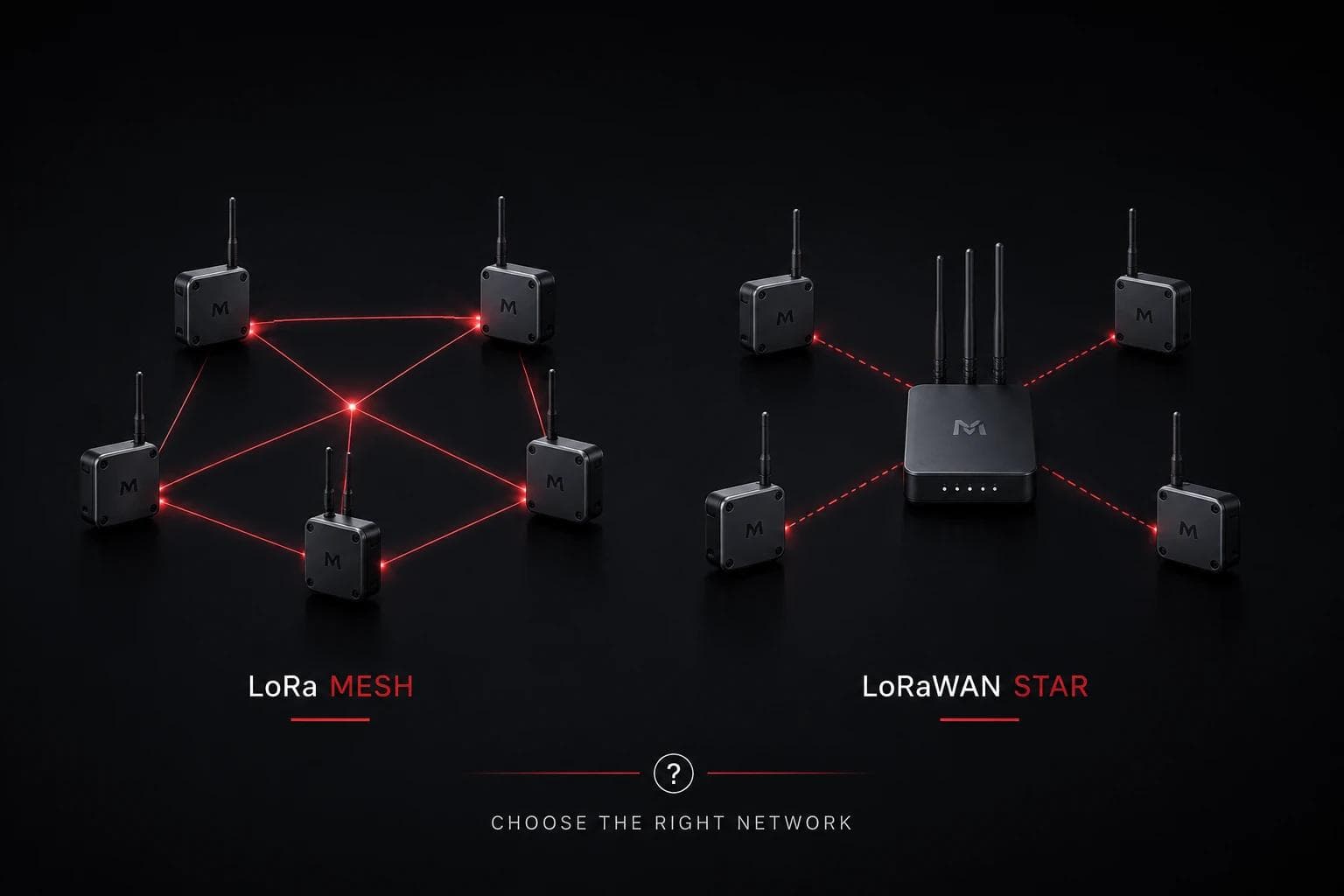
In a LoRaWAN network, every end device talks directly to one or more gateways in a single hop. Devices never relay for each other. The gateways are simple: they convert LoRa radio packets into IP and forward everything upstream to a central network server, which handles authentication, de-duplication, and routing to your application server.
That "star-of-stars" name comes from the two tiers: end devices form a star around each gateway, and the gateways form a star around the network server.
The architecture has four building blocks:
- End device — a battery-powered sensor or actuator that transmits (and, depending on class, receives) data.
- Gateway — a listener that relays raw LoRa packets to the server over IP backhaul.
- Network server — manages device sessions, security, de-duplication, and Adaptive Data Rate.
- Application server — delivers decoded data to your dashboard, database, or cloud.
The single-hop design is what gives LoRaWAN its headline strengths. Because a device only ever wakes up, transmits, and drops back into deep sleep, Class A end nodes can run for years on a coin cell. Adaptive Data Rate (ADR) lets the network server tune each node's spreading factor and transmit power based on link quality — nodes near a gateway use fast data rates at low power, distant nodes trade speed for reliability. And because LoRaWAN is an open standard, you can mix end devices and gateways from different vendors, which is what makes large, low-cost rollouts like smart metering and smart parking viable.
The catch is coverage. Your network reaches exactly as far as your gateways reach. In a clean, open environment that's tens of square kilometres per gateway. But drop that same gateway into a dense city, a factory full of steel, a tunnel, or hilly terrain, and non-line-of-sight fading eats into range fast. A node stuck behind reinforced concrete or a hillside simply can't be heard, and the star topology has no way to route around the obstacles.
How LoRa mesh works
A LoRa mesh network throws out the single-hop rule. Instead of every node reaching a gateway directly, nodes relay packets for each other, hopping data across the network until it reaches its destination. Think of it as a web rather than a hub-and-spoke.
This buys you two things the star can't easily deliver:
- Coverage in hostile terrain. If node A can't reach the gateway but node B can, A routes through B. Obstacles, dead zones, and long linear runs (tunnels, mines, forests, mountain valleys) become solvable without erecting more infrastructure.
- Resilience. Good mesh protocols are self-healing — if a relay node drops off, traffic re-routes through another path automatically. There's no single point of failure the way there is with a lone gateway.
Ecosystems like Meshtastic and MeshCore have made LoRa mesh popular for off-grid communication, where devices need to talk to each other with no gateway, no internet, and no infrastructure at all. That's a fundamentally different problem from cloud-connected telemetry, and it's why these tools exist as a separate branch of the LoRa world.
But mesh has a cost that's easy to underestimate, and it lands squarely on power. A relay node has to keep its radio listening to forward other nodes' packets. That breaks the deep-sleep duty cycle that gives LoRaWAN its multi-year battery life. Worse, how much power a relay burns depends on traffic volume, which depends on topology, which can shift as the network self-organizes — so battery projections for relay nodes are genuinely hard to validate before you deploy.
Reliability has a subtler trap too. Packet delivery compounds across hops. If each individual link delivers 90% of packets, a three-hop path delivers only about 73% (0.9 × 0.9 × 0.9). Every hop you add multiplies in another chance to drop the message.
LoRa mesh vs LoRaWAN star: head-to-head
| Factor | LoRaWAN (star-of-stars) | LoRa mesh (multi-hop) |
|---|---|---|
| Topology | Single-hop, centralized | Multi-hop, decentralized |
| Range strategy | Extend by adding gateways | Extend by adding relay nodes |
| Battery life | Excellent — nodes deep-sleep between transmits | Poor for relay nodes — radios must stay listening |
| Non-line-of-sight | Weak — no way around obstacles | Strong — routes around them |
| Reliability | Predictable per-node link budget | Self-healing, but delivery compounds across hops |
| Scalability | High, standardized, multi-vendor | Depends on protocol; dense networks add delay |
| Standardization | Open LoRaWAN standard | Fragmented — Meshtastic, MeshCore, custom, research |
| Infrastructure | Requires gateways + backhaul | Can run gateway-free and off-grid |
| Best-fit scale | Wide-area, many nodes | Localized, terrain-constrained, or off-grid |
When to use LoRaWAN vs LoRa mesh: a decision framework
Most comparisons stop at the table above and leave you to guess. In practice, an engineer specifying a wireless sensor network doesn't start from protocol specs — you start from the physical constraint set. Three site-specific variables decide it for you:
1. How far is each node from a viable gateway position? If most nodes have a plausible line-of-sight-ish path to a gateway you can actually mount and power, LoRaWAN's star is almost always the right answer. If a meaningful fraction of nodes are buried behind rock, steel, or terrain with no gateway location that reaches them, mesh starts to earn its complexity.
2. How many years must the node run unattended? This is the quiet deal-breaker. If your nodes need multi-year battery life on a coin cell or small primary cell, relay-based mesh fights you the whole way, because relays can't deep-sleep. LoRaWAN Class A nodes are built for exactly this. If nodes are mains-powered or easily recharged, the power penalty of mesh matters far less.
3. What does it cost to send a crew when something needs replacing? Remote, hard-to-reach, or safety-restricted sites make every truck roll expensive. That pushes you toward whichever topology gives the most predictable, longest unattended life — usually the star. It also raises the stakes on mesh's harder-to-predict battery behaviour.
A rough rule of thumb:
- Choose LoRaWAN star for wide-area, power-sensitive, many-node deployments with reasonable gateway placement: smart metering, smart parking, smart agriculture at field scale, asset tracking, building and facade monitoring, most smart-city sensing.
- Choose LoRa mesh for localized or off-grid networks in RF-hostile terrain where you can't place enough gateways and nodes can tolerate the power cost: tunnels, mines, deep forest, disaster-response comms, off-grid messaging.
- Choose LoRa P2P when you own both ends of a short-to-medium link and the job is simple — a remote control, a single sensor-to-display link, a small custom protocol. No gateway, no mesh, minimal overhead.
The middle path: hybrid and LoRaWAN Relay
The choice isn't always binary, and two options let you get most of the star's efficiency while patching its coverage gaps.
Hybrid "mesh + LoRaWAN." In a farm across hilly ground with LoRaWAN coverage holes, you can deploy a small LoRa mesh cluster purely to bridge the dead zone — mesh nodes relay data hop by hop until they reach LoRaWAN gateway coverage, then it flows through the standard star as normal. You get wide-area reach where the terrain is friendly and targeted gap-filling where it isn't. Researchers have even demonstrated hybrid topologies that stay fully transparent to standard LoRaWAN network servers, switching a node between single-hop and multi-hop based on live link quality.
LoRaWAN Relay. This is a relatively recent addition to the LoRaWAN standard itself. A relay device forwards traffic for end devices that can't reach a gateway directly — a controlled, spec-sanctioned way to extend coverage one hop without abandoning LoRaWAN. If you like the standard and just need to reach a few stranded nodes, this is often a cleaner answer than adopting a full mesh stack.
Before reaching for mesh complexity, it's also worth asking whether you simply need another gateway. For a long, mostly open run — a viaduct, say — a second gateway placed midway is usually simpler and more reliable than introducing multi-hop routing.
Frequently asked questions
Is LoRaWAN a mesh or star network? LoRaWAN is a star topology — specifically a star-of-stars. End devices communicate directly with gateways in a single hop, and gateways connect to a central network server. The specification does not support mesh.
Can LoRaWAN do mesh networking? Not natively. The core spec allows only one hop. You can extend it with the newer LoRaWAN Relay feature, build a hybrid where a LoRa mesh cluster feeds into LoRaWAN gateways, or use research-grade multi-hop extensions — but none of these are "standard LoRaWAN mesh."
What is the difference between LoRa mesh and LoRaWAN? Both use the LoRa radio. LoRaWAN uses a centralized single-hop star and prioritizes battery life, scale, and standardization. LoRa mesh uses decentralized multi-hop routing and prioritizes coverage in difficult terrain and resilience, at the cost of relay-node power consumption and compounding packet loss across hops.
When should I use a mesh network instead of LoRaWAN? When nodes can't reach a gateway because of terrain or obstacles, when you need an off-grid network with no infrastructure, or when self-healing resilience matters more than multi-year battery life.
Does mesh reduce battery life compared to LoRaWAN? Yes, for relay nodes. They must keep their radios listening to forward packets, which prevents the deep-sleep cycling that gives LoRaWAN end devices their multi-year battery life. Leaf nodes in some mesh schemes fare better, but relays are the power cost of the topology.
Is LoRa mesh better for non-line-of-sight conditions? Often, yes. Because packets can route around obstacles through intermediate nodes, mesh handles obstructed and sub-surface placements that a single-hop star simply can't reach. Studies on sub-surface nodes have measured substantially lower packet loss for mesh than for a comparable star configuration.
The bottom line
LoRa mesh and LoRaWAN's star aren't really competitors so much as answers to different questions. LoRaWAN's star-of-stars is the default for wide-area, low-power, many-node IoT where you can place gateways sensibly — and that covers the large majority of commercial deployments. LoRa mesh earns its added complexity when terrain, obstacles, or the need to run off-grid make gateway coverage impractical, and your nodes can absorb the power cost of relaying.
Start from the site, not the spec sheet. Map how far each node sits from a gateway, how long it has to survive untouched, and what a maintenance visit costs. Those three numbers will point you at the right topology — and if they point somewhere in between, a hybrid design or LoRaWAN Relay is usually a smarter move than committing fully to either extreme.


