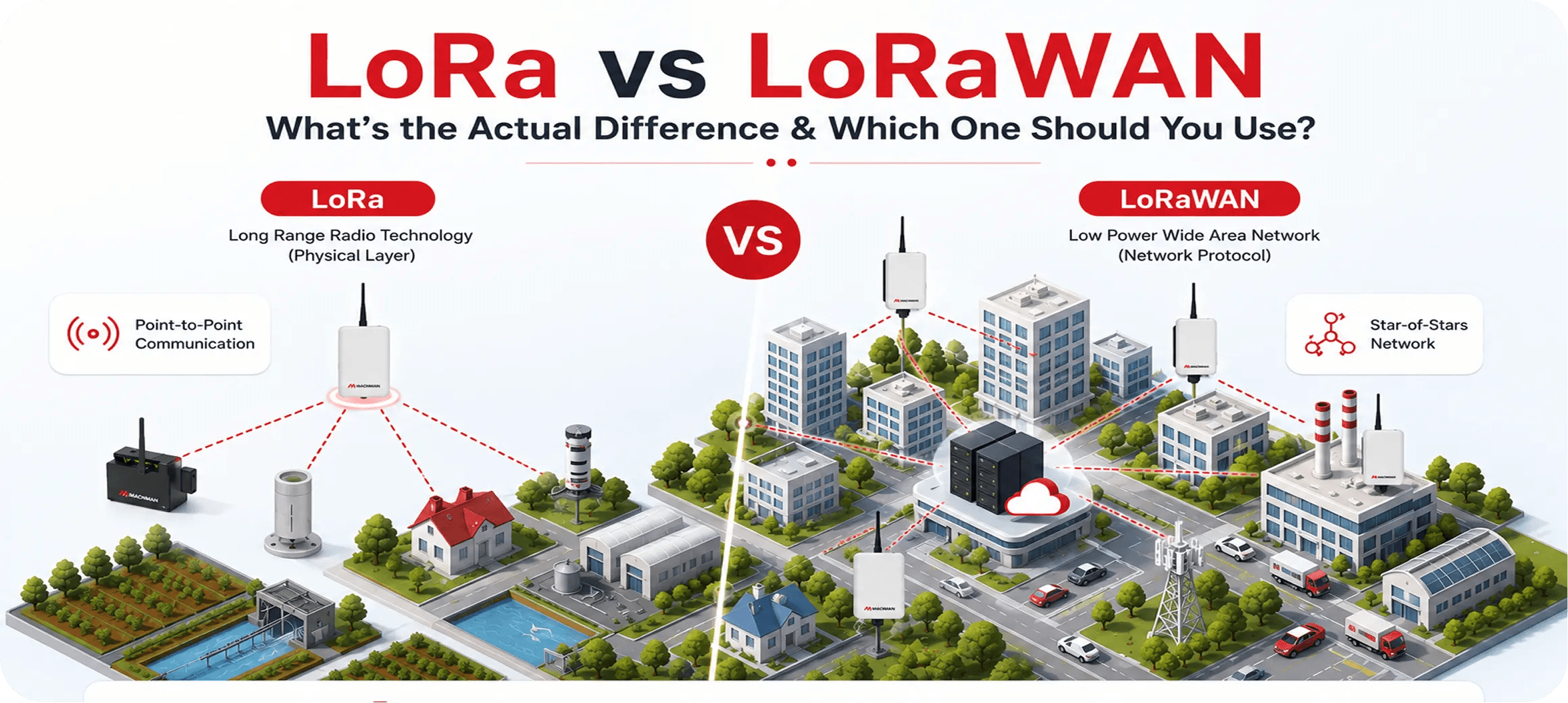
LoRa vs LoRaWAN – What's the Actual Difference & Which One Should You Use?
In the rapidly evolving world of the Industrial Internet of Things (IIoT) and Low-Power Wide-Area Networks (LPWAN), terms like LoRa and LoRaWAN are frequently tossed around interchangeably. Technical datasheets, marketing brochures, and system integration specs regularly conflate the two, leaving field engineers, automation professionals, and enterprise procurement managers with a fundamental point of confusion: If I am buying a LoRa sensor, am I automatically deploying a LoRaWAN network?
The short answer is no. Conflating LoRa with LoRaWAN is a bit like confusing an Ethernet cable with the global internet protocol (TCP/IP) suite. One is a physical link engineered to carry raw electrical pulses over a specific medium; the other is a massive, standardized network architecture that governs how millions of devices securely talk to each other across the globe.
Misunderstanding this structural divide can lead to costly mistakes. Selecting the wrong layer can bottleneck an industrial deployment, result in severe data packet collisions, compromise field security, or trap an organization inside an unscalable, proprietary island.
This deep dive dissolves the confusion. We will dissect the technical mechanics of both technologies, explore their underlying architectures, contrast their capabilities in a side-by-side engineering breakdown, and provide a clear framework to determine which solution fits your precise operational parameters.
What is LoRa? (The Physical Radio Layer)
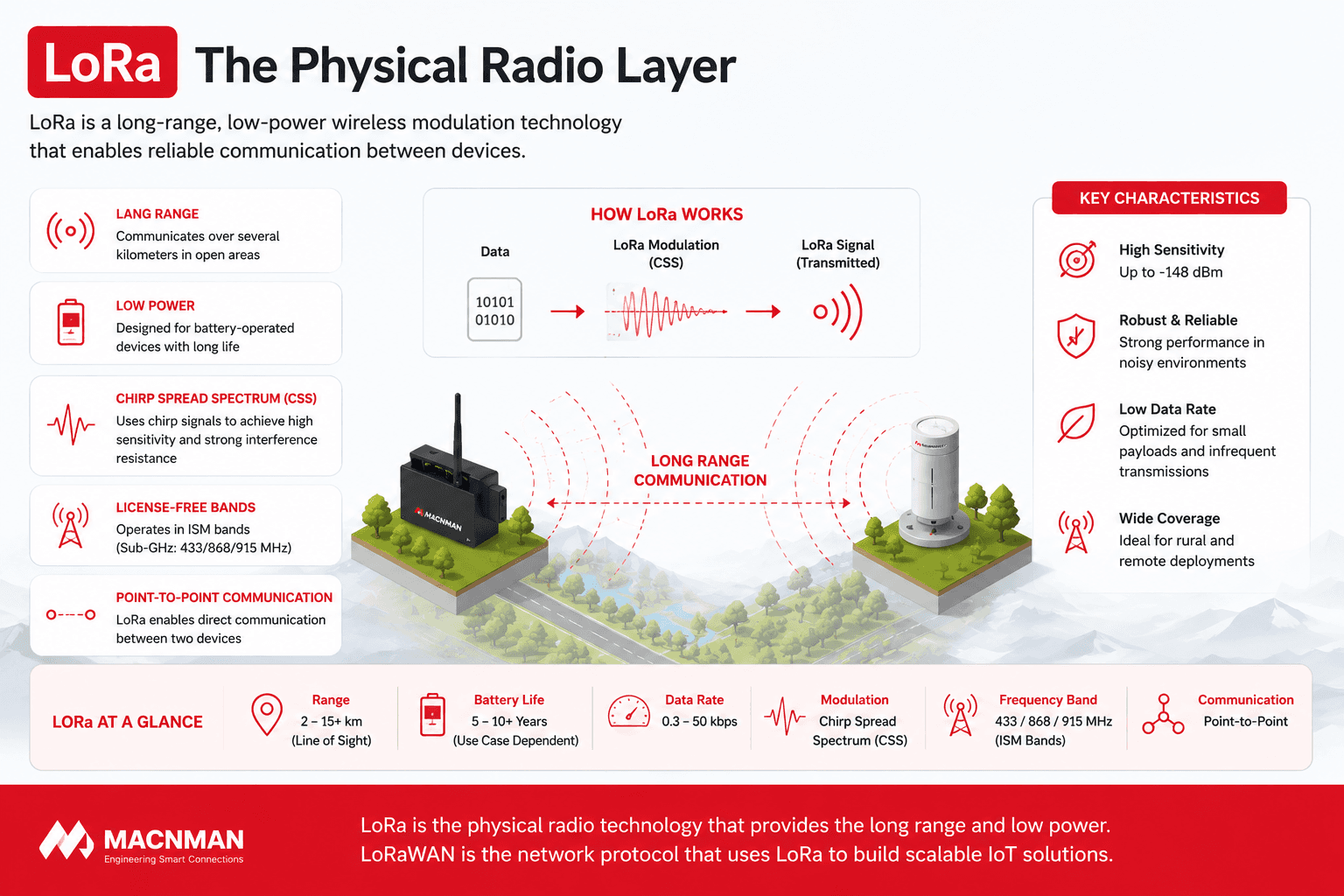
To understand this entire ecosystem, we must begin at the foundational hardware layer. LoRa (short for Long Range) is a proprietary, non-cellular wireless modulation technology developed and owned by Semtech Corporation. It operates entirely within the Physical (PHY) layer of the OSI model.
Instead of handling network servers, cloud routing, or data payloads, LoRa is solely responsible for one highly specialized task: encoding bits of data into radio frequency (RF) signals and pushing them across a physical distance with extreme efficiency.
The Standardized LoRaWAN Architecture
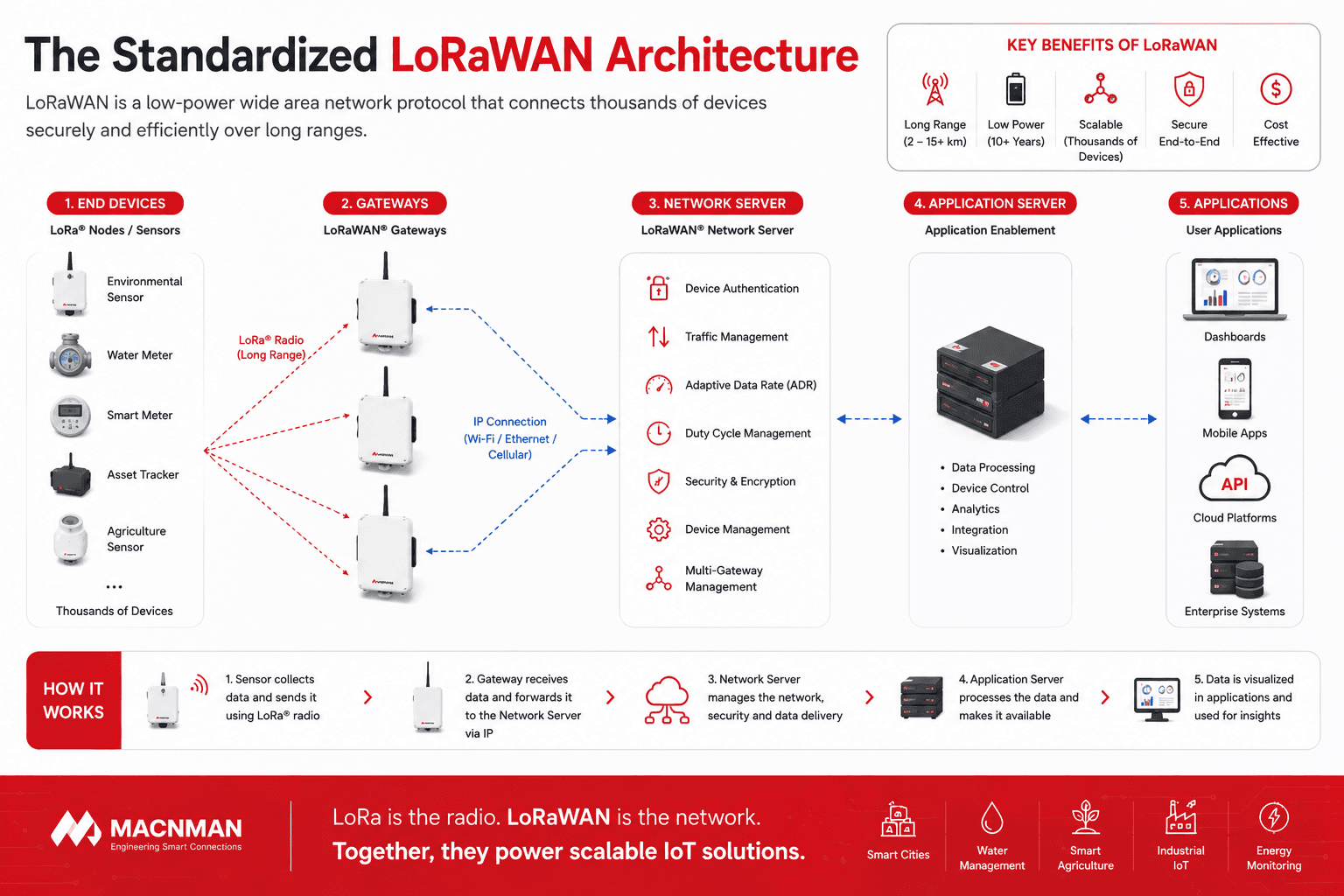
LoRaWAN eliminates the scaling limits of point-to-point radio by defining a highly coordinated, multi-tiered star-of-stars topology. Data flows seamlessly from field-deployed edge endpoints through localized collectors, arriving at unified cloud management engines.
The structural workflow of an enterprise LoRaWAN system follows a strict hierarchical path:
1. End Devices (Nodes & Sensors)
These are the industrial field hardware assets—such as MACNMAN LoRaWAN temperature, pressure, or water level sensors. They capture physical telemetry data, package it into structured payloads, and transmit it using LoRa modulation. They are not joined to a single gateway; instead, they broadcast their data blindly to any listening gateway within radio range.
2. Gateways (Concentrators)
A LoRaWAN Gateway acts as a transparent media bridge. It features a multi-channel RF front-end capable of listening to 8, 16, or 64 radio channels simultaneously. The gateway intercepts LoRa radio waves from any nearby node, wraps the raw payload in a standard IP packet (TCP/UDP), and pushes it over a standard backhaul link (Ethernet, 4G/5G Cellular, or Wi-Fi) to a centralized network server. Gateways do not decode or read the underlying data payloads; they are simple RF-to-IP relays.
3. Central Network Server (LNS)
The LoRaWAN Network Server (LNS)—such as ChirpStack, AWS IoT Core for LoRaWAN, or The Things Stack—is the brain of the network. It handles the critical management tasks required to keep the system functional, including:
- De-duplicating incoming data packets when multiple gateways intercept the same node transmission.
- Validating device security credentials and managing frame counters to eliminate replay attacks.
- Executing downlinks, network acknowledgments, and channel maps.
- Dynamically adjusting device data transmission rates via Adaptive Data Rate (ADR) routines.
4. Application Server
The final destination for the data payload. Once the LNS validates and strips away the LoRaWAN network headers, it routes the clean, unencrypted application payload (via MQTT, HTTP Webhooks, or gRPC) to the user's dashboard platform, SCADA infrastructure, ERP system, or cloud storage pipeline (such as Azure IoT Central or AWS IoT SiteWise).
The Three Device Classes (A, B, and C)
To balance the conflicting demands of low power consumption and real-time responsiveness, LoRaWAN categorizes all end devices into three distinct operational profiles:
Class A (All End Devices - Mandatory)
Class A is the most energy-efficient operating profile. Devices remain in deep sleep until an internal timer or external interrupt triggers an uplink transmission. Immediately following the uplink, the device opens two precise, brief downlink reception windows ($RX1$ and $RX2$).
The network server can only send commands to the device during these two windows. If you send a command to a Class A sensor while it is sleeping, the message is queued at the server and will not execute until the sensor decides to wake up and send its next payload.
- Ideal For: Battery-powered industrial sensors, environmental nodes, and water level gauges.
Class B (Beaconing - Optional)
In addition to the Class A random receive windows, Class B devices synchronize with the network gateway by receiving a periodic time-synchronized beacon signal. This beacon allows the device to open scheduled "ping slots" at specific intervals, allowing the server to send downlink commands with a predictable maximum latency.
- Ideal For: Smart metering arrays, remote valve actuators, and climate controls that must respond within minutes without rapidly depleting a battery.
Class C (Continuous - Optional)
Class C devices keep their radio receivers continuously open except when they are actively transmitting data. Because the receiver is never shut down, downlink latency is reduced to milliseconds. However, this high uptime consumes significant amounts of power.
- Ideal For: Mains-powered hardware, smart streetlights, industrial controllers, and Modbus-to-LoRaWAN gateways.
Adaptive Data Rate (ADR) & Enterprise Security
Two key features elevate LoRaWAN from a basic wireless link to a robust, industrial-grade infrastructure solution:
- Adaptive Data Rate (ADR): ADR is a dynamic optimization protocol managed by the network server. If a sensor is positioned close to a LoRaWAN gateway with an excellent Signal-to-Noise Ratio (SNR), the LNS commands the sensor to use a lower Spreading Factor ($\text{SF7}$) and a higher data rate. This minimizes airtime (the duration the radio is transmitting) down to milliseconds, conserving battery life and freeing up network capacity. If the device is moved far away or behind heavy concrete walls, the server shifts it to a higher Spreading Factor ($\text{SF12}$) to maintain an unbreakable link at the cost of higher power consumption.
- Dual-Layer AES-128 Cryptographic Security: LoRaWAN features built-in, end-to-end encryption. Security is separated into two isolated keys:
- Network Session Key (NwkSKey): Used by the network server to validate device authenticity, check frame counters, and manage routing data. The network provider cannot read your actual business data.
- App Session Key (AppSKey): Used to encrypt the underlying telemetry payload. This data can only be decrypted at the Application Server layer by the final user application, ensuring complete data privacy even across shared or public public network infrastructures.
LoRa vs LoRaWAN: Head-to-Head Comparison
To help your engineering and procurement teams choose the appropriate layer for your deployment, this comprehensive matrix highlights the operational differences across key metrics.
| Feature / Metric | Standalone LoRa (P2P) | LoRaWAN Protocol |
|---|---|---|
| OSI Layer Assignment | Layer 1 (Physical Layer Only) | Layer 2 & 3 (Data Link / Network Protocol) |
| Core Architecture Topology | Peer-to-Peer / Point-to-Point / Star | Multi-tiered Star-of-Stars Structure |
| Hardware Required | Minimum 2 nodes with matching RF transceivers | Nodes, Multi-Channel Gateways, Cloud LNS |
| Max Network Capacity | Extremely Low (typically less than 10-20 devices) | High Scalability (thousands of nodes per gateway) |
| Media Access Control | None (collisions likely without custom code) | Standardized ALOHA channel access + ADR |
| Downlink Management | Manual (must write custom listen-before-talk routines) | Automated via standardized Device Classes (A, B, C) |
| Built-In Cryptography | None (must be manually written in C/C++ firmware) | Native Dual-Layer AES-128 Encryption |
| Channel Management | Static single frequency allocation | Dynamic multi-channel cycling and hopping |
| Cloud Integration | Requires custom hardware gateways and parsers | Native via MQTT, HTTP Webhooks, Node-RED, AWS IoT |
Which One Should You Use? (Application Selection Framework)
Choosing between standalone LoRa P2P and a fully managed LoRaWAN network architecture is not a question of which technology is newer or faster—it depends entirely on scale, infrastructure ownership, and bidirectional latency parameters.
When to Select Standalone LoRa (Point-to-Point)
Standalone LoRa P2P shines in small, localized, isolated environments where data needs to jump a specific distance without complex backhaul routing.
- Remote Field Pump Controls: A water level switch on an agricultural tank needs to turn off a water pump 5 kilometers away across a valley. A simple P2P LoRa link bypasses the need for internet access, routers, or cloud servers.
- Basic HVAC Extension: Passing an analog signal from a rooftop ventilation unit directly down through 15 floors of concrete into a basement mechanical room controller without routing into corporate IT networks.
- Low Node Counts: Scenarios with fewer than 5 channels where data is unidirectional, and packet collisions are mathematically improbable.
When to Select LoRaWAN
LoRaWAN is the mandatory choice for modern enterprise environments, smart facilities, large-scale automation frameworks, and compliance-driven tracking grids.
Smart Manufacturing Plants: Monitoring hundreds of vibration, temperature, pressure, and gas sensors scattered across an active factory floor. LoRaWAN’s multi-channel capabilities and Adaptive Data Rate prevent interference from heavy industrial machinery.Smart Metering Arrays: Utility companies reading thousands of water, gas, or energy meters distributed across a 20-kilometer urban grid. Gateways collect the data, and the Network Server routes it cleanly into billing software.Cold Chain Logistics & Compliance Monitoring: Tracking pharmaceutical or food transport storage temperatures where data gaps can void regulatory safety compliance. LoRaWAN’s verified frame counters, data acknowledgments, and encrypted signatures provide an unalterable audit log.
Why LoRaWAN Delivers Enterprise Scalability
When building a long-term wireless network infrastructure, scalability is the metric that separates successful systems from expensive failures. This is where LoRaWAN provides a massive structural advantage over standalone peer-to-peer radio layouts.
1. Eliminating the Co-Channel Collision Problem
In a basic point-to-point network, every sensor transmits on a single, fixed frequency. If two nodes transmit at the same millisecond, their radio signals overlap, causing a data collision that corrupts both packets.
A standard LoRaWAN Gateway utilizes an advanced baseband processor (such as Semtech’s SX1302/SX1303 silicon core) that continuously monitors 8 to 16 channels simultaneously across multiple Spreading Factors. Furthermore, the LoRaWAN protocol forces devices to use pseudo-random channel hopping. Every time a MACNMAN sensor wakes up to transmit, it shifts to a different frequency channel according to regional regulatory definitions (such as the 865-867 MHz band in India or 915 MHz in North America). This orthogonal spacing allows a single outdoor gateway to process millions of messages per day without data loss.
2. Multi-Gateway Redundancy (Star-of-Stars)
In a traditional mesh network (such as Zigbee or traditional Wi-Fi topologies), a field device must pair with a specific local access point or router node. If that router loses power, the device goes dark until the network map can slowly self-heal.
LoRaWAN utilizes a decentralized star-of-stars topology. End devices do not pair with a specific gateway. Instead, a node broadcasts its payload into the air, and every single gateway within radio range captures that signal and forwards it upstream to the network server.
If Gateway A goes offline due to a localized power failure, Gateways B and C still capture the packet. The network server automatically de-duplicates the incoming streams, ensuring seamless data continuity without requiring any reconfiguration of your field hardware.
Common Misconceptions Addressed
Myth 1: "LoRa and LoRaWAN are two competing wireless standards."
- The Reality: They are not competitors; they are complementary components of the same stack. You cannot build a LoRaWAN network without utilizing LoRa modulation at the physical layer. Conversely, you can use LoRa radios independently without the LoRaWAN protocol, but you forfeit standard network management, security, and scalability features.
Myth 2: "LoRa standalone delivers longer range than LoRaWAN."
- The Reality: The maximum achievable range is dictated entirely by physics—specifically RF power output, antenna gain, environmental path loss, and the Spreading Factor chosen within the LoRa physical layer. Running a LoRaWAN protocol stack adds a tiny byte overhead to the data packet header, but it does not reduce the physical propagation characteristics of the underlying radio wave. In fact, because LoRaWAN network servers utilize automated Adaptive Data Rate (ADR) algorithms, LoRaWAN deployments often maintain long-range connections more reliably over time than unmanaged, statically configured P2P links.
Myth 3: "LoRaWAN networks are too complex and expensive for small installations."
- The Reality: With modern embedded open-source network stacks like ChirpStack, a complete private enterprise network server can run locally on an inexpensive industrial edge controller or an internal Linux server. You do not need to pay recurring data subscription fees to public telecom operators to leverage the structural safety, channel management, and automated security architectures of LoRaWAN.
Frequently Asked Questions
1. Can a standard LoRa node communicate directly with a LoRaWAN Gateway?
Yes, but only if the raw LoRa node is programmed with firmware that packs the data according to the precise structural rules defined by the LoRaWAN specification (including DevEUI, AppEUI, MIC cryptographic signatures, and proper frame counters). A node transmitting raw, unstructured P2P text strings will be rejected by a LoRaWAN gateway as invalid background noise.
2. What are the legal frequency bands for LoRa and LoRaWAN deployment?
Both technologies operate entirely within license-free, Industrial, Scientific, and Medical (ISM) sub-GHz radio bands. These frequencies are strictly regulated by geographic territory:
- India: 865 MHz to 867 MHz (extended up to 4 channels under local telecommunication rules).
- Europe: 868 MHz band.
- North America: 915 MHz band.
- Middle East: Varies between 868 MHz and 433 MHz depending on country-specific regulatory approvals.
3. Does LoRaWAN support real-time audio or video streaming?
No. LoRaWAN is engineered as a low-throughput telemetry pipe optimized for compact payloads (typically ranging from 51 to 222 bytes per transmission). It is built for sensor values—such as temperature updates, fluid levels, pressure logs, or GPS coordinates. Attempting to pass video or heavy data streams will violate regional radio duty-cycle regulations and rapidly drain your field batteries.
4. What is the role of the Spreading Factor (SF) in this ecosystem?
The Spreading Factor ($\text{SF7}$ through $\text{SF12}$) dictates how many chirps are used to encode a single bit of data. A lower Spreading Factor ($\text{SF7}$) sends data quickly, consumes the lowest amount of battery power, and provides higher bandwidth, but requires a cleaner radio environment. A high Spreading Factor ($\text{SF12}$) stretches the transmission over time, providing maximum receiver sensitivity to punch through heavy obstructions over long distances at the expense of speed and battery life.
5. How many sensors can a single industrial LoRaWAN gateway handle?
A standard 8-channel industrial outdoor gateway can easily process between 5,000 and 10,000 active end-devices scattered across its coverage radius, assuming the devices are configured to transmit standard periodic updates (e.g., sending a compact payload once every 15 minutes).
6. What is the difference between OTAA and ABP activation modes?
These are the two validation methods used to securely onboard a device onto a LoRaWAN network server:
- Over-The-Air Activation (OTAA): The secure and recommended method. The device exchanges a dynamic handshake with the server to generate fresh encryption keys ($NwkSKey$ and $AppSKey$) every time it connects.
- Activation By Personalization (ABP): The encryption keys are hardcoded directly into the device firmware during manufacturing. The device joins the network instantly without an initial handshake, which can introduce vulnerability risks if the physical hardware is ever compromised.
7. How does heavy rain or dense foliage impact LoRa and LoRaWAN performance?
Sub-GHz radio frequencies (like 868/915 MHz) are significantly less prone to attenuation from heavy downpours or dense trees than high-frequency networks like 2.4 GHz Wi-Fi or 5G cellular. However, dense wet foliage will cause minor signal degradation. This is where LoRaWAN's Adaptive Data Rate (ADR) steps in, automatically adjusting the node's power output and spreading factor to maintain a continuous data pipeline despite environmental changes.
Summary & Action Plan
Understanding the technical divide between LoRa and LoRaWAN is the first step toward building a reliable, long-term wireless strategy for your organization:
- LoRa is the physical foundation. It is the unique, proprietary radio modulation technology that enables wireless signals to travel long distances while running on minimal battery power.
- LoRaWAN is the network infrastructure built on top. It provides the open protocol, secure dual-layer encryption, automated scaling, multi-channel management, and cloud routing required to run an enterprise-grade IoT network.
For simple, standalone wire-replacement tasks with less than five nodes, standalone LoRa P2P can be effective. However, for industrial automation, smart grid monitoring, multi-sensor deployments, or systems requiring cloud integration, LoRaWAN is the industry standard.


