How to Choose a Smart Parking Sensor: Detection Types, Connectivity, and Which One Fits Which Deployment
Choosing a smart parking sensor comes down to one honest truth: there is no single "best" sensor, only the best-fit sensor for your site. The right choice depends on where you're deploying it — an open curb, a covered garage, a sprawling retail lot — and on the trade-offs you're willing to accept between accuracy, battery life, cost, and resistance to weather and interference. This guide walks through the main smart parking sensor types, the mounting and connectivity decisions that follow, and a deployment-by-deployment matrix so you can match the technology to your case.
A quick scope note before we start: this guide is about smart parking sensors — the IoT vehicle-detection devices that report whether a parking space is occupied, used in smart cities, commercial lots, and parking guidance systems. It is not about automotive bumper sensors that beep when you reverse. Those are a different product entirely.
What is a smart parking sensor?
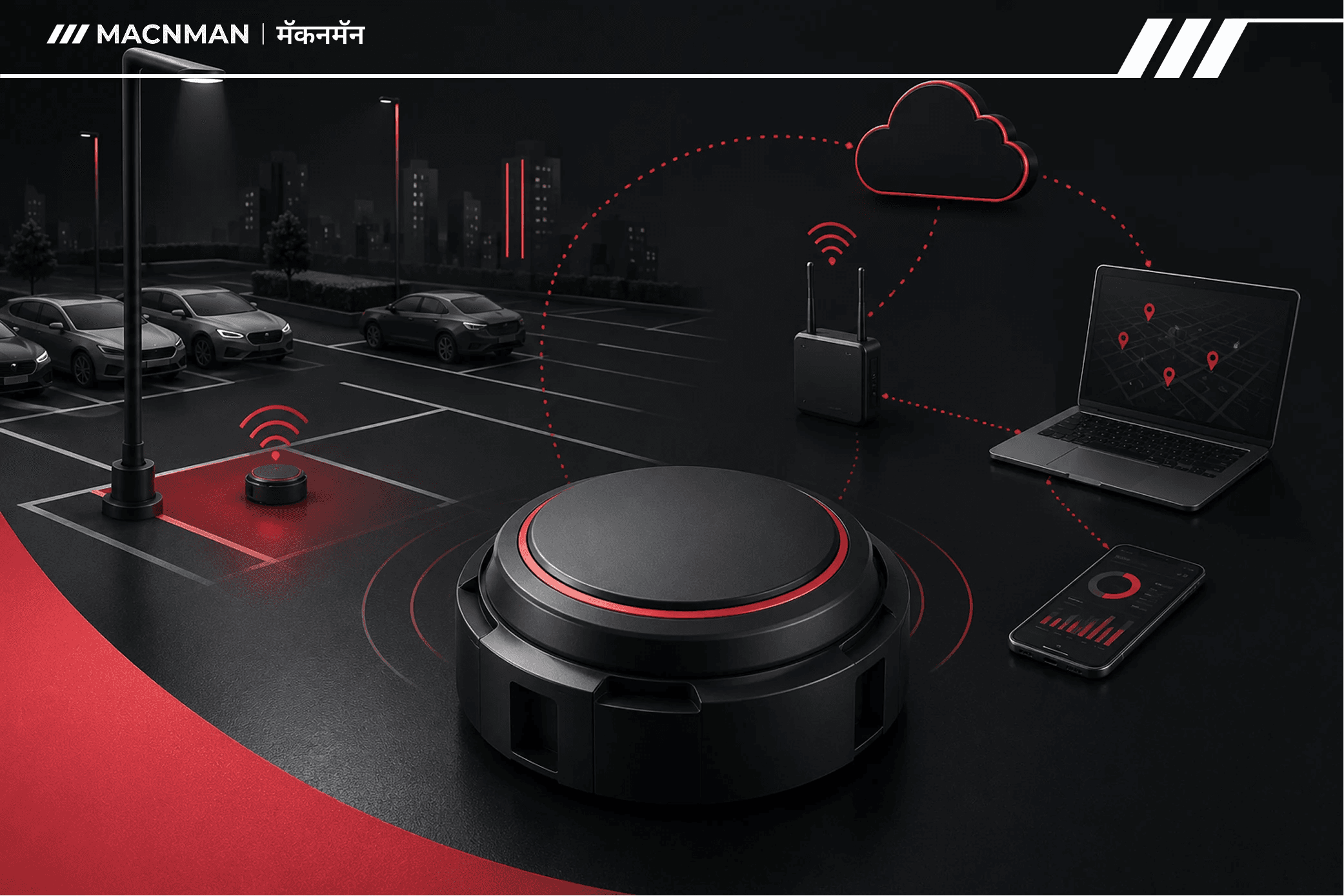
- A smart parking sensor is an IoT device that detects whether a single parking space (or a counted zone) is occupied and transmits that status wirelessly to a backend platform. That real-time occupancy data then feeds mobile apps, digital signage, enforcement systems, dynamic pricing, and analytics dashboards.
Most space-level sensors share the same anatomy: a detection element that senses the vehicle, a low-power radio that reports occupancy, a long-life battery, and a rugged enclosure that survives traffic loads and weather. What separates one sensor from another is how it detects the vehicle — the sensing modality — and that is the first and most important decision you'll make.
The main smart parking sensor types
There are five core detection technologies used in smart parking, plus a "fusion" approach that combines two of them. Each occupies a different point on the accuracy-versus-power-versus-cost spectrum, so understanding the trade-offs is the fastest route to the right choice.
Magnetometer (geomagnetic) sensors
Magnetometer sensors detect the distortion a vehicle's ferrous mass creates in the Earth's magnetic field. When a car parks over the sensor, the metal body warps the local magnetic field, and the sensor registers the space as occupied.
They are the workhorse of ground-based smart parking: low power, low cost, and small enough to embed flush in the pavement. The trade-off is that they can struggle with edge cases — a magnetometer alone may miss a non-ferrous vehicle, misread a car parked slightly off-center, or be fooled by strong external magnetic events such as a passing underground train. On their own they deliver good, not exceptional, accuracy.
Radar sensors
Radar sensors detect a vehicle by bouncing radio waves off it and measuring the reflection. Because radar senses physical presence rather than magnetic signature, it complements a magnetometer's weaknesses beautifully — it doesn't care whether the vehicle is ferrous and it's less affected by magnetic interference.
The cost is power and processing: radar signal processing demands more from the sensor's microcontroller, which shortens battery life relative to a bare magnetometer. Radar is rarely used alone at space level; its real value shows up in fusion sensors.
Ultrasonic sensors
Ultrasonic sensors sit overhead — typically on the ceiling of each bay in a covered garage — and emit sound waves downward, detecting a vehicle by the reflected echo. They're accurate and well-proven for indoor, structured parking, and they pair naturally with per-bay red/green indicator lights for driver guidance.
Their limitation is environmental: ultrasonic sensing wants a covered, controlled space. It's poorly suited to open outdoor lots where wind, temperature swings, and the absence of a ceiling to mount to make deployment impractical.
Infrared sensors
Infrared (IR) sensors detect vehicles either by reflected intensity or by time-of-flight ranging. They're inexpensive and can substitute for radar in a fusion sensor when optical obstructions aren't a concern.
The catch is that optical sensing is vulnerable to real-world debris: leaves, snow, standing water, and dirt can all interfere with the beam. In regions with four distinct seasons, IR is a weaker outdoor choice than radar.
Camera / video detection
Camera-based detection uses computer vision to identify occupancy across many spaces from a single overhead or pole-mounted unit. One camera can watch a whole row of bays, which changes the cost math for large lots, and video adds capabilities a point sensor can't match — license-plate recognition, security, and analytics.
The trade-offs are power, cost, connectivity, and privacy. Cameras need more bandwidth and often mains power, and they raise data-governance questions that ground sensors avoid. This is why the parking sensor vs camera decision is usually about scale and function, not raw accuracy: cameras win on coverage-per-unit and features, ground sensors win on per-space reliability, low power, and simplicity.
Dual-detection (sensor fusion)
Dual-detection sensors combine two modalities — most commonly magnetometer plus radar, or ultrasonic plus infrared — in a single device. Fusion resolves the edge cases that trip up any single method, and well-designed dual-detection sensors reach accuracy figures approaching 99%.
The trade-off is predictable: higher unit cost and, depending on the pairing, higher power draw. For most serious outdoor deployments today, a magnetometer-plus-radar sensor is the practical default, with the radar swapped for infrared time-of-flight only when leaves, snow, and optical obstruction aren't in play.
Detection-technology comparison
| Sensing type | Best environment | Accuracy | Power draw | Relative cost | Main weakness |
|---|---|---|---|---|---|
| Magnetometer | Outdoor, in-ground | Good | Very low | Low | Magnetic interference, off-center cars |
| Radar | Outdoor (in fusion) | High | Medium | Medium | Higher MCU load, shorter battery |
| Ultrasonic | Covered garages | High | Low-medium | Low-medium | Needs a ceiling; poor outdoors |
| Infrared | Outdoor, no debris | Medium | Low | Low | Leaves, snow, optical blockage |
| Camera | Large lots, security | High | High | High | Bandwidth, power, privacy |
| Dual-detection | Demanding outdoor | Very high (~99%) | Medium-high | High | Cost |
In-ground, surface-mount, or overhead: choosing the form factor
Once you've picked a sensing modality, mounting is the next decision, and it's driven by your maintenance model and traffic profile more than anything else.
In-ground sensors are embedded flush into the pavement at each space. They're the most robust and tamper-resistant option and the standard for on-street municipal deployments, but installation is more involved — you're cutting into asphalt or concrete.
Surface-mount sensors affix to the top of the pavement, often in well under a minute with adhesive. They're ideal for retrofits and lots where you can't or don't want to core the surface, at the cost of slightly more exposure to plows and heavy traffic.
Overhead / pole-mounted units — ultrasonic bay sensors or cameras — suit covered garages and guidance-first deployments where you want per-bay indicator lights or wide-area counting rather than embedded point detection.
If your site sees snow plows or heavy service vehicles, specify embedded installs or plow-resistant housings and confirm the enclosure's load rating exceeds your heaviest vehicle. For outdoor use, insist on an IP67 or IP68 rating with supporting lab reports.
Connectivity: LoRaWAN vs NB-IoT for smart parking
After sensing and mounting, you choose the radio. For smart parking, the two dominant low-power wide-area options are LoRaWAN and NB-IoT, and the choice hinges on who owns the network and how your spaces are distributed.
LoRaWAN uses gateways you deploy and control, which drives down ongoing connectivity fees and favors dense deployments — a shopping-center lot or a Park & Ride where one well-placed gateway can cover many spaces. NB-IoT connects each sensor directly to a mobile operator's cellular network, eliminating gateways but adding a per-device SIM cost; it shines where spaces are scattered far and wide, or in subterranean garages where operator coverage is strong. Many modern sensors ship with multi-radio support (LoRaWAN primary, NB-IoT or LTE-M fallback) so you can hedge coverage-critical zones.
This is a downstream decision — pick your sensing modality and deployment first, then match the radio. For a full breakdown of the LPWAN protocol trade-offs, including range, power, and cost across LoRaWAN, NB-IoT, LTE-M, BLE, and Wi-Fi, see our connectivity comparison pillar rather than re-deciding it here.
Which parking sensor should you use for which case?
This is where the selection guide earns its keep. Match the deployment to the modality, mounting, and connectivity below.
| Deployment | Recommended modality | Mounting | Connectivity | Why |
|---|---|---|---|---|
| On-street / curbside | Magnetometer + radar fusion | In-ground | LoRaWAN (city-owned) | Tamper-resistant, weatherproof, high accuracy per space |
| Open outdoor lot | Magnetometer + radar fusion | Surface or in-ground | LoRaWAN | Handles weather and non-ferrous edge cases |
| Covered garage / structure | Ultrasonic (with bay lights) | Overhead | LoRaWAN or wired | Controlled environment; per-bay guidance |
| Shopping mall / retail | Fusion or ultrasonic (mixed) | Mixed | LoRaWAN (one gateway) | Dense layout, single gateway economics |
| Campus / university | Magnetometer + radar | In-ground | LoRaWAN | Large, distributed, operator-owned network |
| Sprawling / scattered curbs | Magnetometer + radar | In-ground | NB-IoT | No cost-effective single gateway location |
| Counting / guidance only | Camera or overhead radar | Pole / overhead | Cellular or wired | Wide-area coverage per unit beats per-space cost |
The pattern is consistent: outdoor space-level detection defaults to magnetometer-plus-radar fusion, in-ground for permanence, over LoRaWAN where you control the gateways. Deviate from that default only when a specific constraint — covered environment, scattered geography, security requirements, or a counting-only goal — points elsewhere.
Smart parking sensor selection checklist
Before you commit to a vendor or a pilot, run through these criteria:
- Accuracy target. Single-modality sensors are "good"; dual-detection reaches ~99%. Decide what your enforcement and guidance use cases actually require — over-specifying accuracy costs money.
- Battery life, budgeted honestly. Headline claims of "up to 10 years" are only meaningful against a defined event profile. Ask the vendor to tie battery life to your expected occupancy-event rate, not a best-case lab figure.
- Environmental rating. For outdoor use, require IP67/IP68 with test reports, plus a load rating that clears your heaviest service vehicle.
- RF planning first. Plan gateway placement and run link-budget simulations before civil works. A single high, well-sited gateway often outperforms several lower ones in dense urban settings.
- Installation and maintenance model. In-ground is robust but disruptive to install; surface-mount is fast but more exposed. Choose the one that matches how you'll service the fleet over 7–10 years.
- Total cost of ownership. Weigh unit price against connectivity fees, gateway CAPEX, installation labor, and battery-replacement cycles — not sticker price alone.
- Integration and scalability. Confirm the platform exposes APIs for signage, enforcement, payments, and navigation, and that the network can start small and expand.
Frequently asked questions
- What is the best smart parking sensor? There is no single best smart parking sensor. For most outdoor, space-level deployments the practical default is a dual-detection sensor combining a magnetometer and radar, mounted in-ground and reporting over LoRaWAN. Covered garages are better served by overhead ultrasonic sensors, and large lots may favor camera-based detection for coverage and security.
- What are the main types of smart parking sensors? The five core detection technologies are magnetometer (geomagnetic), radar, ultrasonic, infrared, and camera/video. Many high-accuracy sensors use dual detection — most often magnetometer plus radar — to combine the strengths of two methods and resolve edge cases.
- How accurate are smart parking sensors? Single-modality sensors deliver good accuracy but can be tripped up by edge cases such as off-center parking, non-ferrous vehicles, or magnetic and optical interference. Dual-detection sensors that fuse two modalities can reach accuracy approaching 99%.
- Which is better for parking detection, a sensor or a camera? It depends on scale and function. Ground sensors win on per-space reliability, low power, and simplicity. Cameras win on coverage-per-unit and added capabilities like license-plate recognition and security, at the cost of higher bandwidth, power, and privacy considerations. Large lots and security-driven deployments often favor cameras; per-space occupancy favors ground sensors.
- Should I use LoRaWAN or NB-IoT for smart parking? Use LoRaWAN when you can host your own gateways and spaces are clustered — it lowers ongoing connectivity costs. Use NB-IoT when spaces are scattered or gateway installation is impractical, since it connects directly to a mobile network without gateways. Many sensors support both for flexibility.
- How long do smart parking sensor batteries last? Well-designed sensors can last up to about ten years, but real-world battery life depends heavily on how frequently the space turns over and how often the sensor transmits. Always evaluate battery life against your actual occupancy-event profile rather than a headline figure.
- What is the best parking sensor for a garage? For covered parking structures, overhead ultrasonic sensors paired with per-bay indicator lights are the standard choice. They perform reliably in a controlled indoor environment and provide clear visual guidance to drivers.
Conclusion
Choosing a smart parking sensor is a sequence of matched decisions rather than a hunt for a single winner. Start with the sensing modality that fits your environment — magnetometer-plus-radar fusion for demanding outdoor sites, ultrasonic for covered garages, cameras where coverage and security matter more than per-space cost. Layer on the right mounting for your maintenance model, then pick the connectivity that fits your network ownership and site geography. Validate accuracy, battery life against real event budgets, and environmental ratings before you scale. Get that sequence right and the "best" sensor stops being a mystery — it's simply the one that fits your case.


