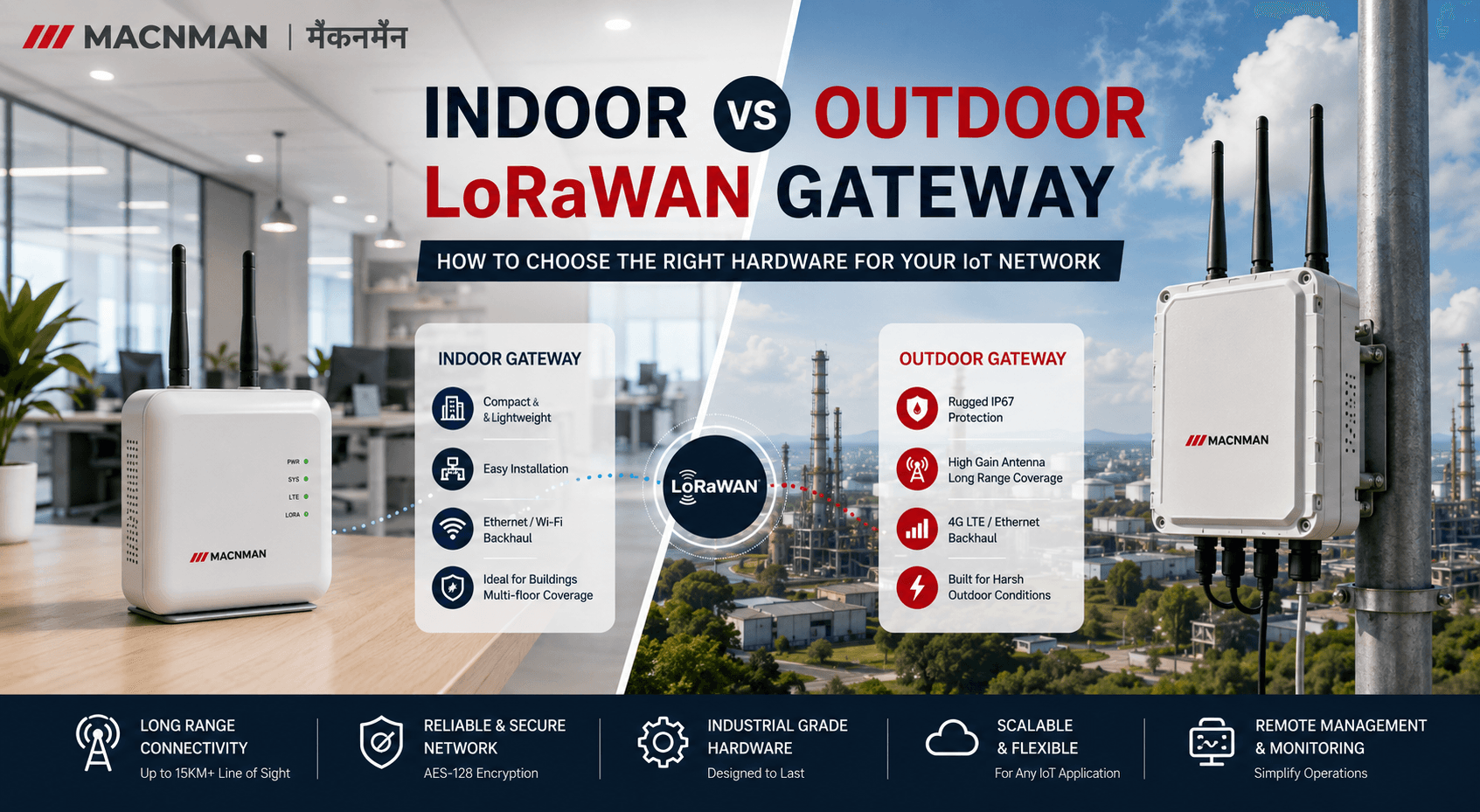
Indoor vs Outdoor LoRaWAN Gateway: How to Choose the Right Hardware
Choosing the wrong LoRaWAN gateway causes severe signal loss and structural failure. Learn how to select the right indoor or outdoor LoRaWAN gateway based on RF coverage, environmental conditions, and industrial deployment requirements.
Deep Technical Breakdown: The Engineering Differences
Ingress Protection & Material Engineering
The enclosure surrounding a gateway is more than a protective shell—it is an integral part of the system's thermal management, environmental durability, and long-term reliability.
Indoor LoRaWAN Gateways
Indoor gateways are engineered for climate-controlled environments where exposure to moisture, dust, ultraviolet radiation, and large temperature fluctuations is minimal.
Typical design characteristics include:
- IP30 or IP54 ingress protection
- Lightweight ABS or polycarbonate housing
- Passive convection cooling
- Compact desktop or wall-mounted form factor
- Internal antennas or low-gain external antennas
- Minimal weather sealing
These gateways are optimized for simplicity and rapid deployment. Plastic enclosures reduce manufacturing costs while allowing passive airflow to dissipate heat generated by the processor and radio modules.
Typical deployment environments include:
- Smart offices
- Educational institutions
- Hospitals
- Hotels
- Shopping malls
- Warehouses
- Laboratories
- Commercial buildings
Because these locations are temperature controlled, designers can prioritize compact size and installation flexibility over rugged environmental protection.
Outdoor LoRaWAN Gateways
Outdoor gateways face a completely different operating environment.
They must withstand years of continuous exposure to:
- Heavy rainfall
- High humidity
- Dust storms
- UV radiation
- Wind-driven debris
- Salt fog
- Thermal cycling
- Lightning-induced electrical surges
To survive these conditions, enterprise-grade outdoor gateways employ significantly more robust mechanical engineering.
Typical specifications include:
- IP67-rated enclosure
- Powder-coated die-cast aluminum housing
- Waterproof cable glands
- Corrosion-resistant stainless steel hardware
- Industrial pressure equalization vents
- Wide operating temperature range (-40°C to +60°C)
Unlike plastic housings, die-cast aluminum acts as a passive heat sink, transferring internal heat away from processors and RF components. This improves long-term reliability while reducing the likelihood of thermal throttling during peak summer temperatures.
Industrial gateways such as MACNMAN's outdoor LoRaWAN gateway portfolio combine rugged mechanical construction with enterprise-grade RF architecture, making them suitable for continuous operation in demanding environments including manufacturing plants, utility infrastructure, ports, and smart agriculture deployments.
Temperature is one of the primary causes of electronic component degradation.
Every 10°C increase in operating temperature accelerates semiconductor aging and reduces the expected lifespan of electronic assemblies.
Indoor gateways dissipate heat using passive airflow.
Outdoor gateways cannot rely on open ventilation because moisture and dust would immediately compromise internal electronics.
Instead, industrial outdoor gateways utilize:
- Die-cast aluminum heat dissipation
- Optimized PCB thermal layout
- High-efficiency power supplies
- Weather-sealed pressure equalization vents
- Wide-temperature industrial-grade electronic components
These design considerations ensure stable RF performance even during prolonged exposure to direct sunlight or high ambient temperatures.
Radio Dynamics & Coverage Geometry
The greatest difference between indoor and outdoor gateways lies in how radio waves propagate through their surrounding environment.
Selecting the wrong gateway often results in excessive path loss, poor receiver sensitivity, and unnecessary infrastructure costs.
Indoor Coverage Geometry
Indoor gateways are optimized for communication within building envelopes rather than maximum transmission distance.
Characteristics include:
- Vertical propagation through multiple floors
- Short communication distances
- Strong tolerance to indoor multipath reflections
- Lower antenna mounting heights
- Dense sensor deployments
Depending on building construction, a single indoor gateway can typically provide reliable coverage across three to five floors.
Applications include:
- Building automation
- HVAC monitoring
- Smart lighting
- Occupancy sensing
- Energy monitoring
- Indoor environmental monitoring
Because communication distances remain relatively short, lower-gain antennas often provide more uniform coverage throughout the building.
Outdoor Coverage Geometry
Outdoor gateways prioritize horizontal coverage over vertical penetration.
Installed above surrounding obstructions, they maximize line-of-sight communication while minimizing diffraction losses.
Typical mounting locations include:
- Communication towers
- Rooftops
- Utility poles
- Lighting poles
- Grain silos
- Water towers
Outdoor gateways generally utilize 5 dBi to 8 dBi fiberglass omnidirectional antennas that significantly increase communication range.
When combined with sufficient antenna height and proper Fresnel Zone clearance, outdoor gateways can provide reliable coverage across several kilometers depending on terrain, building density, antenna gain, and regional transmission power regulations.
Rather than attempting to penetrate multiple reinforced concrete structures, outdoor gateways establish a large RF coverage umbrella that efficiently serves dispersed outdoor assets.
Understanding Fresnel Zone Clearance
One of the most misunderstood aspects of LoRaWAN network planning is the First Fresnel Zone.
Many installers assume that if the gateway and sensor can visually "see" each other, the communication path is fully optimized.
In reality, radio waves occupy an elliptical volume around the direct line-of-sight path known as the Fresnel Zone.
Objects such as:
- Buildings
- Trees
- Utility poles
- Storage tanks
- Shipping containers
- Metallic process equipment
can partially block this zone, introducing diffraction losses even when direct visibility exists.
Professional RF engineers recommend maintaining at least 60% Fresnel Zone clearance for long-distance outdoor links to maximize receiver sensitivity and minimize packet loss.
This is one of the primary reasons why elevated outdoor gateways consistently outperform lower-mounted installations, even when transmit power remains identical.
Deployment Logistics & Backhaul Architecture
Gateway deployment extends beyond RF coverage. Reliable communication between the gateway and the network server is equally critical.
Indoor Deployment
Indoor gateways prioritize installation simplicity.
Typical mounting options include:
- Wall mounting
- Ceiling mounting
- Desktop installation
- DIN rail integration
Backhaul options generally include:
- Ethernet
- Wi-Fi
- Power over Ethernet (PoE)
These installations require minimal civil infrastructure and are typically completed within a few hours.
Outdoor Deployment
Outdoor gateways require considerably more planning.
Typical installation requirements include:
- Pole or mast mounting
- Waterproof cable routing
- Lightning grounding
- Weatherproof RF connectors
- Surge-protected power supplies
- Outdoor-rated Ethernet cables
Enterprise deployments frequently incorporate multiple backhaul options such as Gigabit Ethernet and 4G LTE with dual-SIM failover, ensuring uninterrupted communication even when the primary wired connection becomes unavailable.
MACNMAN's industrial outdoor gateways integrate intelligent cellular backhaul capabilities, enabling reliable connectivity for remote deployments where broadband infrastructure is limited or unavailable.
The Enterprise Buyer's Decision Matrix
Selecting the correct LoRaWAN gateway should never begin with comparing specifications or pricing. Enterprise deployments succeed when gateway architecture is matched to the physical environment, RF propagation characteristics, and long-term operational requirements.
The following engineering framework helps system integrators determine the most suitable gateway architecture before procurement begins.
1. Evaluate the Physical Distribution of Assets
The first design question should always be:
Where are the sensors located?
If sensors are distributed over a wide outdoor area, the network requires an outdoor gateway capable of maximizing horizontal RF coverage.
Typical outdoor deployments include:
- Smart agriculture
- Solar power plants
- Wind farms
- Water reservoirs
- Oil & gas pipelines
- Utility substations
- Railway infrastructure
- Mining operations
- Logistics parks
- Container terminals
Outdoor gateways leverage elevated mounting positions and high-gain antennas to cover several square kilometers while minimizing gateway density.
Conversely, indoor gateways are more appropriate when devices remain concentrated within controlled environments.
Typical indoor applications include:
- Commercial office buildings
- Smart hospitals
- Universities
- Hotels
- Shopping malls
- Manufacturing facilities
- Pharmaceutical laboratories
- Warehouses
Indoor deployments benefit from shorter communication distances, simplified installation, and lower infrastructure costs.
Engineering Recommendation
Sensor Layout
Recommended Gateway
Open outdoor campus
Outdoor Gateway
Multi-building industrial facility
Hybrid Deployment
Smart commercial building
Indoor Gateway
Utility infrastructure
Outdoor Gateway
Manufacturing plant
Indoor + Outdoor Hybrid
Selecting the gateway based on asset distribution significantly reduces infrastructure costs while improving RF reliability.
Understand Building Materials and Signal Attenuation
One of the biggest mistakes in LoRaWAN deployment planning is assuming that Sub-GHz frequencies easily penetrate every structure.
While LoRaWAN provides substantially better penetration than Wi-Fi or 5 GHz networks, every construction material introduces insertion loss.
Typical attenuation values include:
Material : Approximate Signal Loss
Drywall -: 2–4 dB
Brick Wall -: 5–10 dB
Reinforced Concrete-: 10–20 dB
Low-E Glass-: 10–18 dB
Metal Cladding-: 20–35 dB
Steel Machinery-: 20 dB+
Large manufacturing facilities present additional RF challenges because signals must often pass through:
- Steel racks
- Process vessels
- Pipe galleries
- Conveyor systems
- Electrical cabinets
- Industrial machinery
Although an outdoor gateway may appear to provide sufficient coverage on a site map, these obstacles can create significant RF shadow zones.
In many industrial environments, installing several strategically positioned indoor gateways produces considerably higher packet delivery rates than attempting to penetrate the entire facility from a single rooftop gateway.
Professional RF design prioritizes coverage quality over theoretical communication distance.
3. Evaluate Antenna Height Before Increasing Gateway Count
Many engineers respond to poor coverage by adding additional gateways.
In reality, inadequate antenna height is often the root cause.
Increasing antenna elevation typically provides greater performance improvements than increasing transmit power.
Higher mounting positions offer several advantages:
- Improved Line-of-Sight (LOS)
- Reduced diffraction losses
- Better Fresnel Zone clearance
- Lower multipath fading
- Increased gateway diversity
- Larger communication footprint
Typical installation heights include:
Deployment
Recommended Height
Indoor Office-: 2.5–4 meters
Warehouse-: 5–8 meters
Factory-: 8–12 meters
Rooftop-: 10–20 meters
Utility Pole-: 12–30 meters
Whenever possible, mount antennas above nearby obstructions rather than increasing transmitter power.
4. Consider Backhaul Availability
Reliable sensor communication is only one half of the network.
The gateway must also maintain continuous connectivity with the LoRaWAN Network Server.
Typical backhaul options include:
Ethernet
Advantages:
- Lowest latency
- Highest reliability
- Stable bandwidth
- Ideal for permanent installations
Best suited for:
- Offices
- Factories
- Smart buildings
Wi-Fi
Advantages:
- Rapid deployment
- No Ethernet cabling
- Lower installation cost
Limitations:
- Potential interference
- Coverage limitations
- Shared bandwidth
Suitable for temporary or small-scale indoor deployments.
Cellular (4G LTE)
Advantages:
- Independent connectivity
- Remote deployment
- Rapid installation
- Minimal infrastructure
Ideal for:
- Agriculture
- Mining
- Utilities
- Oil & Gas
- Water infrastructure
Enterprise outdoor gateways increasingly support Dual-SIM LTE failover, enabling uninterrupted operation even if one cellular provider experiences service degradation.
The "NEMA Box Hack" — Why It Usually Fails
A surprisingly common installation shortcut involves placing an inexpensive indoor gateway inside a plastic NEMA enclosure to create a makeshift outdoor gateway.
While this appears economical, it introduces several serious engineering problems.
Thermal Build-Up
Indoor gateways rely on natural airflow for cooling.
Once enclosed inside a sealed plastic box, internal temperatures rise rapidly due to:
- Solar radiation
- Processor heat
- Power supply losses
- Poor ventilation
Temperatures exceeding 70°C inside the enclosure are not uncommon during summer afternoons.
High temperatures lead to:
- CPU thermal throttling
- Reduced RF output stability
- Increased packet loss
- Premature component aging
- Unexpected gateway reboots
Internal Condensation
Temperature fluctuations between day and night generate condensation inside sealed enclosures.
Moisture gradually accumulates on:
- PCB assemblies
- RF connectors
- Power circuitry
- Ethernet interfaces
Over time this results in:
- Corrosion
- Oxidation
- Connector degradation
- Reduced RF performance
- Equipment failure
Industrial outdoor gateways utilize breathable pressure-equalization vents specifically designed to prevent this problem.
Poor RF Geometry
Another overlooked issue involves antenna placement.
Improvised outdoor installations often require:
- Long coaxial cables
- Multiple RF adapters
- Sharp cable bends
- Waterproof extension assemblies
Each connector and cable introduces insertion loss.
Even losing 2–3 dB in feeder cable can noticeably reduce communication range.
Purpose-built outdoor gateways minimize RF cable length by integrating the radio directly adjacent to the antenna interface.
No Lightning Protection
Indoor gateways are not engineered for lightning exposure.
Without:
- Ground bonding
- Gas Discharge Tube (GDT) protection
- Surge suppression
- Proper earthing
Nearby lightning strikes can permanently damage RF front-end components and network interfaces.
Industrial outdoor gateways integrate these protections into the overall hardware architecture.
Common Gateway Deployment Mistakes
Many LoRaWAN coverage problems originate from deployment practices rather than gateway hardware.
Avoid these common mistakes:
Installing the Gateway Below Rooftop Level
Large buildings block significant portions of the RF coverage area.
Always maximize antenna elevation whenever possible.
Using Low-Quality Coaxial Cable
Poor-quality feeder cables introduce unnecessary insertion loss.
For outdoor deployments, select low-loss coaxial cable and keep cable lengths as short as practical.
Ignoring Fresnel Zone Clearance
Maintaining visual line of sight alone is insufficient.
Trees, storage tanks, and nearby buildings can partially block the Fresnel Zone, reducing receiver sensitivity despite apparent visibility.
Deploying Too Few Gateways
Large industrial campuses rarely achieve optimal coverage using a single gateway.
Distributed gateway architecture generally provides:
- Better redundancy
- Improved packet reception
- Higher network capacity
- Lower sensor transmit power
- Longer battery life
Selecting Hardware Based Only on Price
Gateway replacement costs often exceed the initial hardware savings.
Engineering considerations should prioritize:
- Environmental durability
- RF performance
- Long-term maintenance
- Backhaul redundancy
- Future scalability
The lowest-cost gateway is rarely the lowest-cost deployment over a ten-year operational lifecycle.
Engineering Deployment Checklist
Before finalizing gateway selection, every project should verify the following:
Engineering Checkpoint
Completed
□ Deployment environment identified
□ Indoor vs outdoor architecture selected
□ RF site survey completed
□ Link budget calculated
□ Fresnel Zone evaluated
□ Antenna height optimized
□ Backhaul redundancy verified
□ Grounding design completed
□ Lightning protection specified
□ Future expansion planned
Projects that complete this checklist typically require fewer redesigns, experience higher packet delivery rates, and achieve lower long-term maintenance costs.
Hybrid LoRaWAN Gateway Architecture for Enterprise Deployments
For enterprise-scale Industrial IoT projects, the decision is rarely indoor versus outdoor. The most resilient and scalable LoRaWAN networks combine both gateway types, allowing each to perform the role it is best suited for.
A hybrid architecture maximizes RF coverage, reduces infrastructure costs, improves network redundancy, and simplifies future expansion without compromising communication reliability.
Instead of relying on a single gateway to overcome every propagation challenge, engineers strategically deploy outdoor gateways to establish wide-area coverage while using indoor gateways to eliminate localized RF shadow zones.
Layer 1: Outdoor Macro Coverage
The primary layer of the network begins with one or more industrial-grade outdoor gateways installed at elevated locations such as:
- Communication towers
- Building rooftops
- Utility poles
- High-mast lighting poles
- Water tanks
- Industrial structures
Their objective is to establish a large RF coverage umbrella across the facility while maximizing line-of-sight communication.
Typical outdoor assets include:
- Utility meters
- Agriculture sensors
- Water reservoirs
- Weather stations
- Environmental monitoring
- Solar farms
- Parking infrastructure
- Logistics yards
Because these gateways operate above surrounding obstructions, they achieve significantly greater communication distances while maintaining stronger receiver sensitivity.
A typical industrial outdoor gateway should provide:
- IP67 environmental protection
- Wide operating temperature range
- High-gain external antenna support
- Lightning surge protection
- Ethernet and cellular backhaul
- Industrial-grade thermal management
Solutions such as the MACNMAN Outdoor LoRaWAN Gateway are specifically engineered for these deployment scenarios, where environmental durability and long-term reliability are equally as important as RF performance.
Layer 2: Indoor Coverage Extension
Outdoor coverage alone cannot overcome every propagation obstacle.
Buildings containing reinforced concrete, steel machinery, elevator shafts, underground parking, or mechanical equipment often create RF shadow zones that reduce packet delivery rates.
Rather than increasing transmitter power, engineers typically deploy indoor gateways to extend localized coverage within these challenging environments.
Typical installations include:
- Manufacturing production floors
- Warehouses
- Commercial office buildings
- Hospitals
- Laboratories
- Data centers
- Control rooms
- Basements
Benefits include:
- Improved packet reception
- Lower sensor transmission power
- Extended battery life
- Better roaming between gateways
- Reduced retransmissions
- Increased overall network capacity
This layered deployment strategy produces significantly more consistent coverage than attempting to penetrate complex building structures from a distant rooftop gateway.
Layer 3: Backhaul Resilience
Reliable RF communication is only one component of an Industrial IoT network.
Every gateway must also maintain dependable connectivity with the LoRaWAN Network Server.
Enterprise deployments typically incorporate multiple backhaul options including:
- Gigabit Ethernet
- Power over Ethernet (PoE)
- 4G LTE
- Dual-SIM Cellular Failover
- VPN Connectivity
This architecture minimizes downtime by maintaining communication even if the primary wired network becomes unavailable.
Why Hybrid Networks Scale More Efficiently
Industrial IoT deployments rarely remain static.
As facilities expand, new sensors are typically added across additional buildings, production lines, storage yards, or remote assets.
A hybrid gateway architecture allows organizations to scale incrementally without redesigning the entire network.
Advantages include:
- Reduced infrastructure costs
- Improved gateway diversity
- Higher packet delivery rates
- Better RF redundancy
- Simplified maintenance
- Lower power consumption at end devices
- Flexible future expansion
Rather than replacing existing gateways, engineers simply extend coverage where new assets are deployed.
For campuses, utilities, logistics hubs, manufacturing facilities, and smart city infrastructure, this modular approach consistently delivers the highest long-term return on investment.
Engineering FAQ
Can an indoor LoRaWAN gateway be installed outdoors?
No. Indoor gateways are designed for climate-controlled environments and typically offer IP30 or IP54 ingress protection. Installing one outdoors—even inside a generic plastic enclosure—can result in overheating, internal condensation, corrosion, reduced RF performance, and premature hardware failure. Outdoor deployments should always use purpose-built IP67 gateways designed for continuous environmental exposure.
Is an outdoor LoRaWAN gateway always better than an indoor gateway?
No. Outdoor gateways provide wider horizontal coverage and greater environmental protection, but they are not inherently superior. Indoor gateways often deliver better performance inside offices, hospitals, warehouses, and commercial buildings because they avoid the signal attenuation caused by reinforced concrete, steel structures, and Low-E glass. The correct gateway depends on the deployment environment rather than the enclosure type.
How much area can an outdoor LoRaWAN gateway cover?
Coverage depends on antenna height, antenna gain, terrain profile, Fresnel Zone clearance, building density, regional transmission regulations, and receiver sensitivity. Under favorable line-of-sight conditions, an outdoor gateway can provide coverage across several kilometers. Dense industrial sites and urban environments generally require shorter planning distances and additional gateway density.
How many floors can an indoor LoRaWAN gateway cover?
A properly positioned indoor gateway can typically provide reliable communication across three to five floors in modern commercial buildings. Coverage varies depending on wall materials, reinforced concrete slabs, elevator shafts, and metallic infrastructure. Large industrial facilities frequently require multiple gateways to maintain consistent signal quality.
What IP rating should an outdoor LoRaWAN gateway have?
For industrial applications, IP67 is generally considered the minimum recommended protection level. An IP67 enclosure provides complete dust protection and withstands temporary water immersion, making it suitable for long-term outdoor deployments exposed to rain, dust, and high humidity.
Why do outdoor gateways require grounding and lightning protection?
Outdoor gateways are commonly installed on rooftops, towers, and utility poles where nearby lightning strikes can induce high transient voltages into antenna cables and power lines. Proper grounding, equipotential bonding, and inline Gas Discharge Tube (GDT) surge protectors safely divert these surges away from sensitive RF electronics, significantly improving long-term hardware reliability.
Does antenna height improve LoRaWAN range?
Yes. Increasing antenna elevation generally has a greater impact on communication range than increasing transmitter power. Higher installations improve line-of-sight visibility, reduce diffraction losses, increase Fresnel Zone clearance, and minimize multipath fading, resulting in stronger and more stable RF links.
Can a single outdoor gateway cover an entire factory?
In most cases, no. Industrial facilities contain steel structures, machinery, storage racks, process equipment, and reinforced concrete walls that create RF shadow zones. A distributed architecture using multiple indoor gateways alongside one or more outdoor gateways generally provides superior packet delivery and greater network resilience.
Which backhaul option is best for a LoRaWAN gateway?
Ethernet remains the preferred option for permanent installations because it offers low latency and high reliability. Outdoor deployments often combine Ethernet with 4G LTE or Dual-SIM cellular failover to maintain connectivity during network outages. Wi-Fi is typically reserved for smaller indoor deployments where wired infrastructure is unavailable.
What is the biggest mistake when deploying a LoRaWAN gateway?
The most common mistake is selecting hardware before conducting an RF site survey. Other frequent issues include poor antenna placement, ignoring Fresnel Zone clearance, using excessive coaxial cable lengths, inadequate grounding, and attempting to use indoor gateways in outdoor environments. Proper RF planning consistently delivers better network performance than simply increasing transmitter power or adding additional gateways.
Selecting the Right Gateway Is an Engineering Decision
The success of a LoRaWAN deployment depends far more on RF planning, gateway placement, antenna selection, environmental suitability, and network architecture than on selecting the highest transmit power or the lowest-cost hardware.
Indoor gateways remain the preferred solution for smart buildings, commercial offices, hospitals, educational campuses, and facilities where sensors are concentrated within controlled environments. Outdoor gateways become essential when monitoring utilities, logistics infrastructure, agriculture, manufacturing campuses, or geographically distributed assets exposed to weather.
For many enterprise projects, the optimal architecture combines both gateway types to create overlapping coverage zones that improve packet delivery, eliminate blind spots, and simplify future expansion.
When evaluating gateway hardware, engineers should prioritize:
- Environmental protection (IP rating)
- RF receiver sensitivity
- Antenna compatibility
- Backhaul redundancy
- Thermal management
- Surge protection
- Serviceability
- Long-term reliability
These engineering parameters have a significantly greater impact on network performance and operational costs than gateway price alone.


