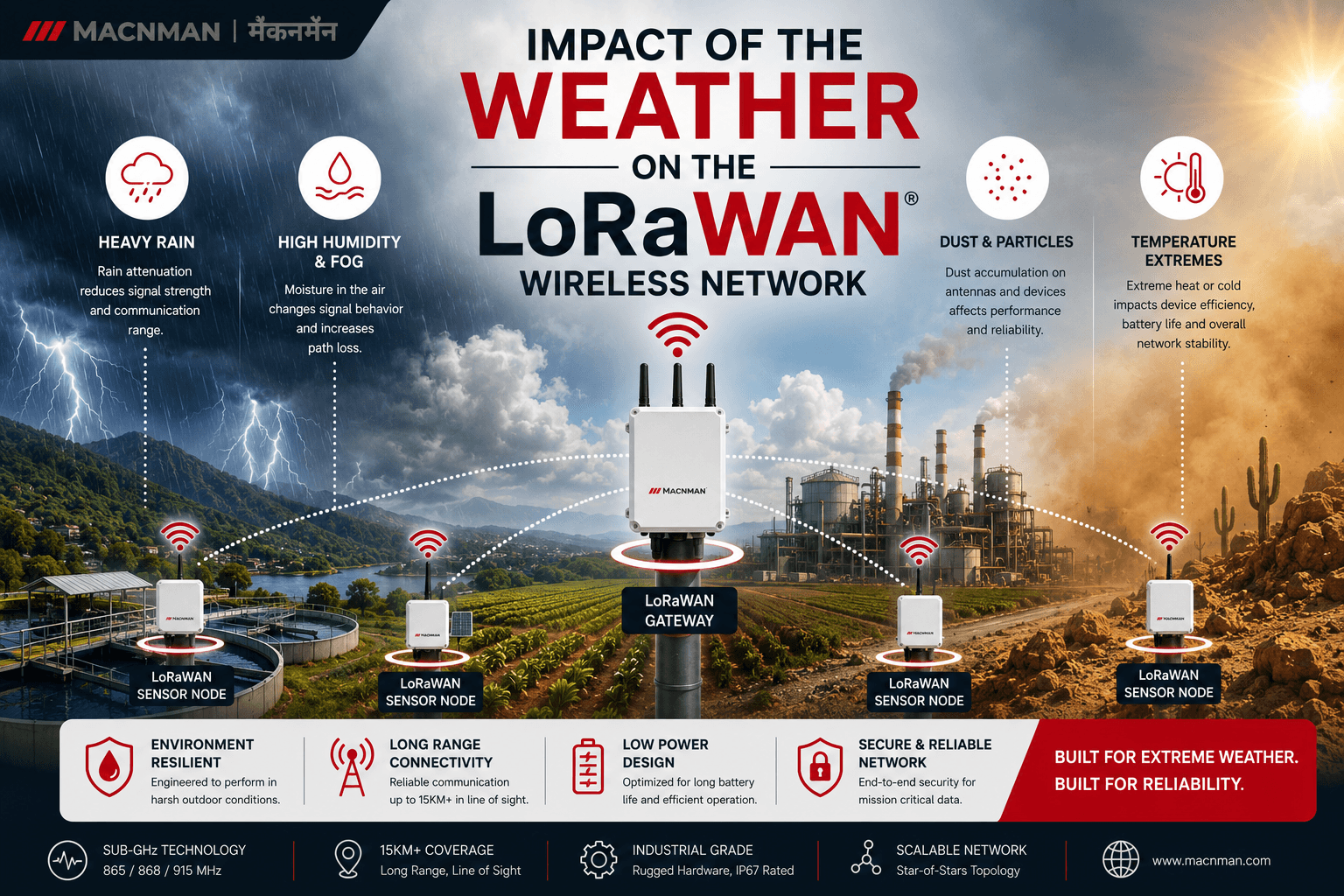
LoRaWAN Weather Attenuation: Industrial RF Network Design Guide
The Operational Stakes of Field Deployments
Deploying an Industrial Internet of Things (IIoT) network is fundamentally different from validating wireless communication inside a laboratory. Controlled testing environments rarely account for continuously changing atmospheric conditions, seasonal weather patterns, terrain irregularities, or long-term environmental exposure. Once a wireless sensor network is deployed across manufacturing facilities, agricultural fields, ports, utility substations, or mining sites, every radio link becomes part of a dynamic propagation environment influenced by rain, humidity, dust, temperature, and physical obstructions.
For system integrators and industrial automation engineers, network uptime is measured in operational continuity rather than theoretical RF performance. A sensor that misses telemetry packets during a heavy storm may delay predictive maintenance, interrupt environmental monitoring, or trigger false alarms within Supervisory Control and Data Acquisition (SCADA) systems. In mission-critical deployments involving water management, energy distribution, smart agriculture, or industrial asset monitoring, even temporary communication failures can translate into operational downtime and increased maintenance costs.
One of the most overlooked design parameters is fade margin—the additional signal strength engineered into a wireless link to compensate for unpredictable propagation losses. During severe weather, atmospheric attenuation combined with foliage moisture, antenna contamination, and multipath fading can easily reduce available link margin by 2–5 dB. While this may appear insignificant on paper, a reduction of only 3 dB effectively halves the received signal power, pushing marginal links below the receiver sensitivity threshold and increasing packet retransmissions or communication failures.
This is precisely why industrial RF engineers prioritize generous link budgets instead of designing networks that merely function under ideal conditions.
Fortunately, LoRaWAN® operates within Sub-GHz Industrial, Scientific, and Medical (ISM) frequency bands, including:
- 865–867 MHz (India)
- 868 MHz (Europe)
- 902–928 MHz (North America)
- 923 MHz (Asia-Pacific regions)
These lower frequencies provide significant propagation advantages over higher-frequency wireless technologies such as 2.4 GHz Wi-Fi, Bluetooth Low Energy, and portions of the 5G spectrum. Longer wavelengths experience lower atmospheric absorption, superior diffraction around obstacles, improved vegetation penetration, and significantly reduced weather-induced attenuation. These characteristics make LoRaWAN particularly well suited for long-range outdoor Industrial IoT deployments where reliability must be maintained throughout changing environmental conditions.
However, weather does influence Sub-GHz propagation—it simply affects it differently than many engineers assume. Understanding the underlying RF physics enables network architects to design resilient wireless infrastructure that maintains dependable communication throughout monsoon seasons, coastal humidity, industrial dust exposure, and extreme temperature variations.
The Deep Technical Physics: Weather Attenuation on Sub-GHz RF Channels
Rain Fade & Scattering (H₂O Impairment)
Rain attenuation is one of the first concerns raised when designing outdoor wireless sensor networks. While the term "rain fade" is commonly associated with satellite communications and microwave backhaul systems, its impact on Sub-GHz LoRaWAN networks is considerably different due to the relationship between electromagnetic wavelength and the physical size of water droplets.
Whenever an RF signal propagates through rainfall, it encounters millions of suspended water droplets. Each droplet interacts with the electromagnetic wave through three primary mechanisms:
- Absorption – A small portion of RF energy is absorbed and converted into heat.
- Scattering – Incident radio waves are redirected in multiple directions.
- Reflection – A very small amount of energy is reflected depending on droplet size and polarization.
The severity of these interactions depends largely on the ratio between the signal wavelength and the diameter of the rain droplets.
Why Sub-GHz Frequencies Naturally Resist Rain Attenuation
The wavelength of an electromagnetic wave is calculated using:
[
\lambda = \frac{c}{f}
]
Where:
- λ = Wavelength (meters)
- c = Speed of light (≈ 3 × 10⁸ m/s)
- f = Frequency (Hz)
Applying this equation produces the following approximate wavelengths:
Frequency
Wavelength
865 MHz
34.7 cm
868 MHz
34.5 cm
915 MHz
32.8 cm
2.4 GHz
12.5 cm
5 GHz
6 cm
By comparison, typical raindrops measure only 0.5 mm to 6 mm in diameter.
This difference is significant.
A 34-centimeter LoRaWAN wavelength is approximately 60 to 600 times larger than most raindrops. Since the droplets are electrically small relative to the propagating wave, very little energy is scattered. Most of the transmitted signal continues through the rain with only minor attenuation.
Higher-frequency technologies operate with much shorter wavelengths that interact far more strongly with rain particles, making them increasingly susceptible to weather-induced losses.
Rayleigh vs. Mie Scattering
Rain attenuation is governed primarily by two scattering mechanisms.
Rayleigh Scattering
Rayleigh scattering occurs when particles are much smaller than the transmitted wavelength.
Characteristics include:
- Extremely low attenuation
- Minimal phase distortion
- Negligible energy loss
- Dominant mechanism at Sub-GHz frequencies
Because LoRaWAN wavelengths are substantially larger than rain droplets, Rayleigh scattering contributes only marginal attenuation during ordinary rainfall.
Mie Scattering
Mie scattering becomes significant when particle sizes approach the wavelength of the transmitted signal.
Characteristics include:
- Higher attenuation
- Increased forward scattering
- Greater phase distortion
- Reduced received signal strength
Microwave communication systems operating above several gigahertz experience much stronger Mie scattering, which explains why satellite television, microwave links, and millimeter-wave 5G networks are considerably more affected by heavy rainfall than LoRaWAN deployments.
How Much Signal Loss Does Rain Actually Cause?
For most Industrial IoT deployments, rain contributes only a modest amount of additional attenuation.
Approximate values are:
Rain Intensity
Additional Attenuation
Light rain (5 mm/hr)
Negligible
Moderate rain (25 mm/hr)
Less than 0.2 dB/km
Heavy rainfall (50 mm/hr)
Approximately 0.3–0.5 dB/km
Extreme tropical storm (>100 mm/hr)
Up to 1 dB/km over extended paths
Even during intense monsoon conditions, a 5 km LoRaWAN link may experience only 1.5–2.5 dB of additional atmospheric loss due solely to rainfall. In most well-engineered networks, this remains comfortably within the designed fade margin.
The greater concern is not rain attenuation in isolation but its cumulative effect alongside other environmental factors such as wet foliage, antenna contamination, connector moisture, and multipath fading. These combined losses can gradually erode the available link budget, particularly on long-distance or marginal RF links.
Rain Is Rarely the Root Cause of Packet Loss
Field investigations frequently reveal that rain itself is not responsible for communication failures. Instead, rainfall exposes weaknesses already present within the RF infrastructure.
Common examples include:
- Water ingress into improperly sealed N-Type or SMA connectors.
- Increased coaxial cable loss due to moisture penetration.
- Antenna detuning caused by accumulated water or contaminants.
- Reduced Fresnel Zone clearance as surrounding vegetation absorbs moisture and increases dielectric loading.
- Marginal links designed with insufficient fade margin under clear-weather conditions.
This distinction is critical. A properly engineered LoRaWAN network should not rely on ideal environmental conditions to maintain reliable communication. Instead, it should incorporate sufficient RF headroom to absorb seasonal atmospheric variations without compromising packet delivery.
Industrial-grade network design therefore focuses less on eliminating weather effects—which is impossible—and more on ensuring that every wireless link retains adequate signal margin under the worst expected operating conditions. This philosophy forms the foundation of resilient Industrial IoT infrastructure and explains why enterprise deployments consistently outperform low-cost consumer-grade installations in harsh outdoor environments.
Humidity, Fog & Thermal Inversions: Hidden Atmospheric Effects on LoRaWAN Performance
While rain receives the most attention when discussing wireless communication, experienced RF engineers know that humidity, fog, atmospheric pressure, and temperature gradients can influence long-range wireless links just as much—particularly for Industrial IoT deployments exceeding 10 km.
Unlike rainfall, these atmospheric conditions rarely introduce significant direct attenuation at 865 MHz, 868 MHz, or 915 MHz. Instead, they alter how radio waves propagate through the atmosphere, affecting signal paths, receiver sensitivity, and long-distance coverage consistency.
Understanding these phenomena allows network architects to design weather-resilient LoRaWAN networks capable of maintaining reliable communication across changing seasons and harsh environmental conditions.
Does Humidity Affect LoRaWAN Signal Strength?
One of the most common questions among system integrators is whether humidity weakens LoRaWAN signals.
The short answer is not significantly.
Water vapor absorbs electromagnetic energy much more efficiently at microwave and millimeter-wave frequencies than at Sub-GHz frequencies.
For LoRaWAN operating between 865 MHz and 915 MHz, atmospheric absorption caused by humidity is almost negligible over normal Industrial IoT distances.
However, humidity still affects wireless performance indirectly by influencing:
- Atmospheric refractive index
- Multipath propagation
- Vegetation moisture
- Surface conductivity
- Antenna contamination
These secondary effects become increasingly important as communication distances increase.
Atmospheric Refractivity and RF Propagation
The Earth's atmosphere is not a uniform medium.
Temperature, humidity, and pressure continuously change with altitude, causing small variations in the refractive index of air.
These changes determine how electromagnetic waves bend while traveling through the atmosphere.
RF engineers typically describe this behavior using Atmospheric Refractivity (N-Units).
Changes in refractivity can produce:
- Signal bending
- Extended propagation
- Unexpected coverage holes
- Multipath fading
- Variable received signal strength
Although these effects are usually subtle, they become increasingly noticeable for:
- Utility monitoring networks
- Pipeline monitoring
- Railway communication systems
- Smart agriculture deployments
- Coastal infrastructure
- Large industrial campuses
Links extending beyond 10–15 kilometers are generally more susceptible because small propagation changes accumulate over longer distances.
Thermal Inversions and RF Ducting
Under normal atmospheric conditions, air temperature decreases with altitude.
Occasionally, the opposite occurs.
A layer of warm air forms above cooler air near the Earth's surface.
This phenomenon is known as a thermal inversion.
Thermal inversions can create atmospheric ducts, allowing radio waves to travel significantly farther than predicted by standard propagation models.
Although this may sound beneficial, ducting often creates unpredictable network behavior.
Potential effects include:
- Temporary coverage extension
- Unexpected interference
- Rapid RSSI fluctuations
- Packet loss caused by multipath cancellation
- Changing gateway reception patterns
These conditions commonly occur in:
- Coastal regions
- River valleys
- Large lakes
- Deserts
- Early morning environments
For Industrial IoT applications, engineers should avoid designing networks that depend upon favorable atmospheric ducting because these conditions are temporary and highly variable.
Instead, link budgets should assume normal propagation conditions while maintaining sufficient fade margin for atmospheric fluctuations.
Coastal Fog and Salt-Laden Air
Fog itself produces almost no measurable attenuation for Sub-GHz radio frequencies.
The real engineering concern is salt contamination.
Ports, offshore platforms, shipyards, and coastal manufacturing facilities expose RF equipment to airborne salt particles suspended within moisture.
Over time, salt deposits can:
- Corrode RF connectors
- Increase contact resistance
- Damage antenna feed points
- Accelerate galvanic corrosion
- Reduce antenna efficiency
Connector oxidation gradually increases insertion loss across the RF chain.
Even a small increase of 1–2 dB in feeder loss can noticeably reduce communication range over large Industrial IoT deployments.
For this reason, industrial gateway installations should always incorporate:
- Marine-grade connectors
- UV-resistant weatherproof sealing
- Corrosion-resistant mounting hardware
- Regular connector inspections
- Proper grounding systems
These preventive measures often have a greater impact on long-term network reliability than atmospheric humidity itself.
Wet Vegetation: An Overlooked Source of Path Loss
Vegetation behaves very differently after rainfall.
Leaves, branches, and crops absorb water, increasing their dielectric constant and making them more effective at absorbing RF energy.
This phenomenon becomes particularly important in:
- Smart agriculture
- Forestry monitoring
- Plantation automation
- Environmental monitoring
- Irrigation systems
A wireless link performing perfectly during winter may experience additional attenuation during monsoon seasons simply because vegetation has become saturated with moisture.
This is one reason experienced RF engineers avoid designing links that barely meet minimum receiver sensitivity.
Maintaining adequate fade margin ensures reliable communication despite seasonal changes in vegetation density and moisture content.
The Particulate Factor: Dust, Sandstorms & Industrial Airborne Contaminants
Weather resilience extends beyond rain and humidity.
Many Industrial IoT deployments operate in environments where airborne particulates create more significant long-term challenges than precipitation.
Examples include:
- Cement plants
- Mining operations
- Steel manufacturing
- Bulk material handling
- Ports
- Coal storage facilities
- Desert infrastructure
- Construction sites
Although dust particles are generally too small to directly attenuate Sub-GHz radio waves, they create several indirect problems that gradually reduce wireless network performance.
Antenna Dielectric Loading
Industrial antennas are carefully designed to resonate at specific operating frequencies.
Accumulated dust changes the dielectric environment surrounding the antenna.
This phenomenon is known as dielectric loading.
Consequences include:
- Slight resonance frequency shifts
- Reduced antenna gain
- Increased return loss
- Higher Voltage Standing Wave Ratio (VSWR)
- Lower radiation efficiency
While these changes are often gradual, they become increasingly important over years of outdoor deployment.
Routine antenna maintenance helps restore original RF performance.
Dust Combined with Moisture
Dry dust alone is rarely problematic.
The challenge arises when airborne particles combine with moisture.
Dust mixed with humidity forms conductive surface deposits that accumulate on:
- Antennas
- RF connectors
- Cable glands
- Gateway enclosures
- Lightning arrestors
These deposits increase:
- Surface leakage currents
- Connector corrosion
- RF insertion loss
- Contact resistance
Industrial gateways deployed in mining regions or coastal ports therefore require periodic inspection and cleaning to maintain optimal RF efficiency.
Sandstorms and Physical Infrastructure
Sandstorms introduce an additional mechanical challenge.
Wind-driven particles can gradually erode:
- Fiberglass radomes
- Plastic enclosures
- Rubber gaskets
- Cable jackets
- Weatherproof seals
Over time, this mechanical wear increases the likelihood of moisture ingress, UV degradation, and eventual equipment failure.
Industrial-grade outdoor hardware mitigates these risks through:
- Die-cast aluminum enclosures
- UV-resistant powder coatings
- Stainless steel mounting hardware
- IP67 sealing systems
- Industrial-grade cable glands
These design characteristics significantly extend service life in harsh outdoor environments.
Multipath Fading in Heavy Industrial Facilities
Industrial environments contain numerous RF reflectors.
Examples include:
- Shipping containers
- Storage tanks
- Steel warehouses
- Overhead cranes
- Conveyors
- Pipelines
- Metallic process equipment
Dust and atmospheric variations slightly alter reflection characteristics, changing how multiple signal paths combine at the receiver.
This creates multipath fading, where reflected signals arrive out of phase with the direct signal.
Symptoms include:
- Intermittent packet loss
- Fluctuating RSSI
- Variable Signal-to-Noise Ratio (SNR)
- Reduced gateway diversity performance
Proper antenna placement, sufficient elevation, and maintaining Fresnel Zone clearance remain the most effective strategies for minimizing multipath effects.
Understanding Link Budget During Severe Weather
A common misconception is that increasing transmitter power alone solves weather-related communication issues.
In reality, the most important metric in any Industrial LoRaWAN deployment is the overall link budget.
A link budget represents the difference between the transmitted signal power and the minimum receiver sensitivity after accounting for every gain and loss throughout the communication path.
It is the engineering safety margin that determines whether a network continues operating during adverse environmental conditions.
A simplified link budget consists of:
- Transmit Power (EIRP)
- Antenna Gain
- Cable Loss
- Free Space Path Loss (FSPL)
- Environmental Attenuation
- Receiver Sensitivity
Every decibel matters.
For example, consider an outdoor gateway installation:
- Gateway transmit power: 27 dBm
- Gateway antenna gain: 6 dBi
- Coaxial cable loss: 1 dB
- Sensor antenna gain: 2 dBi
- Receiver sensitivity: –137 dBm (SF12)
Even if heavy rainfall contributes 2 dB, wet vegetation introduces another 3 dB, and connector aging adds 1 dB, a properly engineered link still maintains reliable communication because adequate fade margin was included during the initial RF design.
Why Fade Margin Matters
Professional RF engineers rarely design wireless links to operate exactly at the receiver sensitivity threshold.
Instead, they include additional signal headroom known as fade margin.
Typical recommendations are:
Deployment Environment
Recommended Fade Margin
Indoor Industrial
10–15 dB
Outdoor Industrial Campus
15–20 dB
Smart Agriculture
20 dB
Coastal Installations
20–25 dB
Mountainous Terrain
20–30 dB
A healthy fade margin allows the network to absorb temporary losses caused by:
- Heavy rainfall
- Atmospheric refractivity changes
- Wet vegetation
- Seasonal foliage growth
- Connector aging
- Cable degradation
- Dust accumulation
- Minor antenna misalignment
Rather than treating weather as an unpredictable threat, professional Industrial IoT network designers account for these variables during the planning phase. The result is a weather-resilient LoRaWAN infrastructure capable of delivering consistent telemetry, stable packet reception, and dependable long-range communication throughout years of continuous outdoor operation.
Engineering Solutions: Designing LoRaWAN Networks to Neutralize Atmospheric Loss
Understanding how weather influences Sub-GHz RF propagation is only half of the engineering challenge. The real objective is designing an Industrial LoRaWAN network that continues operating reliably despite rain, humidity, dust, lightning, and seasonal environmental changes.
Unlike consumer wireless systems, enterprise-grade Industrial IoT infrastructure must be engineered with redundancy, environmental resilience, and long-term operational stability in mind. Every component—from the gateway enclosure to the antenna connector—contributes to the overall reliability of the RF link.
The following engineering practices represent industry best practices for building weather-resilient LoRaWAN deployments.
Adaptive Data Rate (ADR): The First Line of Defense Against Changing RF Conditions
One of LoRaWAN's greatest advantages over conventional LPWAN technologies is its intelligent Adaptive Data Rate (ADR) mechanism.
Instead of transmitting every packet using a fixed modulation profile, the LoRaWAN Network Server continuously analyzes link quality using metrics collected from gateways.
Typical parameters include:
- Received Signal Strength Indicator (RSSI)
- Signal-to-Noise Ratio (SNR)
- Packet Error Rate (PER)
- Gateway diversity
- Packet delivery success rate
Based on these measurements, the Network Server dynamically instructs end devices to adjust their transmission parameters.
This includes:
- Spreading Factor (SF)
- Transmission Power
- Data Rate
- Airtime Optimization
Understanding Spreading Factors
LoRa modulation uses Chirp Spread Spectrum (CSS) technology, allowing devices to trade communication speed for improved receiver sensitivity.
Spreading Factor
Data Rate
Receiver Sensitivity
Typical Use Case
SF7
Highest
Lowest
Dense urban deployments
SF8
High
Better
Smart buildings
SF9
Medium
Improved
Industrial campuses
SF10
Moderate
High
Outdoor industrial monitoring
SF11
Low
Very High
Rural infrastructure
SF12
Lowest
Maximum
Long-range deployments
Higher spreading factors increase processing gain, enabling gateways to decode signals that would otherwise fall below the noise floor.
For example:
- SF7 Receiver Sensitivity: approximately −123 dBm
- SF12 Receiver Sensitivity: approximately −137 dBm
That represents nearly 14 dB of additional receiver sensitivity.
In practical terms, this additional link margin allows a sensor node to maintain communication during temporary weather-induced degradation without requiring additional transmit power.
Why Proper ADR Configuration Matters
Improper ADR configuration is one of the most common causes of inefficient LoRaWAN deployments.
Some installers permanently configure every device to operate at SF12 under the assumption that maximum sensitivity guarantees maximum reliability.
In reality, this creates several problems:
- Increased airtime
- Lower network capacity
- Higher collision probability
- Reduced battery life
- Increased latency
A properly configured ADR algorithm allows devices close to the gateway to operate at lower spreading factors while automatically transitioning distant or weather-affected nodes to higher spreading factors only when necessary.
The result is:
- Higher gateway capacity
- Reduced network congestion
- Improved battery longevity
- Better spectrum utilization
- Stable communication during changing environmental conditions
Hardware Enclosure Material Science: Why IP67 Matters
Weather resilience depends as much on mechanical engineering as it does on RF design.
Many commercial "outdoor" gateways rely on injection-molded plastic housings that are adequate for light-duty installations but unsuitable for demanding industrial environments.
Common failure mechanisms include:
- UV degradation
- Thermal expansion
- Gasket deformation
- Moisture ingress
- Condensation
- Mechanical cracking
- Corrosion around fasteners
These issues often appear gradually, reducing gateway reliability years before complete equipment failure occurs.
IP65 vs. IP67: Understanding the Difference
Ingress Protection (IP) ratings define the level of protection against dust and water.
Feature
IP65
IP67
Dust Protection
Complete
Complete
Water Jets
Yes
Yes
Temporary Water Immersion
No
Yes
Flood Resistance
Limited
Excellent
Outdoor Industrial Applications
Acceptable
Recommended
Although both ratings protect against dust, IP67 provides substantially better protection for outdoor Industrial IoT deployments where heavy rainfall, flooding, or standing water may occur.
For gateways installed on communication towers, agricultural poles, substations, or coastal infrastructure, IP67 significantly reduces long-term maintenance risks.
Why Die-Cast Aluminum Outperforms Plastic Enclosures
Material selection directly affects RF reliability.
Industrial-grade gateways should prioritize mechanical strength and thermal performance rather than minimizing manufacturing costs.
Compared to plastic housings, die-cast aluminum provides:
- Superior heat dissipation
- Excellent structural rigidity
- Improved electromagnetic shielding
- Better corrosion resistance
- Lower thermal expansion
- Increased mechanical durability
- Longer operational lifespan
Effective thermal management is particularly important because high internal temperatures accelerate component aging and reduce electronic reliability.
MACNMAN's Industrial Gateway Design Philosophy
Outdoor gateway infrastructure must withstand years of continuous exposure to environmental stress.
MACNMAN's industrial-grade LoRaWAN gateways are engineered specifically for these demanding deployments by incorporating:
- IP67-rated die-cast aluminum enclosures
- Industrial operating temperature support
- UV-resistant outdoor coatings
- Corrosion-resistant hardware
- Integrated lightning surge protection
- High-performance RF architecture
- Carrier-grade thermal management
These design principles help maintain stable RF performance while minimizing long-term maintenance costs across industrial installations.
Antenna Systems: The Most Critical Component of Long-Range LoRaWAN Networks
Gateway sensitivity often receives significant attention, yet antenna performance has an even greater influence on network coverage.
An improperly installed antenna can reduce communication range by several kilometers regardless of gateway quality.
Industrial antenna design should consider:
- Gain
- Radiation pattern
- Polarization
- VSWR
- Mounting height
- Fresnel Zone clearance
- Cable losses
Each factor directly affects overall network performance.
Selecting the Correct Antenna Gain
A common misconception is that higher antenna gain always improves communication range.
This is only partially true.
Higher-gain omnidirectional antennas compress the vertical radiation pattern.
Advantages include:
- Greater horizontal coverage
- Increased Effective Isotropic Radiated Power (EIRP)
- Longer line-of-sight communication
However, excessively high gain can reduce coverage in hilly terrain because the narrowed radiation beam overshoots nearby devices.
Typical recommendations:
Deployment
Recommended Gain
Industrial Campus
3–6 dBi
Smart Agriculture
5–8 dBi
Ports
6–8 dBi
Utility Infrastructure
5–8 dBi
Proper antenna selection depends on deployment topology rather than maximum gain.
Antenna Coaxial Integrity and Cable Loss
Every meter of coaxial cable introduces attenuation.
This loss directly reduces available link budget.
Typical cable losses at Sub-GHz frequencies:
Cable Type
Approximate Loss (868 MHz)
RG58
High
RG213
Medium
LMR-400
Low
LMR-600
Very Low
Industrial installations should:
- Keep feeder cables as short as possible.
- Use low-loss coaxial cables.
- Minimize unnecessary RF adapters.
- Avoid sharp cable bends.
- Secure cables against mechanical vibration.
Saving even 2 dB of cable loss often provides greater performance improvement than increasing transmitter power.
Protecting Outdoor RF Infrastructure Against Lightning
Lightning rarely strikes the gateway directly.
Instead, nearby strikes induce high transient voltages into:
- Antenna cables
- Communication lines
- Ground systems
- Metal mounting structures
These induced surges are sufficient to permanently damage RF front ends and power electronics.
Industrial deployments should always incorporate:
- Inline Gas Discharge Tube (GDT) surge protectors
- Proper mast grounding
- Low-resistance earth bonding
- Equipotential grounding
- Surge-protected power supplies
MACNMAN outdoor gateway platforms integrate lightning surge protection as part of their industrial design, reducing the risk of catastrophic damage during severe weather events.
Best Practices for Outdoor Gateway Installation
Even premium gateway hardware cannot compensate for poor installation practices.
Correct deployment methodology is essential for achieving maximum communication range and long-term reliability.
Install Above Local Obstructions
Whenever possible, gateways should be mounted above:
- Building rooftops
- Tree canopies
- Storage tanks
- Shipping containers
- Process equipment
Greater elevation improves line-of-sight communication while reducing multipath reflections.
Maintain Fresnel Zone Clearance
Many installers focus solely on visual line of sight.
However, the First Fresnel Zone must also remain largely unobstructed.
Objects intruding into the Fresnel Zone cause:
- Diffraction losses
- Phase cancellation
- Reduced signal strength
- Lower receiver sensitivity
Maintaining at least 60% Fresnel Zone clearance significantly improves long-distance RF performance.
Weatherproof Every RF Connection
Outdoor RF connectors represent one of the most common failure points.
Best practices include:
- Self-amalgamating rubber tape
- UV-resistant PVC overwrap
- Weatherproof N-Type connectors
- Waterproof cable glands
- Corrosion-resistant fasteners
Even minor moisture ingress can gradually increase insertion loss and degrade antenna performance.
Minimize Cable Length
The gateway should be installed as close to the antenna as practical.
Long feeder cables reduce EIRP and receiver sensitivity.
Whenever feasible:
- Mount gateways directly beneath antennas.
- Use Ethernet or fiber for longer backhaul distances.
- Avoid unnecessary RF extensions.
Design for Maintenance Accessibility
Industrial infrastructure should remain serviceable throughout its operational life.
Install gateways where technicians can safely perform:
- Connector inspections
- Antenna cleaning
- Surge protector replacement
- Ground resistance testing
- Firmware upgrades
Reducing maintenance complexity lowers total cost of ownership while improving long-term network availability.
Build for the Worst Weather, Not the Best
The hallmark of a professionally engineered Industrial LoRaWAN network is not maximum communication range under ideal conditions—it is consistent performance throughout years of exposure to rain, humidity, dust, lightning, extreme temperatures, and seasonal environmental changes.
By combining intelligent ADR optimization, properly engineered link budgets, industrial-grade IP67 hardware, low-loss RF infrastructure, effective surge protection, and disciplined installation practices, organizations can build wireless sensor networks capable of delivering carrier-grade reliability in the world's most demanding operating environments.
This engineering-first philosophy is the foundation behind MACNMAN's industrial LoRaWAN gateways, enabling enterprises to deploy scalable, weather-resilient IIoT infrastructure with confidence, whether monitoring smart agriculture, utilities, manufacturing facilities, logistics hubs, or nationwide remote assets.
High-ROI Industrial Use Cases: Where Weather-Resilient LoRaWAN Delivers Business Value
Designing a weather-resilient LoRaWAN network is not merely an engineering exercise—it directly impacts operational uptime, maintenance costs, and return on investment (ROI). Industries that rely on outdoor sensing infrastructure cannot afford communication failures caused by harsh environmental conditions.
By combining robust RF engineering principles with industrial-grade hardware, organizations can maintain continuous telemetry even in regions affected by heavy rainfall, extreme temperatures, coastal humidity, or airborne contaminants.
Below are some of the most common Industrial IoT deployments where weather-resilient LoRaWAN networks provide measurable operational benefits.
Smart Agriculture and Precision Farming
Modern agriculture depends on real-time environmental data to optimize irrigation, fertilizer application, crop health monitoring, and water resource management.
Typical deployments include:
- Soil moisture sensors
- Weather stations
- Rain gauges
- Water tank level monitoring
- Irrigation controller automation
- Groundwater monitoring
- Pump monitoring
These devices are often distributed across hundreds of hectares where wired communication is impractical and cellular connectivity is inconsistent.
Seasonal monsoons, dense vegetation, and varying terrain introduce additional RF challenges that can reduce communication reliability if networks are poorly designed.
Industrial-grade LoRaWAN gateways with high receiver sensitivity, IP67 protection, and adaptive data rate optimization help maintain reliable communication throughout changing weather conditions.
MACNMAN's industrial LoRaWAN gateways and outdoor sensing solutions are specifically designed for these environments, delivering long-range wireless connectivity while minimizing maintenance requirements and power consumption.
Heavy Industrial Plants
Manufacturing facilities expose wireless infrastructure to some of the harshest operating conditions.
Typical environments include:
- Steel plants
- Cement factories
- Chemical processing
- Food processing
- Paper mills
- Automotive manufacturing
Challenges commonly include:
- High temperatures
- Metallic structures
- Electromagnetic interference
- Dust accumulation
- Equipment vibration
- High humidity
Reliable LoRaWAN infrastructure enables predictive maintenance by continuously monitoring:
- Motor temperatures
- Bearing vibration
- Utility meters
- Compressed air systems
- Environmental conditions
- Machine operating hours
A weather-resistant gateway combined with proper antenna placement ensures uninterrupted data collection despite demanding industrial conditions.
Ports, Logistics Parks, and Container Yards
Large logistics hubs require continuous visibility of distributed assets over several square kilometers.
Common applications include:
- Container tracking
- Yard management
- Fleet monitoring
- Fuel level monitoring
- Cold-chain logistics
- Environmental monitoring
- Lighting control
Coastal installations introduce unique challenges such as:
- Salt fog
- Corrosion
- High humidity
- Strong winds
- Metallic reflections
- Lightning exposure
Deploying ruggedized outdoor gateways with surge protection and marine-grade weather sealing significantly improves long-term system reliability while reducing maintenance costs.
Utilities and Smart Infrastructure
Power distribution companies, municipal authorities, and utility providers increasingly rely on LoRaWAN for monitoring geographically distributed infrastructure.
Typical applications include:
- Smart electricity metering
- Water metering
- Gas metering
- Distribution transformer monitoring
- Street lighting
- Reservoir level monitoring
- Pipeline pressure monitoring
Because these assets are often installed in remote locations, communication reliability directly influences operational efficiency.
Weather-resilient LoRaWAN gateways reduce field visits by ensuring continuous connectivity even during severe environmental conditions.
Mining, Oil & Gas Operations
Remote industrial sites frequently experience:
- Sandstorms
- Extreme temperatures
- Heavy machinery vibration
- Long communication distances
- Limited cellular coverage
LoRaWAN enables continuous monitoring of:
- Fuel tanks
- Conveyor systems
- Tailings ponds
- Environmental emissions
- Equipment utilization
- Worker safety systems
Industrial hardware designed with IP67 enclosures and integrated surge protection ensures reliable performance while minimizing unscheduled maintenance.
Common RF Design Mistakes That Reduce Weather Resilience
Many communication failures blamed on weather are actually the result of avoidable engineering mistakes.
Professional RF network design focuses on eliminating these weaknesses before deployment.
Using Consumer-Grade Outdoor Equipment
Consumer networking products are rarely engineered for continuous industrial operation.
Common limitations include:
- Plastic enclosures
- Poor thermal management
- Limited ingress protection
- Low operating temperature range
- Inadequate corrosion resistance
Industrial deployments require purpose-built hardware capable of operating continuously for years under harsh environmental conditions.
Ignoring Fade Margin
Designing a wireless link that only works under ideal weather conditions is one of the most common engineering errors.
Professional deployments should always maintain sufficient fade margin to compensate for:
- Rain
- Seasonal vegetation growth
- Humidity
- Dust accumulation
- Connector aging
- Atmospheric variations
Adequate fade margin dramatically improves long-term communication reliability.
Poor Antenna Placement
Installing antennas below rooftops, behind metallic structures, or inside equipment rooms significantly reduces RF performance.
Best practices include:
- Maximizing antenna elevation
- Maintaining Fresnel Zone clearance
- Avoiding nearby reflective surfaces
- Preserving line-of-sight wherever possible
Often, relocating an antenna by only a few meters delivers greater performance improvements than increasing transmitter power.
Excessive Coaxial Cable Length
Every meter of coaxial cable reduces available signal power.
Long cable runs:
- Reduce transmit power
- Lower receiver sensitivity
- Increase installation costs
- Introduce additional failure points
Where practical, gateways should be mounted close to antennas while Ethernet or fiber is used for network backhaul.
Inadequate Grounding and Surge Protection
Lightning protection is frequently overlooked until equipment damage occurs.
Industrial best practices include:
- Proper earthing
- Lightning arrestors
- Grounded antenna masts
- Surge-protected power supplies
- Bonded communication infrastructure
Preventive protection is substantially less expensive than replacing damaged gateways and field equipment.
Technical FAQ
Does heavy rain reduce LoRaWAN range?
Yes, but only slightly.
Sub-GHz frequencies experience minimal rain attenuation compared to microwave or millimeter-wave systems. Properly engineered LoRaWAN networks generally maintain reliable communication during heavy rainfall because sufficient fade margin is incorporated into the RF design.
Does humidity affect LoRaWAN signal strength?
Humidity has very little direct effect on Sub-GHz RF signals. Its primary impact is indirect, influencing atmospheric refractivity, vegetation moisture, antenna contamination, and long-term connector corrosion rather than causing significant atmospheric absorption.
What is the best IP rating for an outdoor industrial LoRaWAN gateway?
For demanding outdoor Industrial IoT deployments, IP67 is the recommended minimum protection level.
An IP67-rated gateway provides:
- Complete dust protection
- Resistance to temporary water immersion
- Improved long-term environmental reliability
- Better protection against severe weather conditions
How do you protect outdoor LoRaWAN antennas from lightning?
Effective lightning protection requires multiple layers of defense, including:
- Gas Discharge Tube (GDT) surge protectors
- Proper grounding systems
- Bonded antenna masts
- Low-resistance earth connections
- Weatherproof RF connectors
Together, these measures significantly reduce the risk of damage from lightning-induced electrical surges.
How much fade margin should an industrial LoRaWAN network have?
While exact values depend on terrain and application, experienced RF engineers typically recommend:
- 10–15 dB for indoor industrial environments
- 15–20 dB for outdoor industrial campuses
- 20–25 dB for coastal or agricultural deployments
- 20–30 dB for mountainous or heavily obstructed environments
Adequate fade margin ensures reliable communication despite weather variations and long-term infrastructure aging.
Can LoRaWAN operate during thunderstorms?
Yes.
Thunderstorms may temporarily increase background RF noise and create electrical surge risks, but the primary concern is protecting infrastructure rather than signal propagation. Proper grounding, surge protection, and industrial-grade gateway design enable reliable operation even in regions experiencing frequent lightning activity.
Conclusion
Weather is an unavoidable variable in every outdoor Industrial IoT deployment, but it does not have to become a limiting factor. Rain, humidity, fog, dust, thermal inversions, and lightning all influence RF performance to varying degrees. However, the greatest determinants of network reliability remain sound engineering practices, including accurate link-budget calculations, sufficient fade margin, proper antenna placement, high-quality RF components, and industrial-grade hardware.
LoRaWAN's use of Sub-GHz frequencies provides a significant advantage over higher-frequency wireless technologies by offering lower atmospheric attenuation, superior obstacle penetration, and exceptional long-range communication capabilities. When combined with intelligent Adaptive Data Rate (ADR), robust installation practices, and weather-resistant infrastructure, organizations can build highly reliable Industrial IoT networks capable of operating continuously in challenging outdoor environments.
For enterprises planning large-scale deployments, investing in engineering quality during the design phase consistently delivers lower maintenance costs, fewer communication failures, and higher long-term return on investment.
Build Weather-Resilient LoRaWAN Networks with MACNMAN
Successful Industrial IoT deployments begin with reliable infrastructure.
MACNMAN develops industrial-grade LoRaWAN gateways engineered specifically for demanding outdoor applications, combining IP67-rated die-cast aluminum enclosures, integrated lightning surge protection, carrier-grade RF architecture, and enterprise-class reliability for mission-critical deployments.
Whether you're deploying smart agriculture solutions, utility monitoring systems, industrial automation networks, logistics infrastructure, or nationwide sensor deployments, our RF engineering team can assist with:
- Link-budget calculations
- Gateway placement strategy
- Antenna selection
- Network scalability planning
- Coverage optimization
- Custom Industrial IoT architecture
By combining advanced RF engineering with rugged hardware, MACNMAN helps organizations build scalable, weather-resilient LoRaWAN networks that deliver reliable performance throughout years of continuous operation.
Download the MACNMAN Outdoor LoRaWAN Gateway Datasheet to explore our industrial gateway portfolio, or contact our RF engineering team for a customized network design consultation and deployment assessment tailored to your Industrial IoT application.


