Introduction
Finding an available parking space has become one of the most persistent challenges in modern urban mobility. As cities continue to expand and vehicle ownership increases, parking infrastructure has struggled to keep pace. Drivers often spend several minutes circulating parking lots or city streets searching for an empty bay, creating unnecessary traffic congestion, fuel consumption, carbon emissions, and driver frustration.
For municipalities, commercial real estate operators, airports, hospitals, shopping malls, universities, and smart city planners, inefficient parking management represents more than just an inconvenience—it translates directly into operational inefficiencies, reduced customer satisfaction, and lost revenue opportunities.
Traditional parking monitoring technologies such as inductive loop detectors, ticketing systems, and CCTV-based analytics have attempted to solve this problem for decades. However, these approaches often require significant infrastructure investments, continuous maintenance, extensive cabling, or sophisticated image processing systems. Camera-based solutions may also introduce privacy concerns and can experience reduced accuracy under poor lighting, heavy rain, fog, snow, or physical obstructions.
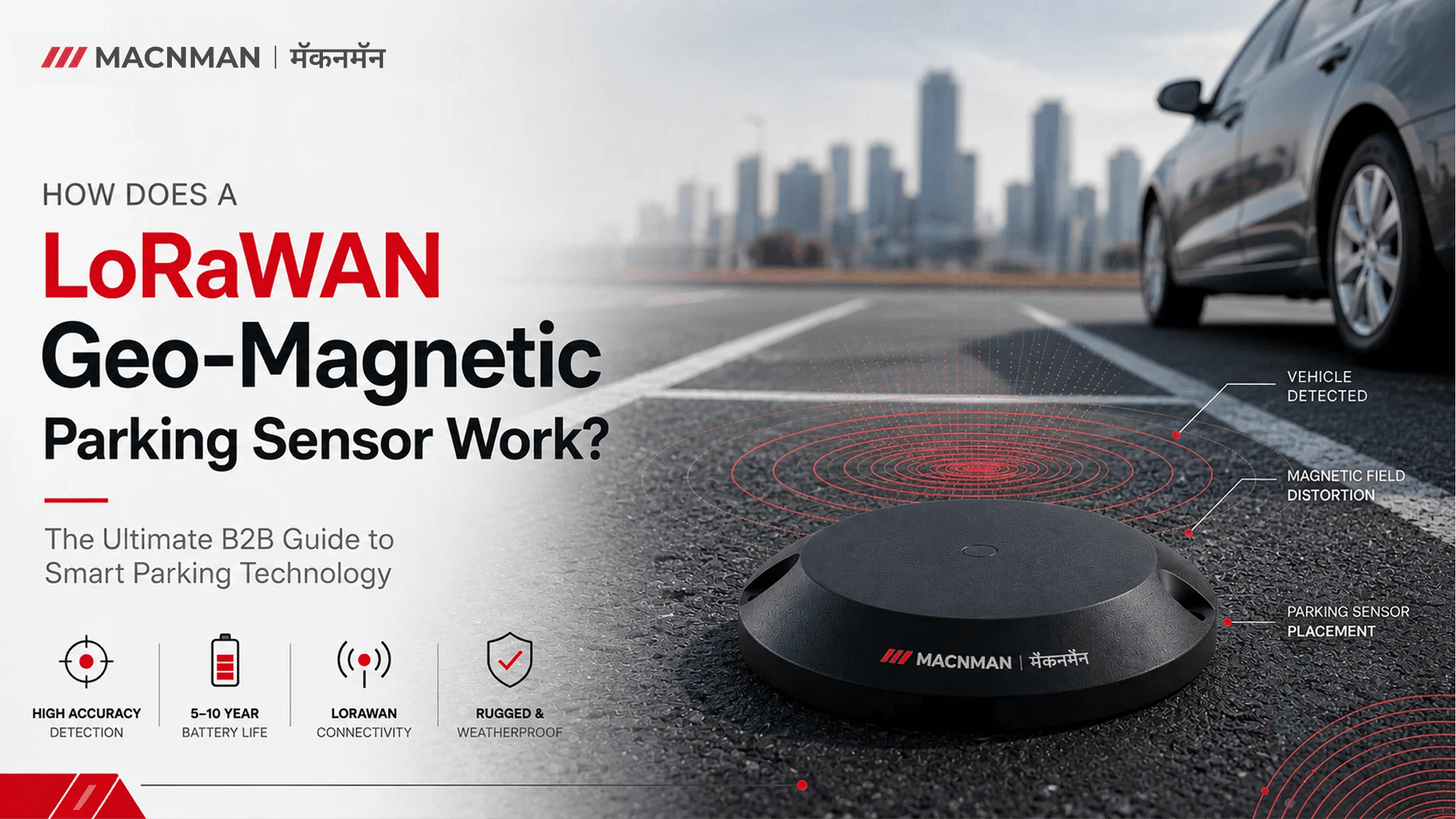
The emergence of the LoRaWAN geo-magnetic parking sensor has transformed the way parking occupancy is monitored. Rather than relying on cameras or embedded loop detectors, these compact IoT devices detect subtle disturbances in the Earth's magnetic field caused by the presence of a vehicle. Combined with the ultra-low-power communication capabilities of LoRaWAN, these sensors provide accurate, scalable, and cost-effective commercial parking occupancy tracking for deployments ranging from a few dozen parking bays to city-wide smart parking networks.
Unlike conventional systems that require continuous power or bandwidth-intensive video streaming, a LoRaWAN parking sensor transmits only occupancy events. This event-driven communication model significantly reduces energy consumption, enabling battery lifetimes that often exceed five years and, in optimized deployments, can approach ten years without maintenance.
For organizations evaluating smart parking solutions, understanding how these sensors operate—from the underlying physics of geomagnetic detection to the wireless communication architecture—is essential for making informed procurement decisions. This guide explores the technology in detail, helping infrastructure planners and decision-makers evaluate where geo-magnetic sensing delivers the greatest operational and financial value.
The Core Physics: How Geo-Magnetic Detection Works
At the heart of every LoRaWAN geo-magnetic parking sensor lies a highly sensitive magnetometer capable of detecting minute changes in the Earth's natural magnetic field. Although the sensing principle appears simple, modern parking sensors combine advanced physics, digital signal processing, and intelligent algorithms to deliver remarkably accurate occupancy detection in challenging urban environments.
Understanding this detection process begins with the Earth's magnetic field itself.
Understanding the Earth's Natural Magnetic Field :
The Earth behaves like a giant magnet, producing a magnetic field that extends from its core into space. This geomagnetic field varies depending on geographic location but generally ranges between 25 and 65 microteslas (µT).
Several factors influence local magnetic field strength:
- Geographic latitude
- Geological composition
- Nearby metallic structures
- Electrical infrastructure
- Environmental conditions
Despite these variations, the Earth's magnetic field remains relatively stable over short periods. This stable baseline provides an ideal reference against which parking sensors can detect the presence of vehicles.
Rather than measuring absolute magnetic strength, modern parking sensors continuously monitor changes relative to their calibrated baseline.
Ferromagnetic Distortion: The Principle Behind Vehicle Detection
Vehicles contain hundreds of kilograms of ferromagnetic materials, including:
- Steel chassis
- Engine block
- Suspension components
- Transmission
- Brake assemblies
- Axles
- Wheels
When a vehicle enters a parking space, this large metallic mass distorts the surrounding magnetic field. This phenomenon is known as ferromagnetic distortion.
Instead of the Earth's magnetic field passing uniformly through the sensor, the vehicle redirects and reshapes the local magnetic field lines.
The resulting magnetic signature is unique and measurable.
Rather than detecting the vehicle visually, the sensor detects the change in magnetic vector characteristics surrounding itself.
This approach provides several advantages:
- Complete darkness has no effect.
- Heavy rain does not reduce performance.
- Fog and dust do not interfere.
- Snow accumulation minimally affects detection.
- No line-of-sight is required.
Because the sensing mechanism is entirely passive, it consumes extremely little power, making it well suited for battery-operated IoT deployments.
Inside the LoRaWAN Parking Sensor: The 3-Axis Magnetometer
Modern industrial smart parking sensors LoRaWAN typically incorporate a 3-axis magnetoresistive sensor, commonly referred to as a 3-axis magnetometer.
Instead of measuring magnetic strength in only one direction, the sensor continuously measures magnetic vectors across three orthogonal axes:
- X-axis
- Y-axis
- Z-axis
This three-dimensional measurement provides several important advantages:
Improved Detection Accuracy :
Vehicles rarely park in identical positions.
A single-axis sensor might produce inconsistent measurements depending on vehicle orientation.
Three-axis sensing allows the embedded processor to evaluate the overall magnetic field vector rather than relying on a single directional measurement.
Better Vehicle Classification :
| Vehicle Type | Typical Magnetic Signature |
|---|---|
| Motorcycle | Small localized disturbance |
| Passenger Car | Moderate field distortion |
| SUV | Larger distortion |
| Delivery Van | Strong magnetic variation |
| Truck | Very high magnetic displacement |
Although most parking sensors simply determine occupied or vacant, advanced algorithms can sometimes distinguish between vehicle categories based on signature magnitude and duration.
Compensation for Installation Variability :
Parking surfaces are rarely perfectly level.
Sensors may be installed on:
- Asphalt
- Reinforced concrete
- Paver blocks
- Composite surfaces
Three-axis sensing allows software to compensate for installation angle, improving consistency across large deployments.
Digital Signal Processing (DSP): Separating Vehicles from Environmental Noise :
Raw magnetic measurements alone are insufficient for reliable occupancy detection.
Urban environments contain numerous sources of magnetic interference, including:
- Passing buses
- Underground metro systems
- Nearby railways
- Electrical transformers
- High-voltage power cables
- Construction machinery
- Elevators
- Temporary metallic objects
Without intelligent filtering, these disturbances could generate false occupancy events.
Modern parking sensors therefore employ sophisticated Digital Signal Processing (DSP) techniques directly on the embedded microcontroller.
These algorithms continuously analyze:
- Signal amplitude
- Directional changes
- Event duration
- Transition rates
- Temporal stability
Instead of reacting to every magnetic fluctuation, the sensor looks for characteristic patterns associated with a stationary vehicle entering or leaving a parking bay.
This edge intelligence dramatically reduces false positives while minimizing unnecessary wireless transmissions.
Automatic Baseline Drift Compensation :
The Earth's magnetic environment changes gradually over time.
Contributing factors include:
- Seasonal temperature variations
- Moisture content in the pavement
- Nearby construction
- Long-term infrastructure changes
- Aging materials
If a parking sensor relied on a fixed calibration value, detection accuracy would gradually deteriorate.
To address this, modern sensors continuously perform automatic baseline drift compensation.
When the parking space is confirmed to be vacant, the sensor slowly adjusts its reference magnetic field to match current environmental conditions.
This adaptive calibration allows sensors to maintain consistent accuracy over many years without requiring manual recalibration.
The adjustment process is intentionally gradual to prevent the system from mistakenly treating a parked vehicle as the new baseline.
Hybrid Detection Technology: Beyond Magnetometers Alone
While geomagnetic sensing alone delivers excellent performance, premium parking sensors increasingly combine multiple sensing technologies to achieve detection accuracies exceeding 99%.
These hybrid dual-detection sensors fuse magnetic data with secondary sensing methods, reducing ambiguity in complex parking environments.
Common combinations include:
Magnetometer + Nano-Radar
Nano-radar emits low-power microwave signals to detect the physical presence of an object above the sensor.
By combining radar reflections with magnetic distortion measurements, the system can reliably distinguish between:
- Stationary vehicles
- Passing traffic
- Large metallic equipment
- Environmental interference
This significantly improves detection performance in areas with frequent vehicle movement adjacent to parking bays.
Magnetometer + Infrared (IR) :
Infrared sensors measure the proximity of objects directly above the parking space.
When fused with magnetic sensing, IR provides an additional confirmation layer, particularly useful for detecting vehicles with lower ferromagnetic content, such as aluminum-bodied electric vehicles.
Sensor Fusion Algorithms :
Modern embedded firmware intelligently combines information from multiple sensors using sensor fusion algorithms.
Rather than relying on a single measurement, the firmware evaluates multiple parameters simultaneously, including:
- Magnetic field distortion
- Radar reflections
- Infrared proximity
- Signal confidence levels
- Historical occupancy behavior
This multi-layer decision-making process minimizes false detections caused by transient environmental conditions while maintaining fast response times.
As electric vehicles become more common and urban environments grow increasingly complex, hybrid sensing technologies are expected to play an increasingly important role in the next generation of commercial parking occupancy tracking solutions.
The Wireless Stack: Why LoRaWAN is the Ideal Network for Smart Parking
While the sensing technology determines whether a parking space is occupied, the wireless communication network determines how efficiently that information reaches operators, enforcement officers, mobile applications, and parking guidance systems.
A parking sensor that detects occupancy with 99% accuracy provides little operational value if it cannot reliably communicate its status. This is where LoRaWAN (Long Range Wide Area Network) has become the preferred communication standard for modern industrial smart parking sensors LoRaWAN.
Unlike traditional wireless technologies designed for high-speed internet connectivity, LoRaWAN was specifically engineered for low-power, long-range IoT applications where devices transmit small amounts of data only when necessary. Parking occupancy monitoring perfectly matches this communication model, making LoRaWAN one of the most efficient technologies for commercial parking occupancy tracking across cities, campuses, airports, shopping malls, hospitals, and industrial facilities.
Why Parking Sensors Have Unique Communication Requirements
Unlike surveillance cameras or video analytics systems that continuously stream large volumes of data, parking sensors generate very little information.
A parking space has only two primary states:
- Occupied
- Vacant
The sensor only needs to report when one of these states changes.
For example:
| Event | Data Generated |
|---|---|
| Vehicle enters parking bay | Occupied (1) |
| Vehicle exits parking bay | Vacant (0) |
| Daily heartbeat | Battery level + Health status |
| Configuration update | Device acknowledgement |
In most parking facilities, a sensor may transmit only a few dozen packets per day.
Because the communication volume is extremely small, deploying high-bandwidth technologies such as Wi-Fi or cellular networks introduces unnecessary complexity, higher power consumption, and increased operational costs.
This low-data, event-driven communication model is precisely what LoRaWAN was designed to support.
Understanding the Complete LoRaWAN Communication Architecture
A modern LoRaWAN geo-magnetic parking sensor is part of a multi-layer IoT ecosystem. Each layer performs a specific function to ensure secure, reliable, and scalable data transmission.
The complete communication path follows this architecture:
Layer 1: The End Node (Parking Sensor)
The parking sensor serves as the edge device within the IoT network.
Its primary responsibilities include:
- Monitoring the magnetic field
- Detecting vehicle arrival and departure
- Running local detection algorithms
- Managing battery consumption
- Encrypting data
- Transmitting occupancy updates
Rather than continuously transmitting information, the sensor remains in an ultra-low-power sleep state for the majority of its operational life.
It wakes only when:
- A vehicle enters
- A vehicle leaves
- A scheduled heartbeat occurs
- A maintenance command is received
This event-driven architecture is the primary reason why smart parking sensor battery life TCO is significantly lower than that of camera-based or cellular-connected alternatives.
Layer 2: The LoRaWAN Gateway
The gateway functions as a transparent bridge between LoRa radio communications and standard IP networks.
Unlike traditional wireless access points, LoRaWAN gateways do not interpret parking data or make occupancy decisions.
Instead, they simply:
- Receive LoRa packets from multiple sensors
- Forward encrypted packets to the network server
- Support thousands of simultaneous IoT devices
- Operate continuously with minimal maintenance
A single outdoor gateway can often provide coverage for:
- Large commercial parking lots
- University campuses
- Hospital complexes
- Industrial parks
- Smart city districts
Depending on environmental conditions, one gateway may support several thousand parking sensors.
This dramatically reduces infrastructure costs compared to technologies requiring one access point for every small coverage area.
Layer 3: The LoRaWAN Network Server
The Network Server acts as the intelligence layer of the wireless infrastructure.
Popular platforms include:
- ChirpStack
- The Things Stack (TTN)
- AWS IoT Core for LoRaWAN
- Actility
- Everynet
Its responsibilities include:
- Device authentication
- Packet decryption
- Duplicate packet removal
- Adaptive Data Rate (ADR)
- Network optimization
- Device management
- Downlink scheduling
- Security enforcement
The Network Server ensures that occupancy messages are reliably delivered to the parking management application while optimizing radio performance across thousands of deployed devices.
For enterprise and municipal deployments, ChirpStack is frequently selected due to its open-source architecture, flexibility, and ability to be deployed on private infrastructure, giving organizations full control over data ownership and network management.
Layer 4: Parking Management Application
Once occupancy data reaches the application layer, it becomes actionable business intelligence.
Typical application capabilities include:
Real-Time Parking Occupancy Maps
Operators can instantly visualize:
- Occupied spaces
- Available spaces
- Reserved bays
- Disabled parking
- EV charging stations
- Loading zones
Driver Guidance
Parking guidance systems can:
- Display available spaces
- Route drivers directly to vacant bays
- Reduce unnecessary vehicle circulation
- Improve customer experience
Parking Enforcement
Municipal authorities can automate:
- Overstay detection
- Illegal parking alerts
- Permit validation
- Time-based enforcement
- Violation notifications
Business Analytics
Historical occupancy data enables insights such as:
- Peak usage hours
- Average parking duration
- Space turnover rates
- Revenue forecasting
- Seasonal demand trends
These analytics support data-driven decisions for pricing strategies, capacity planning, and operational optimization.
Why LoRaWAN Outperforms Alternative Wireless Technologies
Selecting the appropriate communication protocol is a critical design decision for any smart parking deployment. While several wireless technologies are available, each presents trade-offs in terms of range, power consumption, infrastructure requirements, and operational costs.
For parking applications, LoRaWAN offers an optimal balance of long-range communication, ultra-low power consumption, minimal infrastructure, and scalability.
| Technology | Typical Range | Battery Life | Infrastructure Cost | Underground Performance | Suitability for Smart Parking |
|---|---|---|---|---|---|
| LoRaWAN | 2–15 km | 5–10 years | Low | Excellent | Excellent |
| Wi-Fi | 50–100 m | Weeks to months | Medium | Poor | Limited |
| Bluetooth LE | 10–100 m | Months | High (many gateways) | Poor | Small deployments only |
| Zigbee | 50–150 m | 1–3 years | Medium | Moderate | Mesh complexity |
| NB-IoT | Wide area | 3–7 years | SIM & subscription costs | Good | Suitable where public networks are available |
| LTE-M | Wide area | 3–5 years | Higher operational costs | Good | Asset tracking applications |
| Cellular (4G/5G) | Wide area | Days to months | High | Moderate | Unsuitable for battery-powered parking sensors |
Superior Signal Propagation in Urban Environments
One of LoRaWAN’s defining advantages is its operation in the sub-GHz Industrial, Scientific, and Medical (ISM) frequency bands. In India, deployments typically use the IN865–867 MHz band, while other regions operate in bands such as 868 MHz or 915 MHz.
Lower-frequency radio waves generally experience less attenuation than higher-frequency technologies such as Wi-Fi or Bluetooth, enabling improved propagation through common urban materials.
This characteristic is particularly beneficial because parking sensors are often installed:
- Beneath asphalt surfaces
- Embedded in reinforced concrete
- Inside underground parking garages
- Between large metallic vehicles
- Within densely built commercial environments
Compared with 2.4 GHz wireless systems, sub-GHz LoRaWAN signals are better suited to maintaining reliable connectivity under these challenging conditions, reducing the number of gateways required to achieve broad coverage.
Optimized for Tiny Payloads :
Parking occupancy is fundamentally a low-bandwidth application.
A typical uplink message from a LoRaWAN geo-magnetic parking sensor may contain only a few bytes representing:
| Data Field | Example |
|---|---|
| Device ID | Unique identifier |
| Occupancy Status | 0 = Vacant, 1 = Occupied |
| Battery Voltage | 3.58 V |
| Temperature | 31°C |
| RSSI/SNR | Radio diagnostics |
| Timestamp | Event time |
Even with metadata included, the payload remains extremely small.
This compact communication model offers several benefits:
- Faster transmission times
- Reduced airtime
- Lower collision probability
- Improved network scalability
- Extended battery life
- Compliance with regional duty-cycle regulations
By transmitting only meaningful occupancy events rather than continuous streams of data, LoRaWAN enables thousands of parking sensors to coexist efficiently on the same network.
LoRaWAN Class A: Maximizing Battery Life
Battery longevity is one of the most significant advantages of LoRaWAN-enabled parking sensors.
Most deployments use Class A, the most energy-efficient LoRaWAN operating mode.
In Class A:
- The sensor remains in deep sleep for the majority of its lifecycle.
- It wakes only when an occupancy event or scheduled heartbeat occurs.
- It transmits an uplink message.
- It briefly opens receive windows for any pending downlink commands.
- It immediately returns to sleep.
Because the radio is active for only a tiny fraction of the time, power consumption is dramatically reduced. Combined with efficient sensing algorithms and event-driven reporting, this architecture enables battery lifetimes commonly ranging from 5 to 10 years, directly reducing maintenance visits and improving the overall smart parking sensor battery life TCO.
Adaptive Data Rate (ADR): Intelligent Network Optimization :
LoRaWAN incorporates Adaptive Data Rate (ADR), a network-managed mechanism that optimizes radio performance for stationary devices such as parking sensors.
ADR dynamically adjusts communication parameters based on the quality of the radio link between the sensor and the gateway.
For sensors located close to a gateway with a strong signal, the network can instruct the device to transmit:
- At a higher data rate
- With lower transmission power
- Using shorter airtime
Conversely, sensors at the edge of coverage may use lower data rates and higher link budgets to maximize reliability.
The benefits of ADR include:
- Extended battery life
- Increased network capacity
- Reduced airtime
- Improved reliability
- Lower interference between devices
Because parking sensors are fixed in place, they are ideal candidates for ADR optimization.
End-to-End Security by Design :
Smart parking infrastructure often supports municipal operations and commercial revenue streams, making data security essential.
LoRaWAN addresses this with a multi-layer security model based on AES-128 encryption.
Key security features include:
- Unique cryptographic keys for each device
- Mutual authentication during network join
- Encrypted application payloads
- Integrity protection against message tampering
- Replay attack prevention using frame counters
- Secure Over-the-Air Activation (OTAA)
This architecture helps ensure that occupancy data remains confidential and that only authorized devices participate in the network.
Key Takeaways :
The communication requirements of smart parking align exceptionally well with the strengths of LoRaWAN. Event-driven messaging, compact payloads, long-range coverage, low energy consumption, and robust security make it a practical and scalable foundation for commercial parking occupancy tracking.
By enabling years of battery-powered operation with minimal infrastructure, LoRaWAN reduces deployment complexity while supporting reliable, real-time visibility across parking assets of any scale.
Hardware Selection: Surface-Mounted vs. Flush-Mount/In-Ground IoT Parking Sensors
Choosing the right installation method is just as important as selecting the sensing technology itself. While all LoRaWAN geo-magnetic parking sensors share the same fundamental objective—detecting vehicle occupancy—their long-term performance, installation cost, maintenance requirements, and durability can vary significantly depending on whether they are installed above or below the parking surface.
For municipalities, airports, hospitals, shopping malls, commercial office campuses, and industrial facilities, selecting the appropriate sensor enclosure and installation method directly influences the project's total cost of ownership (TCO), deployment timeline, and expected operational lifespan.
The two most common installation approaches are:
- Surface-Mounted IoT Parking Sensors
- Flush-Mount (In-Ground) IoT Parking Sensors
Each offers distinct advantages depending on the parking environment, traffic conditions, and maintenance strategy.
Surface-Mounted IoT Parking Sensors
Surface-mounted parking sensors are installed directly on top of the pavement using industrial-grade epoxy adhesives, anchor bolts, or specialized mounting brackets. Because they do not require core drilling or major civil works, they are often chosen for projects where rapid deployment and minimal disruption are priorities.
Typical installation locations include:
- Shopping malls
- Office complexes
- Hospitals
- University campuses
- Temporary parking facilities
- Corporate parking lots
- Private commercial developments
Installation is generally completed in less than 15 minutes per parking bay, allowing large deployments to be commissioned quickly.
Advantages of Surface-Mounted Sensors
1. Fast Installation
No excavation or asphalt cutting is required. This minimizes labor costs and allows installers to retrofit existing parking lots without significant downtime.
2. Lower Initial Deployment Cost
Reduced installation complexity means fewer specialized tools and contractors are required, making surface-mounted sensors attractive for projects with tight budgets or accelerated timelines.
3. Easy Maintenance and Replacement
If a sensor requires servicing, it can typically be removed and replaced without damaging the pavement, reducing maintenance time and operational disruption.
4. Ideal for Pilot Projects
Organizations evaluating commercial parking occupancy tracking often begin with surface-mounted sensors because they can be installed, tested, and relocated with relative ease.
Considerations
Despite their installation advantages, surface-mounted sensors remain physically exposed.
Potential risks include:
- Snowplow blades in cold climates
- Road sweeping equipment
- Heavy maintenance machinery
- Mechanical impacts from vehicle tires
- Vandalism
- Accidental damage during resurfacing
While modern housings are designed to withstand significant loads, exposed installations may require more frequent inspections in high-traffic environments.
Flush-Mount (In-Ground) IoT Parking Sensors
Flush-mounted sensors are embedded into the pavement using core drilling techniques. Once installed, the sensor sits level with the asphalt or concrete surface, creating a clean, unobtrusive finish.
This installation method is widely adopted for:
- Smart city deployments
- Municipal on-street parking
- Airports
- High-volume parking garages
- Logistics hubs
- Industrial facilities
- Long-term public infrastructure
Although installation requires greater civil work, the resulting system offers superior protection and longevity.
Advantages of Flush-Mount Sensors
1. Maximum Mechanical Protection
Because the sensor is installed below the pavement surface, it is naturally protected from:
- Vehicle impacts
- Tire abrasion
- Snow removal equipment
- Street cleaning vehicles
- Daily wear and tear
This makes flush-mounted sensors particularly suitable for environments with continuous traffic.
2. Improved Aesthetics
With only the sensor cap visible—or, in some designs, completely concealed—the parking area maintains a clean, professional appearance. This is especially important in premium commercial developments and public infrastructure projects.
3. Reduced Risk of Accidental Damage
The flush installation minimizes protrusions above the pavement, reducing the likelihood of damage caused by maintenance equipment or improperly parked vehicles.
4. Longer Service Life
The additional physical protection often translates into reduced maintenance requirements and extended operational life, making flush-mounted solutions a preferred choice for long-term infrastructure investments.
Considerations
The primary trade-offs include:
- Higher installation costs due to core drilling
- Longer deployment timelines
- Requirement for specialized installation equipment
- More complex sensor replacement if future maintenance is required
For projects expected to operate for ten years or more, these additional upfront costs are often offset by lower maintenance expenses over the system's lifecycle.
Engineering for Harsh Outdoor Environments
Parking sensors operate in some of the harshest outdoor conditions. They must withstand continuous vehicle traffic, heavy axle loads, rain, dust, temperature fluctuations, and exposure to chemicals such as fuel, engine oil, and road salts.
Selecting a sensor with appropriate environmental protection ratings is therefore essential.
Why IP68 Waterproof Protection Matters
Ingress Protection (IP) ratings indicate how effectively an enclosure prevents the entry of dust and water.
For parking sensors, IP68 is generally regarded as the industry benchmark.
An IP68-rated sensor offers:
- Complete protection against dust ingress
- Resistance to prolonged water immersion
- Reliable operation during heavy rainfall
- Protection against standing water
- Durability during pavement cleaning and pressure washing
This level of sealing is especially important for flush-mounted sensors, which may experience temporary water accumulation after storms.
Understanding IK Impact Ratings :
Mechanical durability is measured using the IK impact protection standard, which evaluates a device's resistance to external mechanical forces.
Common ratings include:
IK Rating >> Protection Level
Typical Applications >> IK08
Resistant to moderate mechanical impacts >> Commercial parking lots
IK09 >> Enhanced protection against heavier impacts
Public infrastructure >> IK10
Maximum standard impact resistance
Smart cities, industrial sites, airports
An IK10-rated enclosure provides a high level of resilience against accidental impacts and vandalism, making it well suited to demanding public environments.
Designing for Heavy Vehicle Loads :
Unlike many IoT devices, parking sensors must function reliably beneath vehicles weighing several tonnes.
Typical loading scenarios include:
- Passenger cars
- SUVs
- Electric vehicles
- Delivery vans
- Buses
- Emergency vehicles
- Light commercial trucks
To withstand these conditions, manufacturers typically use:
- Glass-filled engineering polymers
- Reinforced composite materials
- Stainless steel fasteners
- UV-resistant coatings
- Corrosion-resistant sealing compounds
These materials help ensure long-term structural integrity despite repeated loading cycles and prolonged outdoor exposure.
Battery Design Considerations :
Battery replacement often represents the largest maintenance cost over the lifespan of a parking sensor deployment.
To maximize service life, modern industrial smart parking sensors LoRaWAN incorporate several energy-saving techniques:
- Ultra-low-power microcontrollers
- Sleep currents measured in microamps
- Event-driven sensing
- Efficient LoRaWAN Class A communication
- Adaptive transmission power
- Intelligent heartbeat scheduling
- Automatic baseline calibration
With these optimizations, many commercial solutions are designed to operate for 5 to 10 years under typical parking usage patterns, significantly reducing maintenance visits and supporting a lower smart parking sensor battery life TCO.
Procurement Checklist: Selecting the Right Parking Sensor :
Before issuing a request for quotation (RFQ) or evaluating vendors, procurement teams should assess both technical specifications and long-term operational considerations.
Sensor Performance
- Detection accuracy of at least 99% under real-world conditions
- Hybrid sensing (magnetometer with radar or infrared) where required
- Fast occupancy detection and release times
- Stable performance across varying weather conditions
Wireless Connectivity
- LoRaWAN 1.0.3 or later compatibility
- OTAA support
- Adaptive Data Rate (ADR)
- AES-128 end-to-end encryption
- Compatibility with public and private LoRaWAN networks
Mechanical Design
- IP68 enclosure
- IK10 impact resistance for high-traffic areas
- UV-resistant housing
- Corrosion-resistant construction
- Wide operating temperature range suitable for local environmental conditions
Power & Maintenance
- Projected battery life of 5–10 years
- Low-maintenance design
- Field-replaceable battery (if applicable)
- Remote firmware update capability
System Integration
- REST or MQTT APIs for application integration
- Compatibility with existing parking management platforms
- Real-time occupancy monitoring and analytics
- Support for historical reporting and dashboard visualization
Evaluating these criteria helps ensure that the selected solution delivers reliable performance, scalability, and long-term value across the entire lifecycle of the deployment.
Financial & Operational ROI: Understanding the True Total Cost of Ownership (TCO)
For municipalities and commercial property owners, selecting a smart parking solution is not solely about detection accuracy—it is a long-term infrastructure investment. Procurement teams must evaluate the complete lifecycle cost of the technology, including installation, communications, maintenance, battery replacement, software integration, and operational efficiency.
While the purchase price of a sensor is easy to compare, the Total Cost of Ownership (TCO) often determines whether a project delivers the expected return on investment over five to ten years.
One of the primary advantages of a LoRaWAN geo-magnetic parking sensor is its ability to deliver high detection accuracy with minimal ongoing maintenance. By combining ultra-low-power electronics with event-driven communication, these sensors significantly reduce operational expenses throughout their service life.
Understanding Smart Parking Sensor Battery Life and TCO
Battery maintenance is one of the largest recurring costs in large-scale IoT deployments.
Consider a city deploying 5,000 parking sensors.
If each sensor required a battery replacement every two years, maintenance teams would need to perform approximately 2,500 battery replacements annually. Beyond the cost of replacement batteries, this also includes:
- Technician labor
- Vehicle travel
- Traffic management
- Lane or parking bay closures
- Administrative scheduling
- Service documentation
These indirect costs often exceed the battery cost itself.
Modern LoRaWAN parking sensors are engineered to minimize these maintenance activities through:
- Ultra-low-power microcontrollers
- High-capacity lithium batteries
- LoRaWAN Class A communication
- Event-driven reporting
- Adaptive transmission power
- Intelligent sleep scheduling
- Efficient firmware design
Under typical parking usage patterns, commercial sensors are commonly designed to achieve 5 to 10 years of battery operation, dramatically reducing lifecycle maintenance costs.
This extended service interval is a major contributor to a lower smart parking sensor battery life TCO, especially for city-wide deployments where maintenance logistics become increasingly complex.
Comparing Geo-Magnetic Sensors and Camera-Based Parking Systems
When evaluating smart parking technologies, procurement teams often compare geomagnetic parking sensor vs camera solutions. Both approaches can provide occupancy information, but they differ significantly in infrastructure requirements, maintenance, privacy considerations, and scalability.
Camera systems can offer additional capabilities such as license plate recognition (LPR), security monitoring, and traffic analytics. However, when the primary objective is commercial parking occupancy tracking, geo-magnetic sensors often provide a simpler, lower-maintenance, and more scalable solution.
Operational Benefits Beyond Occupancy Detection
Real-time occupancy data creates opportunities that extend far beyond simply identifying whether a parking space is available.
1. Reduced Driver Cruising Time
Drivers searching for parking contribute to unnecessary traffic congestion and fuel consumption. By providing accurate occupancy information through mobile applications or parking guidance signs, operators can direct vehicles to available spaces more efficiently.
Potential benefits include:
- Reduced traffic circulation
- Lower fuel consumption
- Decreased vehicle emissions
- Improved customer satisfaction
2. Increased Parking Space Utilization
Historical occupancy analytics help operators understand how parking facilities are being used.
Typical insights include:
- Peak occupancy periods
- Underutilized parking zones
- Average parking duration
- Vehicle turnover rates
- Seasonal demand patterns
These insights support more effective capacity planning and operational optimization.
3. Improved Parking Enforcement
Real-time occupancy data enables enforcement teams to identify potential violations more efficiently.
Examples include:
- Vehicles exceeding permitted parking durations
- Unauthorized use of reserved spaces
- Occupancy of accessible parking bays without authorization
- Loading zone misuse
Rather than conducting manual patrols across an entire facility, enforcement personnel can prioritize areas where alerts have been generated.
4. Dynamic Pricing Strategies
Demand for parking often varies by:
- Time of day
- Day of the week
- Special events
- Weather conditions
- Seasonal demand
Integrating occupancy data with parking management software allows operators to implement dynamic pricing strategies that optimize revenue while improving space availability.
5. Data-Driven Infrastructure Planning
Long-term occupancy trends provide valuable information for future infrastructure investments.
Organizations can use historical data to evaluate:
- Whether additional parking capacity is required
- Which parking areas are consistently underutilized
- Opportunities to reconfigure parking layouts
- Demand for electric vehicle charging spaces
- Potential conversion of parking areas for alternative uses
These insights support evidence-based decision-making rather than relying on manual surveys or assumptions.
Step-by-Step Deployment and Calibration Guide for LoRaWAN Geo-Magnetic Parking Sensor
A successful smart parking project depends not only on selecting the right hardware but also on following a structured deployment process.
Step 1: Conduct a Site Survey and RF Assessment
Before installation, perform a comprehensive survey of the parking environment.
Key activities include:
- Mapping parking bay locations
- Identifying potential sources of radio interference
- Measuring LoRaWAN signal coverage
- Determining gateway placement
- Evaluating power and backhaul options for gateways
A thorough RF assessment helps ensure reliable communication while minimizing the number of gateways required.
Step 2: Install the Sensors
Installation methods vary depending on the selected hardware.
Surface-Mounted Sensors
- Clean the pavement surface
- Apply industrial adhesive or install anchor bolts
- Verify sensor orientation
- Allow adhesive to cure as specified
Flush-Mount Sensors
- Core drill the pavement to the required dimensions
- Insert the sensor housing
- Seal the installation using approved compounds
- Ensure the sensor is level with the surrounding surface
Proper installation is essential for both mechanical durability and consistent detection performance.
Step 3: Connect to the LoRaWAN Network
Each sensor must be securely provisioned using Over-the-Air Activation (OTAA).
Typical commissioning steps include:
- Register the device in the LoRaWAN Network Server
- Configure DevEUI, JoinEUI, and AppKey
- Verify successful network join
- Confirm gateway connectivity
- Validate uplink and downlink communication
- Assign the sensor to its corresponding parking space within the management application
OTAA simplifies deployment while ensuring secure device authentication.
Step 4: Perform Baseline Calibration
Baseline calibration establishes the reference magnetic field for each parking space.
This process should always be completed when the parking bay is completely empty.
During calibration, the sensor records the local magnetic environment and stores it as the baseline for future comparisons.
Many modern sensors also implement automatic baseline drift compensation, allowing the reference to adapt gradually to long-term environmental changes while maintaining reliable occupancy detection.
Step 5: Validate System Performance
Before commissioning the system, perform functional testing across all installed sensors.
Recommended validation includes:
- Vehicle entry detection
- Vehicle exit detection
- Communication latency
- Dashboard visualization
- Mobile application updates
- Battery reporting
- Gateway redundancy testing
- Alert generation
Acceptance testing helps identify installation or configuration issues before the system enters operational use.
Best Practices for Large-Scale Smart Parking Deployments
Organizations planning city-wide or multi-site deployments should consider the following best practices:
- Design gateway coverage with redundancy in critical areas.
- Use OTAA for secure and scalable device provisioning.
- Enable Adaptive Data Rate (ADR) where appropriate to optimize battery life.
- Schedule periodic health messages to monitor battery status and communication quality.
- Integrate occupancy data with existing parking management, enforcement, and analytics platforms.
- Plan maintenance workflows based on predictive battery replacement rather than reactive servicing.
- Conduct pilot deployments before full-scale implementation to validate performance under local conditions.
Following these practices can improve reliability, reduce operational costs, and simplify long-term management.
Conclusion :
The LoRaWAN geo-magnetic parking sensor has emerged as a practical and scalable technology for modern parking management. By combining geomagnetic sensing with ultra-low-power wireless communication, these sensors provide reliable commercial parking occupancy tracking while minimizing infrastructure complexity and ongoing maintenance.
Compared with traditional loop detectors and many camera-based solutions, LoRaWAN-enabled parking sensors offer advantages such as long battery life, simplified installation, reduced communication costs, and improved scalability. When paired with robust parking management software, they also enable valuable capabilities including real-time occupancy monitoring, parking guidance, enforcement support, utilization analytics, and dynamic pricing.
For municipalities, commercial real estate operators, airports, healthcare campuses, universities, and industrial facilities, investing in a well-designed smart parking solution can improve operational efficiency, enhance the user experience, and support data-driven planning decisions for years to come.
As demand for connected urban infrastructure continues to grow, selecting the right sensing technology, installation method, and communication architecture will be essential to building reliable, future-ready parking systems.
Frequently Asked Questions (FAQ)
How accurate is a LoRaWAN geo-magnetic parking sensor?
Modern sensors typically achieve detection accuracies above 98%, and hybrid designs that combine magnetometers with radar or infrared sensing can exceed 99% under suitable installation and operating conditions.
How long does the battery last?
Battery life depends on factors such as traffic volume, reporting frequency, ambient temperature, and battery capacity. Many commercial sensors are designed for an operational lifespan of 5 to 10 years before battery replacement is required.
Can these sensors work in underground parking garages?
Yes. LoRaWAN's sub-GHz radio frequencies generally provide better penetration through concrete and other construction materials than higher-frequency wireless technologies. Proper RF planning and gateway placement remain important for reliable coverage.
Are geo-magnetic parking sensors suitable for electric vehicles?
Yes. While electric vehicles may contain different proportions of ferromagnetic materials than conventional vehicles, modern detection algorithms—and particularly hybrid sensing technologies—are designed to detect a wide range of vehicle types.
Can the system integrate with existing parking management software?
Most enterprise-grade solutions support integration through APIs, MQTT, or other standard interfaces, enabling interoperability with parking management platforms, mobile applications, enforcement systems, and analytics tools.


