
MacSync Wi-Fi 7-in-1 Soil Sensor Datasheet
Product Overview
MacSync Wi-Fi 7-in-1 is an outdoor, battery-operated Wi-Fi soil sensor that measures soil moisture, soil temperature, electrical conductivity (EC), pH, nitrogen, phosphorus and potassium (NPK) with a single stainless-steel probe. It sends all seven readings over the Wi-Fi you already run, straight to your MQTT broker or HTTPS endpoint, with no gateway, hub or controller in between.
Only the probe goes in the ground. Its corrosion-resistant stainless-steel electrodes on an epoxy-encapsulated body read in clay, sandy, saline and wet soils, and are made to stay buried season after season. The transmitter mounts above it on a pole or a wall, in a glass-filled nylon enclosure rated IP65 (IP67 optional) that operates from −40 °C to +80 °C.
An internal 19 Ah cell runs the transmitter and the probe, estimated at more than six years on hourly uploads. Readings are stored on the device, up to 30,000 records, and forwarded when the network returns, so a router reboot or a power cut leaves no gap in the soil record.
The sensor is configured from a phone with the Macnman Maya app over BLE, and publishes over MQTT, HTTP and HTTPS to AWS IoT Core, Microsoft Azure IoT Hub, Google Cloud, a private cloud or an on-premise server. It is built for greenhouses, polyhouses, nurseries, research plots, gardens and campuses: anywhere every probe sits within reach of a Wi-Fi access point.
Download Center
Download the PDF version of the datasheet.
Connect a MacSync Wi-Fi device to your network with the Maya app.
Point the sensor at your MQTT broker and check the first message.
Key Features
Seven Readings from One Probe Moisture, temperature, EC, pH, nitrogen, phosphorus and potassium from a single stainless-steel probe, so one hole in the ground replaces a set of separate sensors.
Works on Your Existing Wi-Fi Joins 2.4 or 5 GHz networks directly, with WPA2 or WPA3 security and DHCP or a static IP. No gateway, hub or controller is needed.
Battery-Operated A 19 Ah cell powers the transmitter and the probe, estimated at more than six years on hourly uploads, so no power cable goes out to the bed or plot.
Stainless-Steel Soil Probe Corrosion-resistant electrodes on an epoxy-encapsulated body read in clay, sandy, saline and wet soils, and are made to stay buried.
Moisture You Can Irrigate On Volumetric water content from 0 to 100% VWC, accurate to ±5% at 0.1% resolution: the reading irrigation is scheduled on.
EC and pH for Fertigation EC up to 10,000 µS/cm shows dissolved salt and fertiliser in the root zone; pH from 3 to 9 shows whether the crop can take it up.
NPK as a Trend Nitrogen, phosphorus and potassium estimates from 0 to 1,999 mg/kg, read as a direction between laboratory soil tests.
30,000 Records On-Board Readings are stored on the device and forwarded when the network returns, so a router reboot or power cut leaves no gap.
Cloud & MQTT Ready MQTT, HTTP and HTTPS to AWS IoT Core, Azure IoT Hub, on-premise servers and custom IoT platforms, with no mandatory vendor cloud.
Configured from a Phone Pair over BLE with the Macnman Maya app to set the network, server, upload interval and alarm limits for moisture, EC or pH.
Outdoor IP65 Enclosure Glass-filled nylon transmitter enclosure, IP65 rated with an IP67 option, operating from −40 °C to +80 °C on a pole or wall.
Made in India Designed and manufactured in Pune. WPC compliant and RoHS conforming.
Suited Applications
Greenhouses & Polyhouses Vegetables, flowers and herbs under cover, where Wi-Fi already reaches or one access point covers the structure. Moisture, EC and pH are logged bed by bed.
Smart Irrigation & Precision Farming Irrigate when the root zone is actually dry rather than by the clock. A soil moisture limit triggers an upload the moment a bed dries past it.
Fertigation & Crop Nutrition EC rises when fertiliser is injected and falls as it is taken up or washed out. EC and pH in the root zone show whether a dose arrived and stayed.
Nurseries & Seedling Production Continuous moisture and soil temperature readings catch a dry or cold root zone before the seedlings show it.
Research Plots & Field Trials Trial plots at universities, research stations and seed companies, with an unbroken record of seven soil parameters for every treatment.
Parks, Lawns & Landscape Irrigation Lawns, campus gardens, parks and golf courses watered on measured soil moisture instead of a fixed timer.
Terrace Farms & Urban Gardens Rooftop farms, kitchen gardens and community plots inside ordinary building Wi-Fi, with no farm network to build.
Soil Restoration & Saline Land Reclaimed, saline or degraded ground, where the question is whether salinity and pH are moving the right way over months.
Seven Soil Parameters
A 7-in-1 probe reports seven values every time it is read. Four are measurements you can act on directly. The three nutrient values are estimates, best read as a trend.
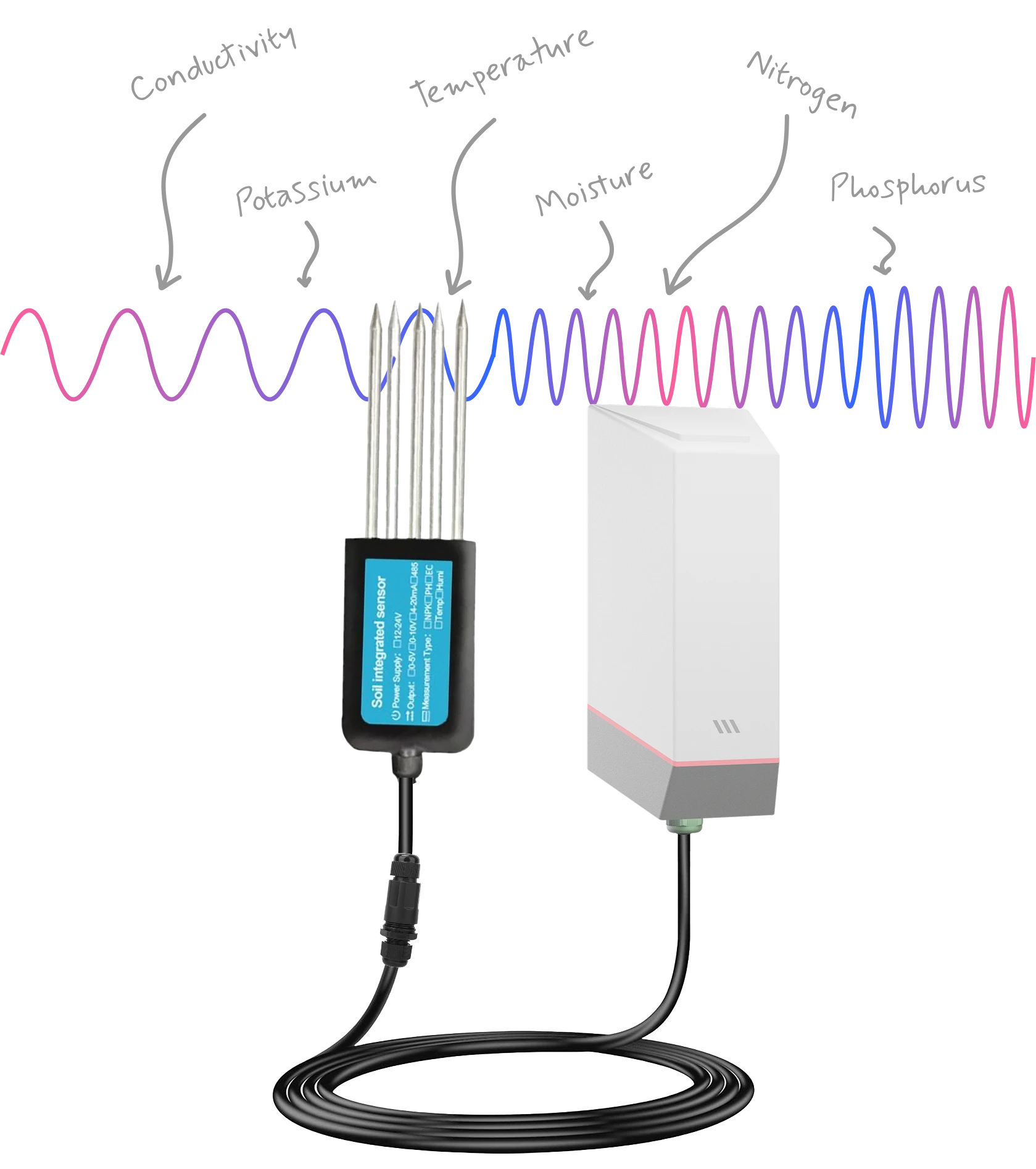
| Parameter | Range | Accuracy | Resolution | What it tells you |
|---|---|---|---|---|
| Soil moisture | 0–100% VWC | ±5% | 0.1% | When to irrigate, and whether water is reaching the root zone |
| Soil temperature | −45 to +115 °C | ±0.5 °C | 0.1 °C | Germination and root activity; frost and heat stress |
| Electrical conductivity (EC) | 0–10,000 µS/cm | ±3% of full scale | 10 µS/cm | Dissolved salts: fertiliser strength and salinity build-up |
| pH | 3–9 pH | ±0.3 pH | 0.1 pH | Whether the nutrients in the soil are available to the crop |
| Nitrogen (N) | 0–1,999 mg/kg | ±2% of full scale | 1 mg/kg | The trend in available nitrogen between soil tests |
| Phosphorus (P) | 0–1,999 mg/kg | ±2% of full scale | 1 mg/kg | The trend in available phosphorus between soil tests |
| Potassium (K) | 0–1,999 mg/kg | ±2% of full scale | 1 mg/kg | The trend in available potassium between soil tests |
Technical Specifications
Battery Life
Battery life depends almost entirely on how often the sensor connects. Soil changes slowly, so most sites upload every 30 or 60 minutes. These are estimates from the model behind the Macnman Wi-Fi battery life calculator, for the 19 Ah cell with one probe reading and one TLS connection per upload.
| Upload interval | DHCP address | Static IP address |
|---|---|---|
| Every 10 minutes | About 1.8 years | About 2.5 years |
| Every 15 minutes | About 2.5 years | About 3.5 years |
| Every 30 minutes | About 4.3 years | About 5.7 years |
| Every hour | About 6.7 years | About 8.2 years |
| 15-minute readings, uploaded hourly (sampling mode) | About 6.1 years | About 7.4 years |
These figures are estimates, not guarantees. A weak Wi-Fi signal makes each connection take longer and shortens them.
Wi-Fi or LoRaWAN?
Macnman builds the 7-in-1 soil sensor for both networks. The right choice depends on how far the probes are from a building.
| Compare | MacSync Wi-Fi 7-in-1 | MacSync LSS X5 (LoRaWAN) |
|---|---|---|
| Network it needs | The Wi-Fi already on site | A LoRaWAN gateway |
| Reach | Typically up to 100 m from an access point | Kilometres from one gateway |
| Readings | Moisture, temperature, EC, pH, N, P and K | Moisture, temperature, EC, pH, N, P and K |
| Route to your platform | Direct, over MQTT or HTTPS | Through a LoRaWAN network server |
| Power | Internal 19 Ah battery | 19 Ah battery, or 20 W solar with an 8,000 mAh rechargeable battery |
| Choose it when | Every probe sits inside Wi-Fi coverage: greenhouses, nurseries, gardens and campuses | Fields, orchards and plantations spread beyond Wi-Fi reach |
Installation
- Seat the probe in the root zone. Open the soil to root depth, around 15 cm for most row crops and about 5 cm to the side of a drip emitter. Push the probe into undisturbed soil and firm the soil back so no air gaps remain.
- Mount the transmitter above ground. Fix it to a pole or a wall with the supplied clip and screws, clear of standing water and where the Wi-Fi reaches.
- Pair with the Maya app over BLE. Choose the Wi-Fi network, enter the MQTT broker or HTTPS endpoint, and set the upload interval and alarm limits. Send Uplink confirms the signal strength and that a message reached the server.
- Let it settle, then compare with a soil test. Readings stabilise as the soil re-consolidates around the probe; allow 10 to 14 days. Then compare pH and NPK with a laboratory test from the same spot and note the difference.
What's in the Box?
Make sure the box contains the following items before installation.
- MacSync Wi-Fi 7-in-1 Soil Sensor
- Mounting Clip
- Mounting Screws
- User Manual
- Warranty Card
- IP68 Cable Extender *
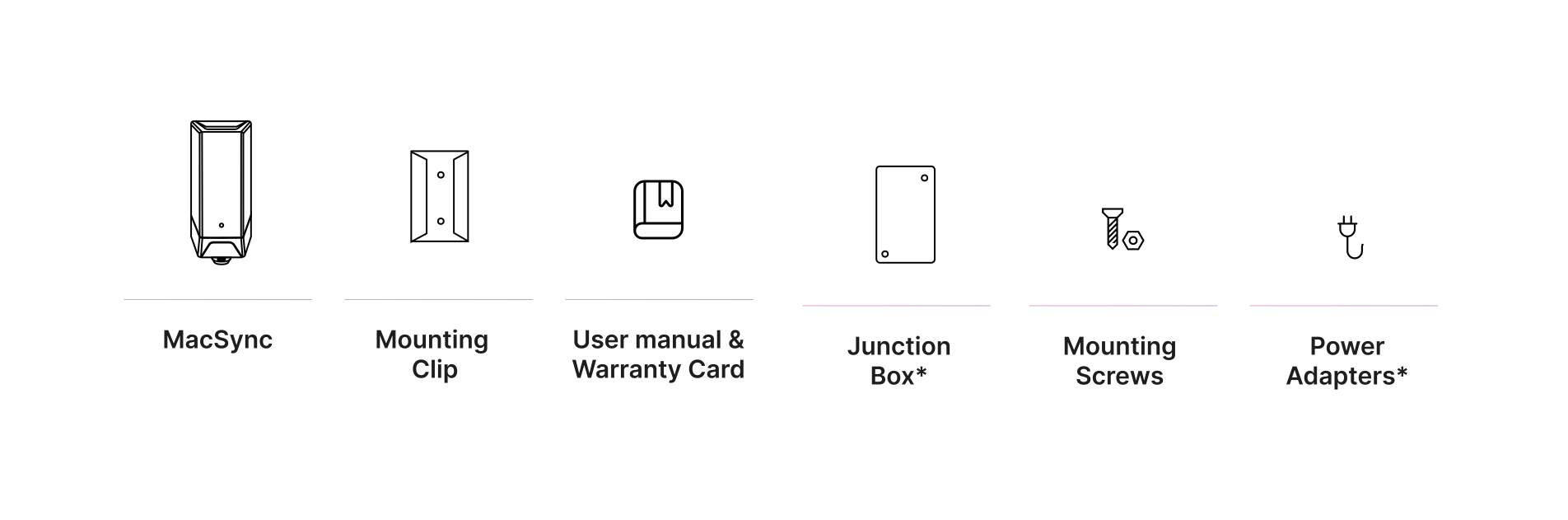
Accessories marked with (*) are optional and may need to be purchased separately.
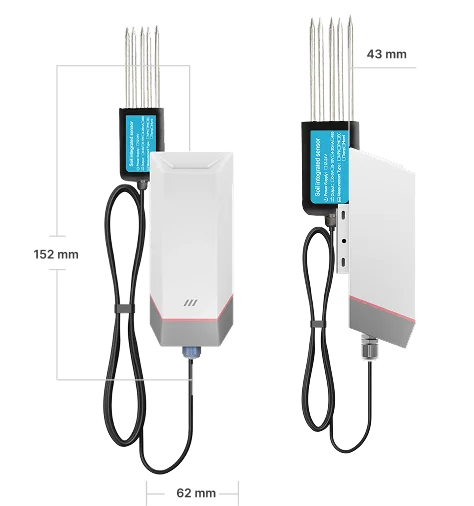
MacSync Wi-Fi 7-in-1 Dimensions
Frequently Asked Questions
What is the MacSync Wi-Fi 7-in-1 soil sensor?
It is a single stainless-steel probe that measures seven soil properties at once: moisture, temperature, electrical conductivity (EC), pH, nitrogen, phosphorus and potassium. A battery-operated Wi-Fi transmitter sends the readings to your server or dashboard, without a separate controller or gateway.
What are the seven parameters and their ranges?
Soil moisture from 0 to 100% VWC (±5%); soil temperature from −45 to +115 °C (±0.5 °C); EC from 0 to 10,000 µS/cm (±3% of full scale); pH from 3 to 9 (±0.3 pH); and nitrogen, phosphorus and potassium, each from 0 to 1,999 mg/kg. Moisture, temperature, EC and pH are direct measurements. The three nutrient values are estimates, best used as a trend.
How accurate are the NPK readings?
Treat them as a trend, not as a laboratory result. The probe estimates nitrogen, phosphorus and potassium from the soil's electrical behaviour rather than by chemical analysis, so the absolute numbers can differ from a lab report. Compare the first settled readings with a laboratory test from the same spot, then follow the change over time.
Does the sensor need a gateway or hub?
No. It joins your existing 2.4 or 5 GHz Wi-Fi network directly and publishes to your MQTT broker or HTTPS endpoint. There is no gateway, hub or proprietary receiver to buy or maintain.
How far from the Wi-Fi access point can it be?
Typically up to 100 m, depending on walls, polyhouse structures, foliage and terrain in between. Send Uplink in the Maya app reports the Wi-Fi signal strength at the mounting spot; −65 dBm or stronger is a good link. Beyond Wi-Fi reach, add an outdoor access point or use the LoRaWAN version, the MacSync LSS X5.
How long does the battery last?
The internal 19 Ah cell is estimated to last about 2.5 years at 15-minute uploads, about 4.3 years at 30 minutes and about 6.7 years at hourly uploads on a DHCP network. A static IP address extends these figures, and a weak Wi-Fi signal shortens them. These are estimates, not guarantees.
What happens to readings when the Wi-Fi goes down?
Nothing is lost. The sensor keeps measuring and stores up to 30,000 records on the device, then uploads them when the Wi-Fi or the server comes back. At one reading every 15 minutes that is about 10 months of history.
How deep should the probe be installed?
In the active root zone: commonly around 15 cm deep for row crops and about 5 cm to the side of a drip emitter, deeper for tree crops. Push it into undisturbed soil, firm the soil back so there are no air gaps, and allow 10 to 14 days for the readings to settle.
Which platforms and protocols does it work with?
It publishes over MQTT, HTTP and HTTPS, so it works with any MQTT broker or REST endpoint: AWS IoT Core, Microsoft Azure IoT Hub, Google Cloud, a private cloud or an on-premise server. There is no mandatory vendor cloud.
How is the sensor configured?
With the Macnman Maya Android app over Bluetooth, standing next to the device: choose the Wi-Fi network, enter the server details, and set the upload interval and alarm limits. Settings can also be changed later with JSON commands from the server.
Should I choose Wi-Fi or LoRaWAN?
Choose Wi-Fi when every probe sits within reach of an access point: greenhouses, polyhouses, nurseries, gardens and campuses. Choose LoRaWAN for open fields, orchards and plantations: the MacSync LSS X5 reads the same seven parameters and reports through a gateway that can be kilometres away.
Is there a solar-powered version?
The Wi-Fi model is battery-operated. A solar-powered 7-in-1 soil sensor is available in the LoRaWAN range: the MacSync LSS X5 with a 20 W panel and an 8,000 mAh rechargeable battery.
Related Products and Resources
- User manual: Connect to Wi-Fi with the Maya app and MQTT setup
- Related datasheets: MacSync LSS X5 LoRaWAN 7-in-1 soil sensor, MacSync-WT1 Wi-Fi temperature and humidity sensor, MacSync-WX1-PO RS485 and analog to Wi-Fi data logger, LoRaWAN soil sensor datasheets
- Product page: MacSync Wi-Fi 7-in-1 soil sensor on macnman.com
- Help: Warranty terms and conditions and contact Macnman support